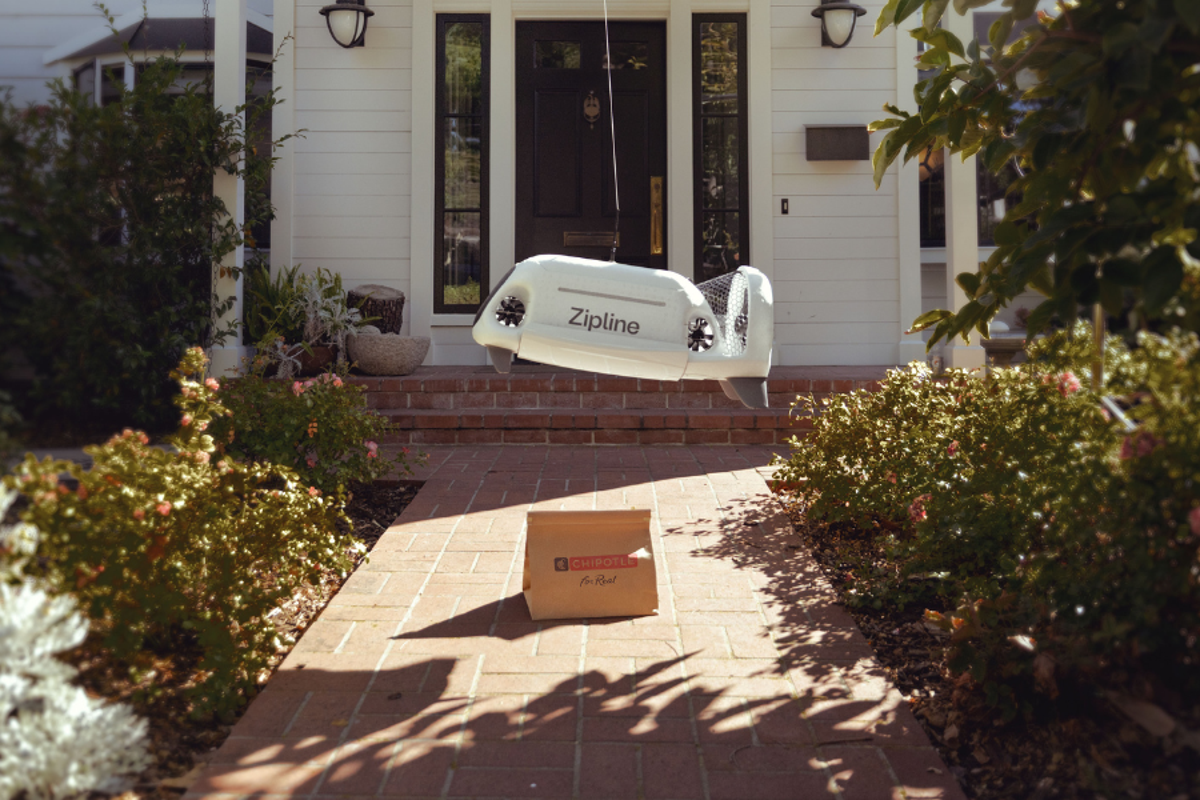
The expansion of Chipotle’s drone delivery program represents a shift from marketing-led experimentation to a cold calculation of last-mile efficiency. While the casual observer views drone delivery through the lens of novelty, the operational reality is rooted in the "Triple Constraint of Food Logistics": thermal integrity, delivery velocity, and labor cost reduction. Chipotle's move into more cities is not a quest for "heavenly" bowls; it is a strategic attempt to solve the structural inefficiency of the $500 billion quick-service restaurant (QSR) delivery market.
The Last Mile Bottleneck and the Cost of Human Friction
Traditional third-party delivery models are fundamentally broken at the unit level. In a standard gig-economy transaction, a human driver must navigate traffic, find parking, and enter a physical storefront, creating a high "dwell time" that erodes profit margins.
The economic incentive for drone integration rests on three pillars:
- Labor Decoupling: Human delivery costs scale linearly with volume. Drone delivery costs, following an initial capital expenditure phase, scale asymptotically toward the cost of electricity and maintenance.
- Velocity Consistency: Ground-based delivery is subject to stochastic variables—traffic congestion, road construction, and weather. Aerial corridors offer a deterministic environment where delivery times can be predicted within a 30-second margin of error.
- Thermal Half-Life: A burrito bowl loses its optimal temperature at a predictable rate. By reducing the delivery window from 25 minutes to under 10 minutes, Chipotle maintains product quality without the need for excessive chemical additives or specialized (and heavy) thermal packaging.
The Operational Architecture of Aerial Integration
Chipotle’s expansion strategy relies on a hub-and-spoke model where the "hub" is not a distribution center, but the existing retail footprint. This turns every restaurant into a micro-fulfillment center. For this to function, the kitchen's internal logic must be reorganized.
The Dedicated Digital Line (DDL) Efficiency
Chipotle already utilizes a secondary prep line for digital orders. For drone delivery to scale, this line must synchronize with the drone’s arrival. If a bowl is ready 120 seconds before the drone lands, it sits in a thermal transition zone. If it is ready 120 seconds after the drone lands, the drone—a depreciating asset—is idling. The expansion necessitates a "Just-In-Time" (JIT) assembly protocol that integrates the Point of Sale (POS) system directly with the flight control software.
The Weight-to-Battery Ratio
Every gram of guacamole added to a bowl has a direct correlation to battery drain. The physics of drone delivery dictate a strict payload limit. Chipotle's standardized menu is uniquely suited for this; unlike a pizza, which has a high surface-area-to-volume ratio and is prone to heat loss, a burrito bowl is dense. This density allows for a more stable center of gravity during flight, reducing the energy required for stabilization in high-wind scenarios.
Regulatory and Geopolitical Constraints
The expansion into new cities is not merely a corporate decision but a negotiation with the Federal Aviation Administration (FAA) under Part 135 certification. The primary hurdles are Beyond Visual Line of Sight (BVLOS) operations and over-people flight permissions.
Noise Pollution and Community Friction
As density increases, the acoustic footprint of delivery drones becomes a political liability. High-frequency rotor noise is perceived more negatively than the low-frequency hum of street traffic. Expansion into suburban markets like those in Virginia or Texas is a tactical choice: these areas have lower vertical density and higher tolerance for localized noise compared to hyper-urban cores like Manhattan or San Francisco.
Airspace Deconfliction
Expansion requires a sophisticated Unmanned Aircraft System Traffic Management (UTM) platform. As more retailers—Amazon, Walmart, and Wing—occupy the 200-to-400-foot altitude block, the risk of mid-air collision increases. Chipotle’s choice of partners (such as Zipline or Flytrex) determines their ability to scale; they are buying into an ecosystem that can negotiate airspace in real-time.
The Variable Cost Function of Drone Logistics
To understand why Chipotle is doubling down, we must quantify the difference between a courier and a drone.
- Courier Model: $Base Pay + Tip + Platform Fee + Fuel Surcharge$. The cost per delivery rarely falls below $5.00 for the merchant.
- Drone Model: $(CapEx / Total Expected Flights) + (Maintenance / Flight) + (Electricity / Flight)$. In high-volume scenarios, the marginal cost per delivery is projected to drop below $1.00.
The bottleneck here is the "Pilot-to-Drone Ratio." Current regulations often require one human supervisor per drone or a small fleet. The path to profitability depends on shifting this ratio to 1:20 or higher. Expansion into more cities provides the data density required to prove to regulators that autonomous systems can handle contingencies without human intervention, thereby unlocking the 1:20 ratio.
Strategic Risks and the Fragility of the Model
The drone expansion is not without significant systemic risks.
The first limitation is the "Doorstep Problem." While a human driver can walk to an apartment on the 4th floor, a drone requires a clear drop zone. This limits the addressable market to single-family homes or buildings with designated "drone pads." If the expansion focuses on high-density urban areas without this infrastructure, the "failed delivery rate" will spike, leading to redundant human-led redeliveries that negate any cost savings.
The second limitation is weather-induced downtime. Rain, high winds, and icing conditions can ground a fleet. A business model that relies on drones must maintain a "Shadow Fleet" of human drivers or accept a 15-20% service interruption rate during inclement seasons. This creates a dual-cost structure that can bloat overhead if not managed through a dynamic pricing model that shifts customers back to traditional delivery or pickup during "No-Fly" windows.
Market Capture and the Data Moat
By expanding now, Chipotle is securing prime "Air Rights" and consumer habits. The first mover in a neighborhood establishes the infrastructure—physical landing markers or simply the mental association between the brand and the speed of the service.
Furthermore, the data collected from thousands of aerial deliveries allows for the optimization of "Flight-Path Prep." If the system knows a drone is 3 minutes away and the flight path is clear, it triggers the grill to start the chicken for that specific order. This level of granular synchronization is impossible with human couriers who might stop for gas or take a wrong turn.
The Tactical Play for Competitors and Investors
The expansion of the drone program signals that Chipotle is moving toward a "Logistics-First" identity. The following strategic actions are the inevitable conclusion of this trajectory:
- Redesigning the Footprint: New store builds in expansion cities will likely feature "Drone Launch Gantry" systems on roofs, moving away from street-level handoffs to avoid pedestrian interference.
- Menu Engineering for Aerodynamics: Expect a shift toward "Drone-Safe" packaging that eliminates liquids or loose items that could shift and unbalance the aircraft.
- Tiered Delivery Pricing: Implementation of a "Velocity Premium" where customers pay more for 5-minute drone delivery versus 30-minute human delivery, allowing Chipotle to segment the market based on urgency.
The shift toward autonomous aerial delivery is a structural reorganization of how caloric energy is moved through a city. Chipotle is betting that the upfront cost of navigating the regulatory and technical thicket will result in a permanent, defensible advantage in last-mile unit economics. The move to more cities is the final test of whether this model can survive the transition from a controlled pilot environment to the chaos of a national supply chain.