Ocean conservation has a shiny new distraction, and everyone is falling for it.
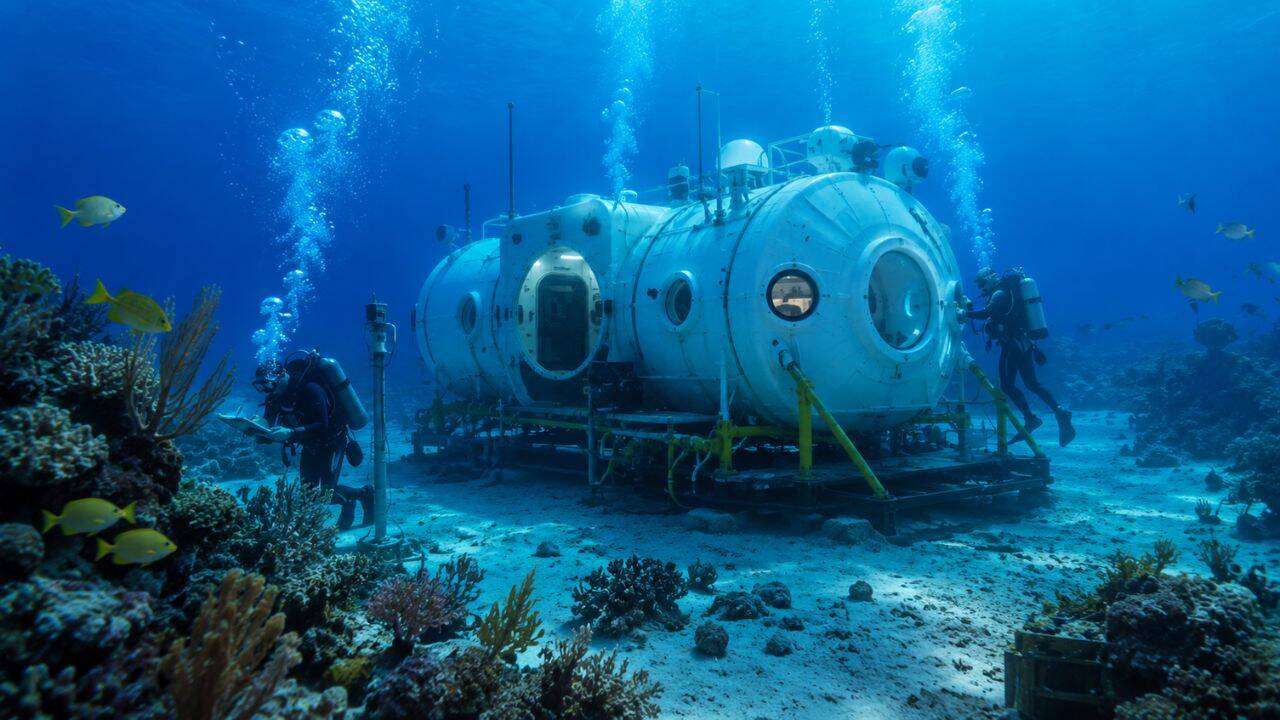
After four decades, a new underwater habitat is planned for Florida's coast. The media is breathless. Marine scientists are cheering. The public is getting treated to gorgeous renders of aqua-vistas and cozy living quarters beneath the waves.
It is romantic. It is cinematic. It is also an absolute waste of capital.
For decades, the marine research playbook has been dominated by a single, flawed premise: to truly understand the ocean, humans must live inside it. We have spent millions trying to recreate SeaLab and Aquarius, building pressurized steel cans on the seafloor so aquanauts can sip coffee while watching parrotfish swim by.
We are spending 21st-century budgets on a mid-20th-century fantasy.
The Myth of the Aquanaut
The pitch for ocean habitats always sounds noble. Proponents claim that putting saturation divers on the seabed for weeks at a time provides unmatched observation capabilities. They talk about "uninterrupted time" with marine ecosystems and the unique psychological data of long-term isolation.
Here is what they do not tell you: human bodies are terrible sensor platforms.
We are slow, fragile, expensive to keep alive, and biologically limited. A human inside a hyperbaric underwater living structure requires thousands of pounds of life-support infrastructure, redundant power systems, surface support teams, and complex decompression protocols. Keeping three humans safe at a depth of sixty feet costs exponentially more than deploying a swarm of autonomous vehicles capable of mapping square miles of reef in a single day.
[Image of autonomous underwater vehicle]
When you send a human down to live on the ocean floor, 90% of your operational budget goes toward stopping that human from dying. Only a fraction goes to actual science.
I have watched research institutions burn through capital on high-maintenance physical assets while their data pipelines ran on obsolete tech. Raising tens of millions for a physical habitat looks great in a press release. It attracts donors who want to feel like Jules Verne. But if the goal is actual ocean restoration, climate mitigation, or marine biology, it is an wildly inefficient allocation of resources.
The Tech Has Moved On. The Funding Has Not.
The ocean science community is suffering from a massive tech-gap hallucination.
While habitat enthusiasts are busy designing comfortable bunks for divers, modern robotics and remote sensing have fundamentally changed what is possible.
- Autonomous Underwater Vehicles (AUVs) can dive deeper, stay longer, and endure conditions that would instantly kill a human diver.
- eDNA (environmental DNA) sampling allows us to track entire biodiversity profiles from a simple liter of water, eliminating the need for hours of visual observation by a diver with a clipboard.
- Fixed sensor arrays and AI-driven camera systems can monitor reef health 24/7/365 without lighting up the environment with unnatural artificial floodlights that alter fish behavior.
When you drop a massive metal structure onto the seafloor and flood it with light, noise, and human waste systems, you are not observing an undisturbed ecosystem. You are observing an ecosystem reacting to a massive steel invader.
To argue that we need humans living on the reef to study the reef is like arguing we need astronomers to live on the surface of the moon to study space. We built the James Webb Space Telescope instead. Oceanography needs its Webb moment, but it remains bogged down in its Apollo era.
The Real Cost of the Nostalgia Complex
Why does this persistent urge to build underwater houses remain? Because human presence sells.
It is easy to get a corporate sponsor to put their logo on a habitat where a famous explorer will spend 30 days living underwater. It is remarkably hard to get that same sponsor excited about fifty quiet, long-endurance oceanographic gliders that collect raw salinity and temperature metrics.
This preference for showmanship actively harms the field. Every dollar funneled into hyperbaric plumbing, scrubbers, and offshore support vessels is a dollar diverted away from automated monitoring networks that could cover entire ocean basins.
There is a minor counter-argument here. Yes, saturation diving allows direct, tactile manipulation of delicate experiments that robotic arms still struggle to execute with fine motor control. Yes, testing human physiology in extreme environments offers valuable cross-over data for spaceflight simulation.
If the primary goal is space analog research, call it space research. Do not frame it as the savior of marine biology.
If the goal is saving coral reefs, monitoring ocean acidification, and understanding climate impacts on pelagic species, putting humans in a submerged box is an expensive distraction.
How We Actually Save the Oceans
We need to stop funding human-centric ocean vanity projects and pivot entirely to scalable, persistent, uncrewed platforms.
Instead of building one multi-million dollar habitat that monitors a few hundred square yards of reef, that capital should be distributed across three distinct technologies:
- High-Density Sensor Grids: Deploy thousands of low-cost, smart buoys capable of continuous acoustic, thermal, and chemical monitoring.
- Long-Range Autonomous Fleet Deployments: Fund multi-domain unmanned surface and subsurface vehicles that can patrol thousands of ocean miles without returning to port.
- Open-Source Marine Data Pipelines: Standardize and centralize global ocean data so machine learning models can predict toxic algal blooms, thermal bleaching events, and illegal fishing activity in real time.
We do not need more aquanauts. We need more data. We need actionable intelligence operating at a global scale.
Stop celebrating the return of the underwater habitat. Start demanding scalable technology that actually protects the marine environment instead of just hosting humans inside it.

:quality(85)/x8/fh/7HXvnnMcdomscTiif7/Blonde-porn-star-Shayla-LaVeaux-bends-over-to-get-her-pussy-smashed_015.jpg)