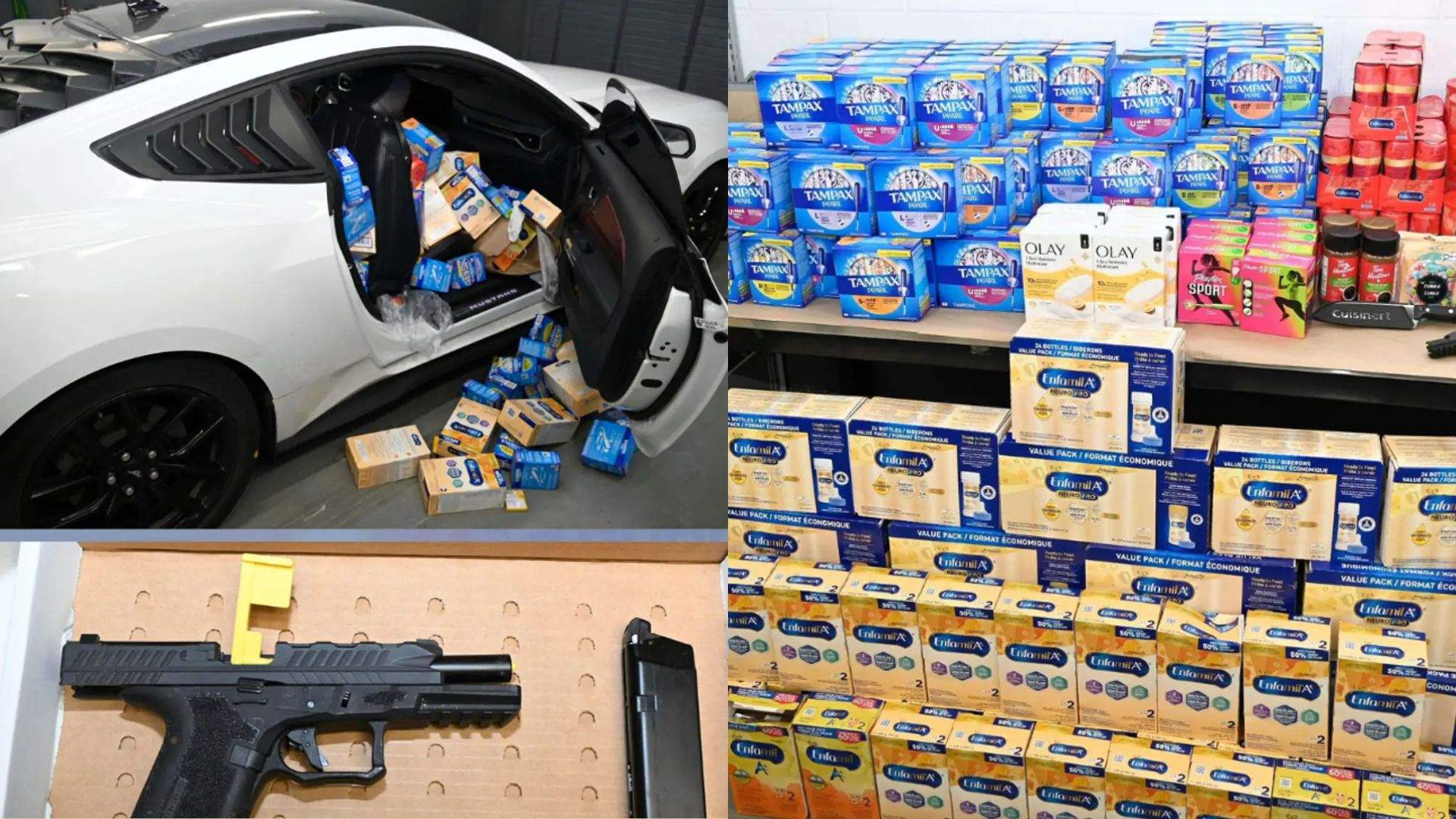
A standard fraud arrest involving a $6,000 seizure of baby formula and hygiene products looks like a straightforward win for local law enforcement. It fills a property room table for a press conference photo, ticks a box for retail loss prevention departments, and fades from the news cycle within forty-eight hours.
But treating these incidents as isolated acts of petty theft misreads the entire mechanics of modern retail crime. A $6,000 haul is not a desperate parent stealing for a hungry child. It is a highly calculated, logistics-heavy business operation that exploits structural failures in the global supply chain, economic desperation, and the predictable mechanics of secondary marketplaces. Police can seize the inventory, but until the underlying economic incentives change, the pipeline will remain intact.
The Anatomy of a High Margin Booster Loop
Organized retail crime relies on a specific hierarchy of actors. At the street level are the "boosters." These are the individuals who physically enter big-box retailers, drugstores, and supermarkets to sweep shelves of high-value, fast-moving consumer goods.
Baby formula is the holy grail for these operations. It is expensive, compact, essential, and possesses an incredibly predictable demand curve. Parents cannot opt out of buying it when they need it. When inflation squeezes household budgets, the premium price of name-brand formula creates a massive, parallel demand for discounted products.
Boosters do not steal to consume. They steal to sell to a "fence."
A fence operates as the middleman, buying stolen goods from boosters for roughly 20 to 30 percent of their retail value. For a $6,000 haul, a fence might pay out $1,200 to $1,800 in cash or drugs. The fence then consolidates this inventory, cleans off any security tags or store-specific markings, and prepares it for re-entry into the commercial stream.
[Street-Level Booster] -> Steals formula from retail shelves
       ↓
[The Fence] -> Buys at 20-30% retail value, consolidates inventory
       ↓
[Secondary Market] -> Sold via e-commerce, bodegas, or independent distributors
This is where the operation scales. The consolidated inventory is rarely sold on street corners. Instead, it moves through sophisticated digital and physical pipelines:
- Online Marketplace Platforms: Third-party seller accounts on major e-commerce sites allow fences to mask themselves as legitimate liquidators.
- Wholesale Flipping: Some fences run legitimate-looking distribution companies that sell stolen inventory back to independent corner stores, bodegas, or small grocery outlets at a steep discount.
- Cross-Border Smuggling: In some regions, stolen domestic formula is packed into shipping containers and sent to international markets where trust in local dairy supply chains is low, commanding prices far above US retail value.
Why Retail Security Measures Fall Short
Supermarket chains and big-box retailers have spent millions attempting to harden their stores against this specific type of theft. They have installed plexiglass lockboxes, implemented sweeping receipt checks, and deployed AI-driven camera systems designed to detect erratic shelf-clearing behavior.
The results have been mixed at best, counterproductive at worst.
Locking up infant formula protects the inventory, but it introduces massive friction to the shopping experience. A parent rushing through a store after work does not want to wait ten minutes for an understaffed floor associate to find the key to a plexiglass case. Data from retail consulting firms suggests that locking up high-velocity items can cause a drop in legitimate sales of up to 15 to 25 percent. Customers simply walk out and buy the item online.
Furthermore, aggressive in-store security measures often push the crime upward rather than stopping it. When shelf-sweeping becomes too difficult, organized crews pivot to cargo theft, intercepting delivery trucks or hitting distribution centers where the volume is exponentially higher and there are no cash registers or security guards to navigate.
The Regulatory Blind Spot in Digital Marketplaces
The true engine of the illicit formula trade is the ease with which stolen property can be liquidated online. While physical fences used to operate out of pawn shops or flea markets, the internet provided them with global reach and complete anonymity.
The INFORM Consumers Act was passed to combat this by requiring online marketplaces to verify the identity of high-volume third-party sellers. The law mandates the collection of bank account numbers, tax IDs, and working contact information to prevent criminals from hiding behind burner email addresses.
Yet, loopholes persist. Fences have adapted by using networks of "mules" to open clean seller accounts using stolen or purchased identities. Once an account accumulates too many flags or negative reviews regarding damaged seals or expired batch codes, the fence abandons it and spins up another pre-verified profile.
The platforms themselves face a fundamental conflict of interest. They earn a percentage fee on every transaction that occurs across their infrastructure, whether the item was sourced from a legitimate distributor or swept off a shelf in Duluth. While no major platform explicitly condones the sale of stolen goods, their enforcement mechanisms are largely reactive, relying on retailers to prove an item is stolen after it has already been listed.
The Public Health Risk of the Secondary Market
When police display thousands of dollars of recovered baby formula, the focus is almost exclusively on the financial loss suffered by corporations. This ignore the far more urgent issue of consumer safety.
Infant formula is a highly regulated food product for a reason. It requires strict temperature controls and specific storage conditions to maintain its nutritional integrity and prevent the growth of harmful bacteria like Cronobacter sakazakii.
Once formula leaves a retail store in a booster’s duffel bag, the chain of custody is obliterated. Fences frequently store their stolen inventory in unsecured, unconditioned environments:
- Trunks of hot cars during summer months, where temperatures can exceed 140°F, degrading the nutrients and curdling the proteins.
- Damp, rodent-infested basements or storage units where moisture can compromise the integrity of metal cans, leading to micro-perforations and contamination.
- Exchanging expired labels by using chemical solvents to erase expiration dates and printing fake stickers to make old, potentially dangerous formula look fresh.
When a unsuspecting consumer buys this product from a third-party online seller or an unauthorized neighborhood market to save five dollars, they are unknowingly playing Russian roulette with their child’s health. If a child gets sick, tracing the source of contamination back through a decentralized network of anonymous digital fences is nearly impossible for public health officials.
Moving Beyond the Property Room Photo Op
Chasing down individual shoplifters or raiding small-scale fences provides a temporary localized disruption, but it does nothing to dismantle the wider economic ecosystem. To make an actual dent in organized retail crime, the strategy must shift from reactive policing to systemic disruption.
Prosecutors must stop treating these cases as simple larceny. If a fence is coordinating multiple boosters, managing inventory, and laundering cash through online platforms, they should be prosecuted under state-level racketeering and corrupt organization (RICO) statutes. Shifting the legal framework from simple theft to enterprise corruption changes the risk-reward calculus for the coordinators of these networks.
Simultaneously, financial institutions must improve their detection of micro-laundering patterns. Fences often pay boosters via peer-to-peer payment apps using specific, repetitive transaction amounts that mimic casual transfers but occur with industrial frequency.
Until the digital friction of selling a stolen can of formula equals or exceeds the difficulty of walking out of a store with it, the shelves will continue to be cleared. The $6,000 seizure isn't a sign of a cracked case; it's a stark reminder of an incredibly lucrative, resilient shadow industry that operates right before our eyes.