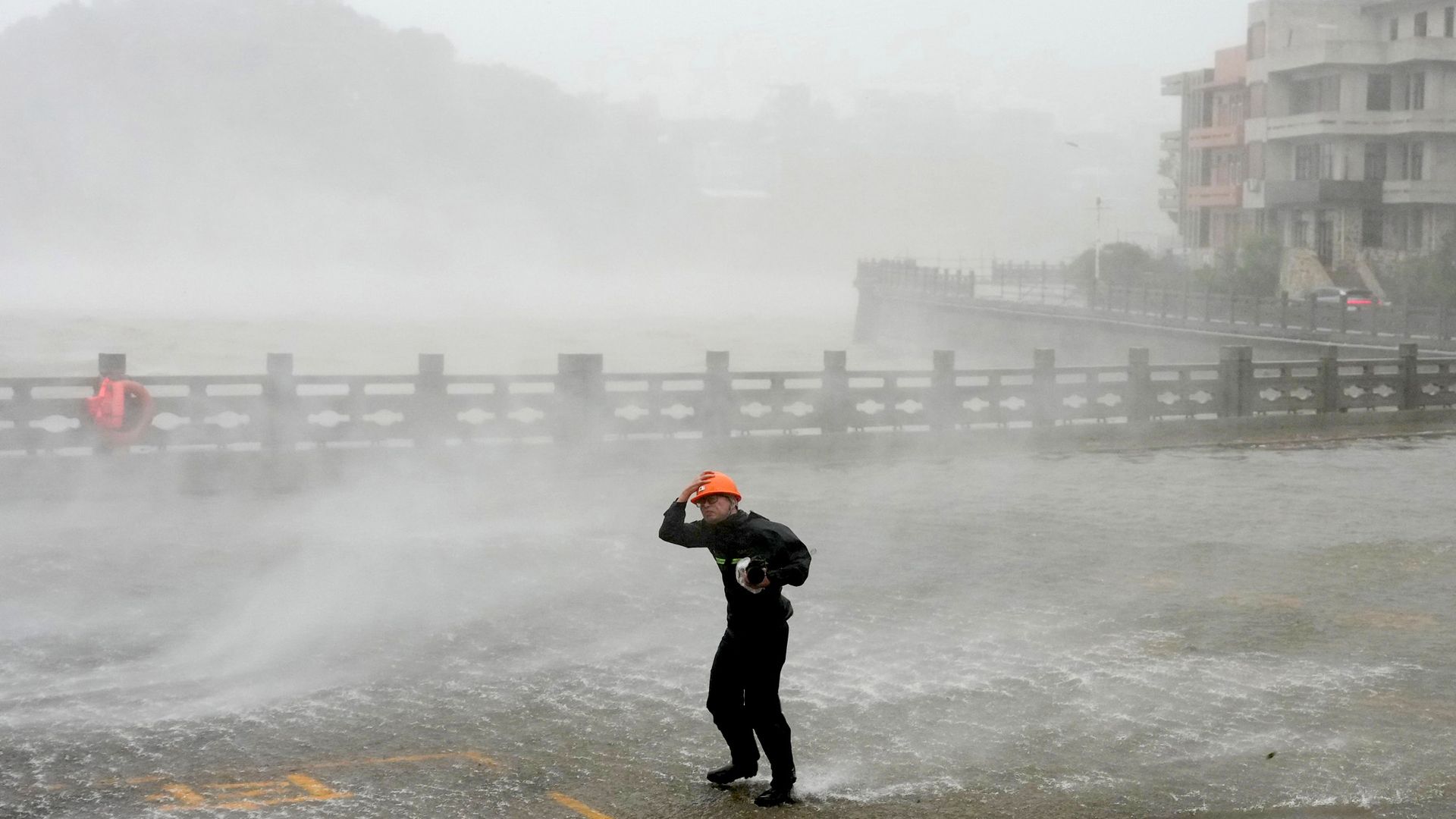
Every time a storm like Typhoon Dolphin slams into the Asian coastline and strands hundreds of flights, the media runs the exact same lazy script. They point at the wind speeds. They point at the radar map. They interview a stranded passenger crying over a missed vacation.
It is mass theatre designed to obscure a much more uncomfortable reality. In related updates, we also covered: Wildlife Incident Dynamics A Behavioral Analysis of Human Bison Conflicts.
Weather is not the villain here. Fragility is.
I have spent the last fifteen years auditing logistics networks for major international carriers, and I can tell you precisely what happens behind closed doors when a category-three typhoon hits airspace. The panic isn't about safety. It's about exposure. Airlines run their schedules so close to the bone, so utterly devoid of slack, that a single afternoon of wind shear causes a cascading failure across entire continents. Condé Nast Traveler has also covered this critical issue in great detail.
Stop blaming the meteorology. Start blaming the business model.
The Just-In-Time Delusion
For decades, the aviation industry looked at supply chain logistics in manufacturing and thought they could copy-paste the playbook. The goal became maximum asset utilization. Planes parked on the tarmac lose money. Crew members resting in hotels cost money.
So, planners designed networks where aircraft fly five or six legs a day with turnaround times tighter than a drum.
Imagine a scenario where a single widebody jet is scheduled to service Beijing, Shanghai, Guangzhou, and back within a twenty-four-hour window. When Typhoon Dolphin halts operations in eastern China, that single aircraft doesn't just get delayed. It drops out of the matrix entirely. By hour six of the ground stop, the airline's scheduling software is throwing errors from Tokyo to Frankfurt.
This is not an act of God. This is an act of engineering hubris.
When you eliminate all redundancy to squeeze out an extra half-point of operating margin, you aren't running an efficient airline. You are running a house of cards that happens to have wings.
The Myth of the Unavoidable Ground Stop
Passengers are fed a comforting lie every time a flight is cancelled: "Safety is our number one priority."
Of course safety is a priority. No pilot wants to fly into a hurricane. But let us be entirely honest about what happens next. The ground stop is called not because the storm is an absolute wall of death for every square mile, but because the systemic downstream consequences of a minor deviation are too expensive to manage.
If an airline had proper backup crews stationed regionally, if they kept spare airframes idling at key hubs, and if air traffic control management systems weren't built on legacy software from the Carter administration, a typhoon would be a localized inconvenience rather than an international crisis.
Instead, carriers prefer to absorb the PR hit of mass cancellations. Why? Because passengers have no alternative. When every major carrier operates on the same razor-thin, hyper-optimized margins, the entire industry fails in unison. There is no competitive penalty for failure when everyone fails together.
The Real Cost of Cheap Fares
We brought this on ourselves.
Consumers spent the last twenty-five years demanding fifty-dollar international tickets through aggregator sites. You cannot demand ultra-low-cost travel and simultaneously expect a resilient, shock-proof infrastructure.
Every time you book the cheapest flight on the screen, you are voting for a system that has zero capacity to absorb a punch. Typhoon Dolphin is just the sparring partner.
When hundreds of flights are grounded, the immediate reaction is to look at airport boards and curse the wind. Look at the balance sheet instead. Look at the fleet-to-crew ratios. Look at the corporate obsession with quarterly earnings over operational depth.
The next time a storm hits, don't ask why the airline didn't fly. Ask why they built a system so brittle that a stiff breeze can break it.
Pack a spare day into your itinerary, buy travel insurance that actually covers operational meltdowns, and stop pretending weather is the enemy. The enemy is the spreadsheet.