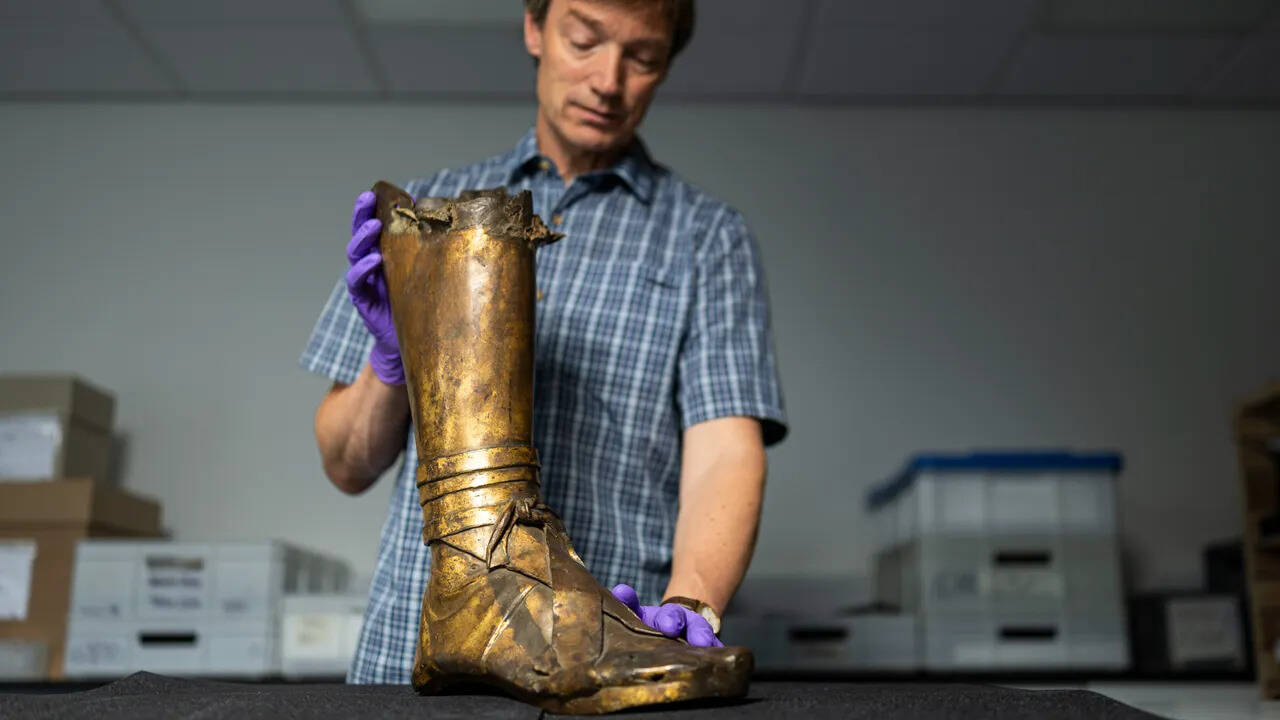
For over two hundred years, one of the most celebrated ancient artifacts in Switzerland sat behind museum glass under a false identity. Excavated near the Rhine in 1820, the massive, cast-bronze limb was long dismissed as standard Roman military loot hauled north by Germanic raiders during the collapse of the western frontier. Now, forensic metallurgical testing and three-dimensional anatomical modeling reveal a dramatically different story. The leg belongs to an imperial, larger-than-life portrait statue of Emperor Antoninus Pius, and it was likely not stolen in a raid at all. Instead, it appears to have been deliberately dismantled, transported, and buried as part of a calculated political and ritual act on the empire's volatile northern border.
This reattribution forces a complete overhaul of how historians view the relationship between Rome and the Germanic tribes along the Upper German-Rhaetian Limes. What nineteenth-century antiquarians wrote off as a trophy of mindless barbaric plunder is actually evidence of sophisticated cross-border diplomacy, localized imperial cult worship, and the ritualized decommissioning of Roman state power. Read more on a similar topic: this related article.
The 1820 Discovery and the Plunder Narrative
In the early nineteenth century, European archaeology operated less like a forensic science and more like a treasure hunt filtered through colonial biases. When farmers unearthed the hollow-cast bronze leg—measuring nearly a meter from mid-thigh to the sole of an ornate sandal—the prevailing historical framework dictated only one possible explanation. The artifact had been found outside the formal boundaries of consolidated Roman urban centers, near territories associated with the Alemanni, a confederation of Germanic tribes that repeatedly breached Roman defenses in the third century AD.
To scholars of the 1820s, the narrative wrote itself. Rome was civilization; the tribes beyond the Rhine were destroyers. Therefore, a severed bronze limb found in the dirt had to be the leftover scrap of a looted temple or forum, hacked apart by raiders who lacked the appreciation for classical art and only wanted raw metal to melt down for weapons or currency. Further journalism by Associated Press delves into comparable perspectives on the subject.
That assumption stuck for two centuries. Museum placards repeated it. Academic catalogs reinforced it. Once an artifact is filed under a convenient label in a major collection, institutional inertia makes it remarkably difficult to challenge. Nobody questioned why raiders intending to melt down bronze for scrap would carefully preserve an intricate, heavy piece of imperial footwear without leaving a single chisel mark on the knee joint.
Forensic Metallurgy Changes the Timeline
The crack in the two-hundred-year-old consensus came when conservators subjected the bronze to modern non-invasive diagnostics, including X-ray fluorescence spectroscopy and industrial computed tomography. The scans revealed two critical details that nineteenth-century eyes could never have seen.
First, the alloy composition—a specific ratio of copper, tin, and lead—matched known imperial foundry outputs from the mid-second century AD, specifically the workshops operating in Rome and Lyon during the reign of Antoninus Pius between 138 and 161 AD. Third-century provincial bronzes, produced when the empire was gripped by hyperinflation and silver debasement, show far higher concentrations of recycled scrap metal and erratic lead levels. This leg was cast from virgin, state-controlled ingots at the absolute height of Roman economic stability.
Second, and far more damaging to the loot theory, the internal wall thickness and casting seams proved the leg was never hacked off a standing statue. Roman monumental bronzes were cast in separate anatomical sections using the lost-wax method, then joined together with structural soldering and mechanical pins. The upper edge of the 1820 leg shows clean, unforced separation along the original manufacturing seam. Whoever took this statue apart knew exactly how it was engineered. They heated the solder joints and disassembled the emperor piece by piece.
Identifying Antoninus Pius Through Imperial Footwear
Pinpointing the exact emperor required looking at the feet. In Roman state portraiture, imperial clothing was never a matter of personal fashion; it was a rigid visual code broadcast across three continents to illiterate populations. Every strap, knot, and leather fold on a statue's footwear communicated specific legal and religious authority.
The 1820 leg wears a calceus patricius, the high-laced ceremonial boot reserved for the highest ranks of the Roman aristocracy and the emperor himself. However, high-resolution 3D laser scanning of the bronze surface revealed subtle decorative tooling along the central leather tongue and a distinct arrangement of ankle straps that narrowed the timeline down to a twenty-year window.
When archaeologists overlaid the 3D scan of the leg onto surviving marble and bronze portraits of second-century emperors, the proportions aligned with the established sculptural canon of Antoninus Pius. Unlike his restless predecessor Hadrian, who spent half his reign touring the provinces, or his successor Marcus Aurelius, who spent decades fighting brutal wars on the Danube, Antoninus Pius never left Italy during his twenty-three years on the throne. Because the emperor was physically absent from the frontiers, his administration flooded the border provinces with standardized, larger-than-life bronze portraits to project stability and personal presence.
The math behind the reconstruction is straightforward:
- Surviving limb length: 94 centimeters from mid-thigh to heel.
- Estimated full statue height: Roughly 2.4 to 2.6 meters, or approximately 1.4 times life-size.
- Original weight: Between 250 and 300 kilograms of hollow-cast bronze, requiring a reinforced stone plinth.
A statue of that scale was not a private commission by a wealthy merchant. It was an official monument funded by the provincial administration or a military legion, standing at the center of a fortified town's forum or a legionary headquarters.
Why Dismantle an Emperor Without Melting Him
If Germanic raiders did not hack the statue apart, and metal scavengers did not melt it down, how did the leg of Antoninus Pius end up buried in the earth? The answer lies in the complex political reality of the Roman frontier, where the line between Roman citizen and "barbarian" was far blurrier than classical historians liked to admit.
By the mid-third century, the frontier along the Rhine was collapsing under simultaneous pressure from external migrations and internal Roman civil wars. When Roman garrisons pulled back from outlying forts and administrative towns, they faced a logistical problem. Massive bronze statues of emperors were sacred objects within the imperial cult. Leaving an intact image of a deified emperor behind for advancing tribes to deface was an unthinkable religious and political humiliation.
In several documented cases along the Rhine and Danube borders, retreating Roman officials or loyal local elites deliberately dismantled their own imperial monuments. They disassembled the statues along their foundry seams and buried the pieces in deep pits, wells, or marshlands—effectively giving the emperor a ritual burial to protect the sacred bronze from desecration until Rome could return.
There is a second, equally compelling possibility involving Germanic mercenaries. Thousands of warriors from beyond the Rhine served in the Roman auxiliary forces, earning citizenship, military pay, and an intimate understanding of Roman state religion. When these veterans returned home or broke away during periods of imperial instability, they often took dismantled fragments of Roman monuments with them. To a Germanic warlord who had served in the Roman army, the leg of an emperor was not raw scrap metal. It was a potent talisman of authority—a physical piece of the Roman state apparatus used to legitimize his own local rule.
The Blind Spots of Classical Archaeology
The two-hundred-year misidentification of the Antoninus Pius leg exposes a persistent flaw in how Western institutions handle ancient history. For generations, archaeology treated the Roman frontier as a strict binary wall separating high civilization from chaotic savagery. Any luxury object found inside Roman borders was evidence of imperial grandeur; the exact same object found ten miles across the river was automatically categorized as stolen goods.
That bias warped the historical record across Europe. Dozens of Roman silver hoards, diplomatic gifts, and architectural fragments found in northern Europe were reflexively labeled as raid loot, obscuring a vibrant network of trade treaties, cross-border marriages, subsidies, and mercenary contracts. Rome rarely maintained its borders through military force alone. For centuries, it bought peace on the Rhine by pouring gold, silver, and prestige goods into the hands of cooperative tribal leaders.
Reclassifying a single bronze leg does not rewrite the fall of the Western Roman Empire, nor does it erase the very real violence of the third-century frontier raids. Germanic warbands certainly burned Roman towns and hauled off mountains of plunder. Yet the forensic evidence proves that history is rarely tidy enough to fit nineteenth-century stereotypes.
What Happens to the Artifact Now
Museums across Europe are currently auditing their nineteenth-century collections using the same non-invasive scanning and metallurgical techniques that cracked this case. Storage vaults are full of mislabeled fragments—arms, heads, drapery folds, and horse hooves—excavated before modern stratigraphy existed. By mapping the exact alloy signatures and foundry seam geometries of these scattered pieces, researchers are beginning to digitally reassemble monuments that were separated across different museums over a century ago.
For the leg of Antoninus Pius, the immediate impact is a rewritten gallery label and a new digital reconstruction showing visitors the towering, gilded emperor who once stood watch over the northern frontier. More importantly, it serves as a sharp reminder that the physical evidence of the past does not lie, even when historians spend two centuries reading it wrong.