The morning air in northern Minnesota smells like pine resin and cold iron. It is the kind of quiet that feels earned, settling over the surface of a glass-calm lake before the sun has fully decided to burn off the fog. You stand on the aluminum deck of a boat, breath pluming white against the gray dawn, fingers stiff inside fingerless gloves. You have cast thousands of times in your life. Your muscle memory is absolute. The rod becomes an extension of your wrist, a graphite spine whispering against the wind.
Then comes the snap.
It is a dry, sickening crack. A brand-new rod, purchased just hours before with the hopeful optimism that accompanies the opening of a season, splinters right above the reel seat. The tip flies forward, tangled in the line, dangling uselessly in the dark water.
Most people quit right there. They mutter something profane, reel in the wreckage, and head back to the dock to drink bad coffee from a thermos and curse their luck.
Greg Amundson did not quit.
What happened next is a masterclass in calm desperation. A moment where split-second instinct overrides frustration. This is not just a story about a fish. It is a story about the exact threshold where preparation meets pure, unfiltered adrenaline, and how a shattered piece of carbon fiber very nearly cost a fisherman the prize of a lifetime.
The Anatomy of a Disaster
Fishing gear is expensive. Modern rods are marvels of aerospace engineering, designed to be feather-light yet capable of absorbing violent shocks. But they have a breaking point.
Greg had just unpacked his gear. The ink on the receipt was barely dry. He stepped onto the water looking for panfish, expecting the usual rhythm of bluegill fishing: light taps, quick hooksets, and the gentle pull of dinner-plate-sized fish fighting in the weeds.
Instead, the rod failed.
Crack.
There is no sound quite like it. It tells you that your money is gone, your morning is ruined, and your equipment has abandoned you. For a fraction of a second, Greg was weaponless. He held a stump of graphite while something heavy, methodical, and entirely alien began to pull back from the abyss below.
Consider what happens next: the fish does not know your rod is broken. It does not care about your budget or your morning schedule. It only knows that it has a hook in its lip, and it wants to return to the safety of the submerged timber.
Greg did not have a functional rod. He had a stub. To land what was on the other end of that line, he had to ditch standard technique entirely. He had to hand-line the fish.
The Weight in the Deep
Bluegill are scrappy fighters relative to their size. Pound for pound, they pull harder than almost any other freshwater panfish. But a standard bluegill weighs half a pound, maybe three-quarters if you find a true river monster.
This was different.
When the line started singing through the water, cutting a clean V-shape across the surface, Greg felt a dead, heavy momentum. This was not a panfish playing games. This was a tank.
He gripped the bare line with his calloused fingers. Every surge of the fish sent friction burns across his skin. Without the shock-absorbing bend of a rod tip, every headshake traveled directly up his forearm, vibrating in his teeth.
Hold.
Release.
Pull.
It was a delicate, dangerous dance. Pull too hard, and the 4-lb test line snaps like sewing thread, leaving you with nothing. Give too much slack, and the fish throws the hook, vanishing back into the shadows of the weed bed. Greg operated purely by feel, his eyes locked on the dark water churning ten feet off the bow. He was wrestling a ghost in the dim light, relying entirely on decades of accumulated water-sense.
The Shape of a Record
When the fish finally broke the surface, it did not splash. It rolled.
That is the signature move of a giant. Big fish are old fish, and old fish are conservative with their energy. They do not waste time acrobatic leaping; they use their sheer mass to exhaust the angler.
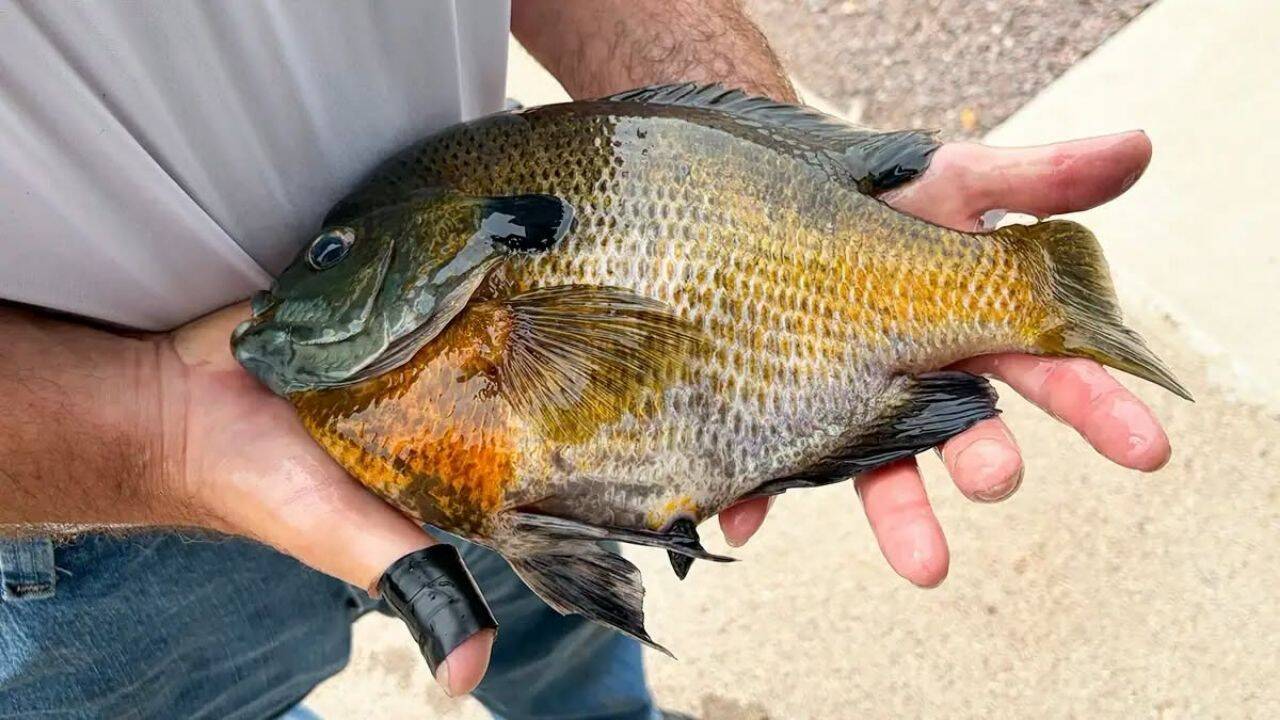
Greg saw the broad, saucer-shaped flank catch the gray morning light. It flashed a deep, iridescent turquoise and copper, glowing like a stained-glass window against the dull water.
Even seasoned guides would have blinked. This was not just a big bluegill. This was an anomaly. A genetic outlier that had somehow dodged every predator, every ice-fishing spear, and every casual angler for over a decade, growing fat and cautious in the deep basin of the lake.
With one final, desperate heave using his bare hands and the jagged stump of his ruined rod, Greg hoisted the creature over the gunwale and dropped it into the bottom of the boat.
It lay there, heaving slightly, magnificent and absurdly wide.
The Numbers That Matter
When Greg brought his catch to dry land and placed it on certified scales, the reality of the morning solidified into hard data.
The fish weighed 2.21 pounds.
To anyone who does not fish, that number sounds small. A bag of sugar weighs more. But in the world of freshwater angling, a two-pound bluegill is the mythical beast. It is the four-minute mile of panfishing.
The Minnesota Department of Natural Resources keeps meticulous records. State records are fiercely contested, heavily scrutinized, and rarely broken. Most standing records for panfish have survived for decades, guarded by remote waters and sheer statistical improbability.
Greg’s fish measured an astonishing length with a girth that defied normal biology for Lepomis macrochirus. It was a certified state record.
Think about the chain of failures that had to align for this moment to exist. If the rod had not broken, would he have applied too much pressure and snapped the line? If he had panicked and dropped the line when his skin started burning, the fish would be sitting in six fathoms of water right now. The catastrophic equipment failure was, paradoxically, the exact thing that forced him to slow down, to feel the fish directly, and to land it with surgical, desperate precision.
The Aftermath on the Water
The sun finally cleared the tree line, washing the lake in a warm, golden hue that chased away the morning chill.
Greg sat on the middle bench of his aluminum boat, staring down at the fish resting in the livewell. His hands were red and throbbing where the monofilament had bitten into his skin during those frantic, rodless seconds. The broken pieces of his brand-new rod rattled gently in the bottom of the boat with every ripple of the hull.
He did not look angry anymore. He looked tired, bewildered, and quietly triumphant.
The store where he bought the rod would exchange it, of course. Warranties cover manufacturing defects. But no warranty can cover the sheer, chaotic magic of breaking your gear on cast number one, only to pull up a living legend from the deep water using nothing but your bare hands and stubborn defiance.
Out on the lake, the water closed over the rings of the disturbance, smoothing out into glass once more, hiding its remaining secrets until the next dawn.