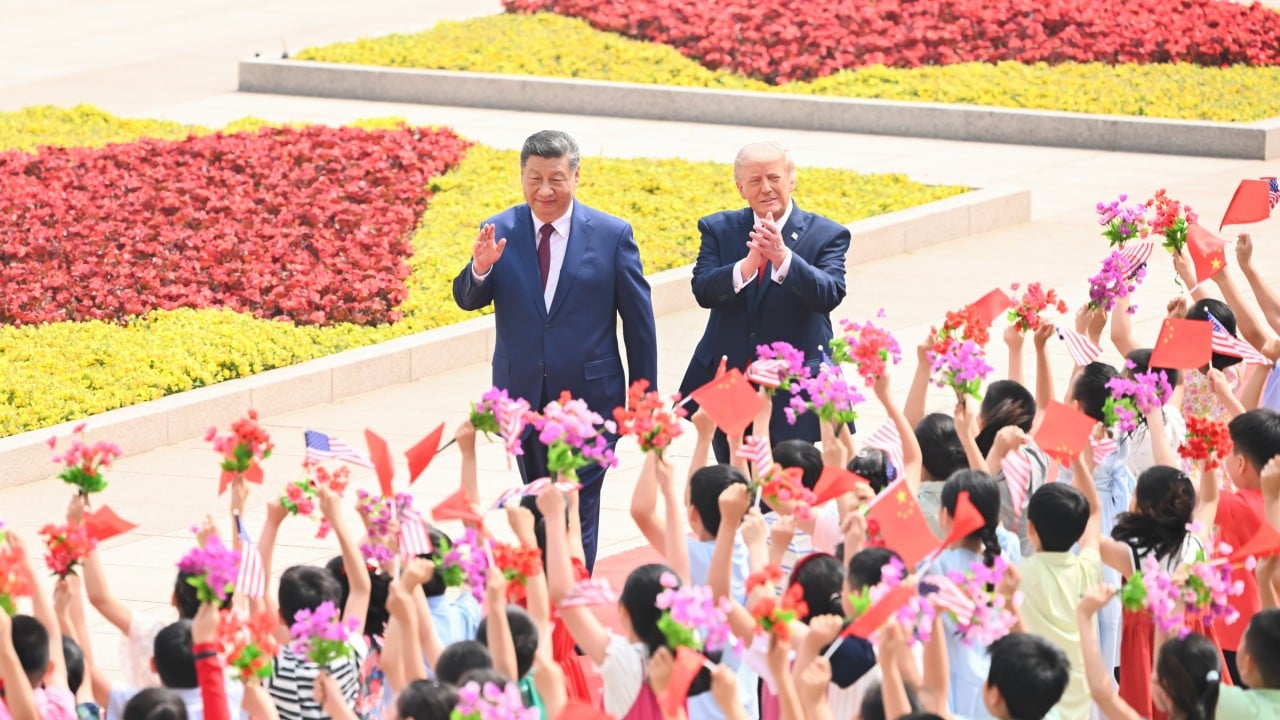
The air on the South Lawn of the White House smells faintly of cut grass, wet concrete, and centuries of heavy expectation.
Step outside the press pen on a morning like this, and you feel the weight of it in your teeth. Two hundred and one cannon blasts do not just shake the air; they rattle the windows of the Treasury Department down the block. They rearrange the dust motes in the Oval Office. They signal to seven billion people that two men, carrying the economic gravity of half the planet in their breast pockets, have entered the same room. Discover more on a connected issue: this related article.
State visits are pageantry stripped of its innocence. We call them diplomacy, but they are theater designed with terrifying precision. Every foot of red carpet rolled across the stone portico is measured. Every stride of the military honor guard is timed to the second. When President Biden stood alongside Chinese President Xi Jinping under the autumn sun, the cameras flashed a million times a second, freezing a smile, a nod, a slight tilt of the head.
Yet the real story of a state visit never happens on the podium. More analysis by TIME delves into similar perspectives on the subject.
To understand what actually occurs when the White House rolls out the red carpet, you have to look past the velvet ropes and the state dinner menus featuring dry-aged ribeye and mandarin-infused chiffonade. You have to look at the geometry of silence.
Consider what happens behind closed doors. Imagine a room on the second floor of the executive mansion, away from the journalists tapping frantically on their phones, away from the protesters chanting behind steel barricades on Pennsylvania Avenue. The doors close with a heavy, muffled thud. The aides step back. The translators adjust their earpieces.
In that room, the grand abstractions of global trade, semiconductor supply chains, maritime navigation rights in the South China Sea, and carbon reduction targets are reduced to human friction. Xi Jinping speaks in measured, deliberate cadences, his words filtered through interpreters who know that a misplaced verb can shift a billion-dollar tariff negotiation into hostile territory. Joe Biden leans forward, hands clasped, relying on decades of legislative posturing and late-night phone calls to find the grain of sand where compromise might grow.
This is the invisible architecture of international relations. We treat nations as monolithic monoliths—blue states and red states, communist parties and democratic republics—forgetting that foreign policy is ultimately executed by tired human beings running on too much coffee and too little sleep.
For the average citizen watching the evening news from a kitchen table in Ohio or a high-rise apartment in Shanghai, the pageantry feels distant, almost unreal. Why should a factory worker in Guangzhou or a software developer in Seattle care about a twenty-one-gun salute?
Because of the ripple effect.
When the cameras stop rolling and the motorcades streak back toward Dulles International Airport, the tension does not vanish; it transforms. The agreements reached—or the silences maintained—dictate whether shipping containers sit stranded in harbors or move freely. They dictate whether tech startups can source rare earth minerals or face crippling shortages. They determine the price of a gallon of gas, the interest rate on a mortgage, and whether a generation of young people grows up viewing their peers across the Pacific as trading partners or existential threats.
We have lived through decades of escalation. We have watched the rhetoric harden, turning every bilateral meeting into a zero-sum cage match where compromise is treated as weakness. That is why the red carpet matters. It is not an endorsement of every policy or every domestic crackdown. It is an acknowledgement that total isolation is a luxury no superpower can afford.
Standing on the lawn that morning, watching the flags flutter in the crisp air, a strange realization settles in. For all our technological marvels, for all our artificial intelligence and instantaneous global communication, the fate of the modern world still hinges on two men sitting across a mahogany table, deciding whether to listen or to shout.
The cannons fall silent. The smoke drifts away over the Potomac. The doors open.
And the world waits to see what they decided behind closed doors.