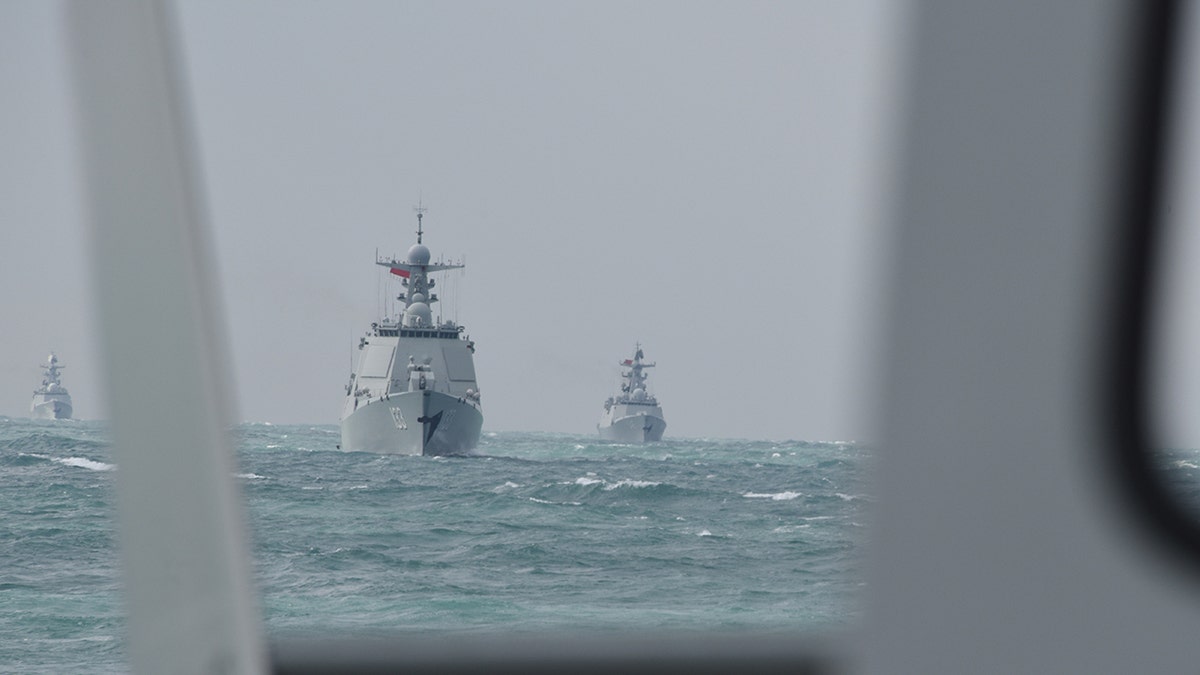
Geopolitics is often a theater of the absurd where the loudest voices usually signal the least amount of actual risk. The recent headlines screaming about Donald Trump’s promise to blow Iran "off the face of the earth" if they touch a U.S. ship aren’t a strategy. They are a marketing campaign. For years, traders and analysts have reacted to this rhetoric like Pavlovian dogs, spiking oil prices and shorting the dollar the moment a carrier strike group moves an inch in the Persian Gulf. They are missing the point.
The consensus view—the "lazy consensus"—is that we are one tweet or one rogue drone away from a hot war that collapses the global economy. This view assumes that state actors are irrational and that military posturing is the primary driver of market stability. It’s wrong. The reality is that the threat of total annihilation is the most effective tool for maintaining the status quo, not for upending it.
The Myth of the Madman Theory
Mainstream media loves the "Madman Theory"—the idea that a leader’s unpredictability keeps enemies at bay. In reality, the Pentagon and the Iranian Revolutionary Guard Corps (IRGC) operate on a highly predictable, mathematical framework of escalation. Trump’s "blown off the face of the earth" comment isn't a shift in policy; it’s a verbal reinforcement of a doctrine that has existed since the 1980s.
When the competitor article highlights these threats, it frames them as a ticking time bomb. I’ve sat in rooms with energy analysts who have predicted "imminent war" in the Strait of Hormuz for three decades. They’ve been wrong every single time. Why? Because the cost-benefit analysis of closing the Strait is a suicide pact that neither Tehran nor Washington is willing to sign.
Iran knows that sinking a U.S. destroyer doesn't just invite a "proportional response." It invites the complete dismantling of their oil infrastructure. The U.S. knows that a full-scale war in the Middle East would send gas prices to $10 a gallon, effectively handing their opponent the next election. The rhetoric is the pressure valve that prevents the explosion.
Oil is No Longer the Weapon It Used to Be
Every time a headline like this drops, the knee-jerk reaction is to look at Brent Crude. This is 1970s thinking. The world has changed. Thanks to the shale revolution and the massive expansion of non-OPEC production, the "Geopolitical Risk Premium" on a barrel of oil has shrunk.
In the past, a threat against U.S. ships would send oil up 10% overnight. Today, it barely moves the needle for more than a few hours. The market has priced in the noise. We have seen actual attacks on tankers and Saudi refineries in the last few years that resulted in temporary blips, not sustained rallies. If you are trading based on the fear of a closed Strait, you are chasing a ghost.
The real risk isn't a missile hitting a ship; it’s the slow, grinding shift of trade routes and the insurance premiums that follow. Shipping companies like Maersk or MSC don’t care about the fire and brimstone in a stump speech. They care about the "War Risk" surcharges. That is the actual economic impact—a tax on global trade—not a world-ending conflict.
The Currency Play Everyone Gets Wrong
Standard analysis says: "War threats = flight to safety = buy Gold and the Swiss Franc."
This is a rookie mistake. In the modern era, threats of American military dominance, even when phrased aggressively, tend to reinforce the hegemony of the U.S. Dollar. When the President (or a leading candidate) asserts that the U.S. has the power to erase a nation from the map, it reminds the world who owns the reserve currency and the military hardware that backs it.
I’ve seen portfolios get shredded because they bet against the Greenback during times of high-decibel rhetoric. They expect the U.S. to look weak or overextended. Instead, the market realizes that there is no alternative. You don't flee to the Euro when the Middle East is on fire; you go back to the source of the fire.
The Asymmetric Reality of Modern Warfare
Let’s talk about "swarming." Iran’s naval strategy isn't about matching the U.S. Navy ship-for-ship. It’s about using thousands of fast-attack craft and suicide drones to overwhelm Aegis combat systems. This is the "nuance" the mainstream press misses.
Imagine a scenario where 200 low-cost drones, costing roughly $20,000 each, are launched at a $2 billion Arleigh Burke-class destroyer. Even if the ship intercepts 190 of them, the remaining 10 cause catastrophic damage. This isn't "blowing someone off the face of the earth." This is a paper cut that causes a billion-dollar infection.
The danger isn't the "big war" Trump talks about. It’s the "small war" that neither side can win or lose. This is a perpetual state of "Gray Zone" conflict. For an investor or an industry insider, the play isn't to hedge against an apocalypse. It’s to look at the defense contractors who are pivoting from massive platforms (carriers) to autonomous systems and electronic warfare.
Where the Money Actually Goes
- Electronic Warfare (EW): The ability to jam drone signals is more valuable than a 16-inch gun.
- Point Defense Systems: Kinetic interceptors that cost less than the missiles they are shooting down.
- Satellite Surveillance: Real-time tracking of small craft movements.
The competitor's focus on the "face of the earth" rhetoric ignores the fact that the U.S. military is currently more concerned with the cost-per-intercept than with total destruction. If it costs $2 million to shoot down a $50,000 drone, the U.S. loses the war of attrition without a single sailor dying.
The China Factor: The Elephant Not in the Room
Why does Trump talk about Iran while the Pentagon watches the South China Sea? Because Iran is an easy villain for a domestic audience. It’s a distraction.
The real threat to U.S. naval dominance isn't a skirmish in the Persian Gulf; it’s the denial of access in the Pacific. By focusing on the Middle East, the media allows the public to ignore the much more complex—and market-shaking—realities of the U.S.-China maritime standoff. Iran is the sideshow that keeps the defense budget bloated while the real strategic shift happens elsewhere.
If you want to understand the future of global markets, stop reading the transcripts of political rallies. Start looking at the maritime insurance rates in the Malacca Strait and the production schedules of semiconductor plants in Taiwan. Those are the real "ships" that matter.
The Flawed Premise of "Stability"
People ask: "How can we restore stability to the region?"
The question is flawed because it assumes stability is the goal. For many players, including the military-industrial complex and certain political factions, a "managed instability" is much more profitable. It justifies high oil prices for some, high defense spending for others, and a constant stream of "breaking news" for the rest.
If the Middle East were actually stable, the U.S. wouldn't need a massive presence there. If the U.S. didn't have a presence, it wouldn't have the leverage to influence global energy flows. The "threat" of war is the mechanism of control.
The Hard Truth About Geopolitical "Pivots"
I have spent two decades watching "game-changing" announcements fall flat. Every time a politician uses hyperbole like "blown off the face of the earth," it is an admission of limited options. True power doesn't need to shout; it acts. The fact that this rhetoric is being used indicates that the U.S. is currently unwilling or unable to engage in the very conflict it is threatening.
It is a bluff designed to buy time.
If you are an executive or a high-net-worth individual, your job is to see through the smoke. The smoke is the "imminent war." The fire is the underlying economic shift toward deglobalization and the fragmentation of trade blocks.
Stop waiting for the big bang. The world doesn't end with a bang; it ends with a series of increased tariffs, higher insurance premiums, and a slow transition to a multi-polar energy market.
Don't buy the fear. Buy the volatility, or better yet, ignore the noise entirely and focus on the structural changes in how goods are moved across oceans. The ships aren't going to be "blown off the face of the earth." They’re just going to get more expensive to operate.
The next time you see a headline about "annihilation" in the Gulf, go get a coffee. Nothing is happening.