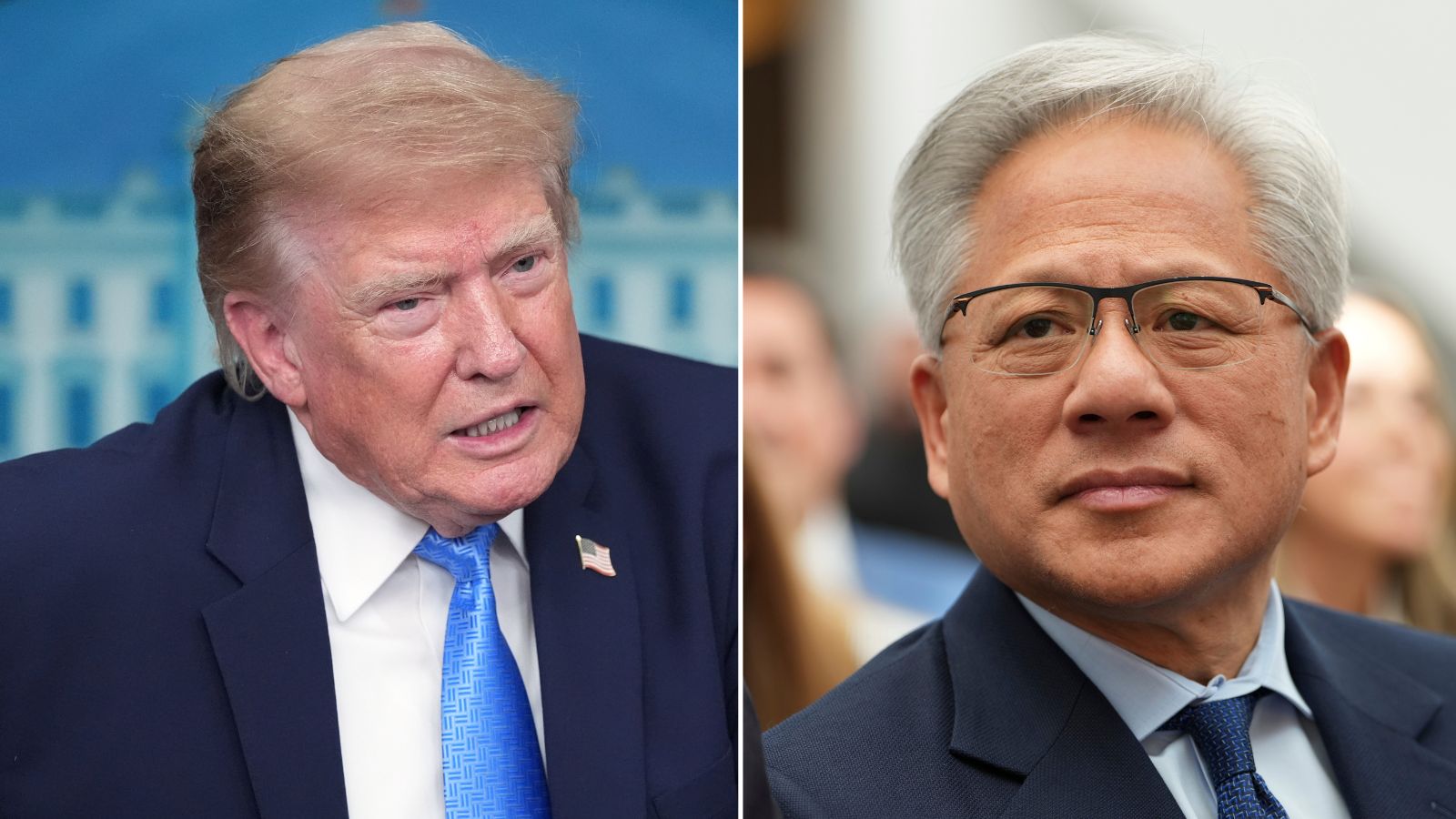
Washington is having another collective meltdown over silicon.
When Donald Trump publicly backed Nvidia CEO Jensen Huang against allegations of Chinese espionage links, the Beltway foreign policy establishment did what it always does. It gasped. Pundits immediately framed the moment as a dangerous lapse in national security judgment, a gullible commander-in-chief taking a billionaire tech executive at his word while Beijing quietly siphons off American compute superiority. For a different perspective, consider: this related article.
That consensus is lazy. Worse, it misunderstands how modern hardware, supply chains, and geopolitical deterrence actually function.
The mainstream coverage treats Nvidia like a defense contractor caught selling blueprints out the back door, and Trump like a mark falling for a sales pitch. Both premises are wrong. If you actually look at the mechanics of chip architecture, export controls, and global capital flows, backing Huang isn't an act of blind faith. It is the only rational move left on the board. Similar coverage on this trend has been published by The Next Web.
The Espionage Myth vs. Hardware Reality
Let's dismantle the core accusation first. Critics love to whisper about "China spy links" whenever a Silicon Valley giant maintains revenue streams or engineering ties in East Asia. In Nvidia's case, the hysteria usually centers on three things: historical R&D centers in Shanghai and Beijing, customized compliant chips like the H20 built specifically to clear U.S. Department of Commerce thresholds, and the grey-market smuggling of H100 and Blackwell GPUs through third-party brokers in Singapore or the Middle East.
None of that constitutes espionage. Calling grey-market arbitrage "spy links" is like blaming Ford when a cartel buys an F-150 from a dealership in Texas and drives it across the border.
I have sat in boardrooms where compliance teams spent tens of millions of dollars trying to track physical server racks after they left a Taiwanese ODM (Original Design Manufacturer) like Foxconn or Quanta. Once a GPU leaves the loading dock and enters the global distribution channel, the designer has zero physical custody over it. Hardware isn't a cloud SaaS login you can revoke with an API key—at least not without baking hardware-level kill switches into the silicon, a move that would instantly cause every sovereign buyer from Berlin to Tokyo to abandon American tech out of fear Washington would brick their data centers on a whim.
Furthermore, the people yelling about Nvidia "handing over secrets" fundamentally misunderstand what an Nvidia GPU actually is. Nvidia is a fabless designer. They do not own the machines that etch transistors onto wafers.
- The Foundry: Taiwan Semiconductor Manufacturing Company (TSMC) fabricates the silicon.
- The Lithography: ASML in the Netherlands builds the Extreme Ultraviolet (EUV) machines required to print at 3nm and below.
- The Memory: SK Hynix and Micron supply the High Bandwidth Memory (HBM) stacks that keep the tensor cores fed.
Even if a Chinese intelligence asset walked out of Nvidia's Santa Clara headquarters with the complete RTL (Register-Transfer Level) schematics for the Blackwell architecture tomorrow, Beijing still couldn't manufacture it at scale. Knowing the recipe for a Michelin-star meal doesn't help you when you don't own a stove, gas, or ingredients.
Why the Beltway Wants a Villain
If the technical reality is so clear, why does the narrative around Nvidia and China remain so toxic? Because Washington suffers from a chronic addiction to zero-sum thinking.
In the mind of a D.C. think-tank hawk, every dollar Nvidia earns in China is a direct subsidy to the People's Liberation Army. This view ignores the basic economics of semiconductor R&D. Designing a next-generation architecture costs billions of dollars upfront before a single chip is sold. Those massive capital expenditures are amortized across global volume.
When the U.S. government artificially amputates a company's access to one of the largest enterprise markets on earth, it doesn't just hurt the company's stock price. It starves the R&D budget required to maintain the architectural lead over Huawei's Ascend line.
Trump, whatever you think of his rhetoric, operates on transactional instinct rather than think-tank dogma. He understands a simple truth that eludes career bureaucrats: you do not kneecap your own champion in the middle of a championship fight.
The Paradox of Export Controls
Look at what happened after the Bureau of Industry and Security (BIS) tightened export restrictions in 2022 and 2023. The goal was to freeze Chinese AI development in its tracks. The actual result?
- Beijing panicked and poured state capital directly into domestic alternatives, accelerating Huawei's HiSilicon division faster than organic market forces ever could.
- Chinese hyperscalers like Alibaba, Tencent, and ByteDance—who previously preferred Nvidia's CUDA software ecosystem—were forced to rewrite their codebases to run on domestic silicon.
- Nvidia lost billions in high-margin revenue that would have been funneled straight back into American engineering salaries and next-gen compute clusters.
When Trump says he trusts Jensen Huang, he is signaling an end to the self-sabotage. He recognizes that keeping Chinese developers dependent on Nvidia's proprietary CUDA platform is a far stronger form of American leverage than forcing them onto an independent, sanctions-proof Chinese tech stack. If Beijing runs on American architecture, Washington retains visibility and influence. If Beijing builds its own parallel universe, Washington is flying blind.
Dismantling the "People Also Ask" Fallacies
Whenever this story spikes in the news cycle, the same predictable questions flood search engines and cable news chyrons. Almost all of them are built on broken premises.
"Does Nvidia share source code with the Chinese government?"
No. This rumor usually stems from a gross misreading of standard enterprise security reviews or localized software compliance. Companies operating in China are routinely subjected to regulatory audits, and critics love to conflate routine compliance paperwork with handing over the crown jewels. Nvidia's moat isn't even a single file of source code—it is twenty years of relentless iteration across compilers, libraries (like cuDNN and TensorRT), and hardware-software co-design. You can't hand that over on a thumb drive.
"Why is Jensen Huang so vocal about opposing strict chip bans?"
Critics paint this as pure greed. They aren't entirely wrong—Huang has a fiduciary duty to his shareholders to maximize revenue. But dismissing his warnings as mere corporate lobbying misses the structural danger he is pointing out. Huang has repeatedly stated that if you deprive the U.S. tech industry of the Chinese market, you hand that entire market's revenue stream over to Chinese competitors on a silver platter. In an industry governed by Wright's Law—where every cumulative doubling of production yields a consistent percentage drop in cost and boost in efficiency—giving your rival a captive domestic market of 1.4 billion people is strategic suicide.
"Could Nvidia chips be used by the Chinese military?"
Yes. Just like Intel CPUs, Cisco routers, and Microsoft Windows can be. Dual-use technology is the defining headache of the twenty-first century. You cannot build a general-purpose parallel processor capable of training large language models or rendering video games without also creating a tool capable of simulating hypersonic aerodynamics or processing satellite imagery. Trying to eliminate dual-use risk entirely means shutting down commercial semiconductor exports globally. That isn't a policy; it's an embargo on yourself.
The Uncomfortable Downsides of the Trump-Huang Alignment
I am not here to write a love letter to Nvidia or pretend that trusting corporate executives is a flawless geopolitical strategy. Every approach carries sharp edges, and the pragmatist's path has real vulnerabilities.
First, corporate incentives and national security incentives are never 100% aligned. Jensen Huang is loyal to Nvidia's survival and dominance, not to the U.S. Department of Defense. If geopolitical winds shift violently, a multinational corporation will always look for ways to hedge its bets and protect its supply chain—which, for Nvidia, remains dangerously concentrated in Taiwan.
Second, softening the hardline stance on export controls does create a window where Chinese labs can acquire higher-end compute legally, narrowing the raw hardware gap in the short term. If DeepSeek or Qwen can train frontier models on legally purchased, slightly detuned American silicon, American AI labs lose their artificial compute moat and have to compete purely on algorithmic efficiency and talent.
Third, relying on personal trust between a president and a CEO is a fragile foundation for industrial policy. Personnel changes. Political winds shift. A strategy built on handshakes rather than coherent, predictable regulatory frameworks leaves the entire semiconductor sector vulnerable to sudden whiplash every four years.
Stop Policing Silicon and Start Out-Building the Competition
If Washington wants to actually win the compute race instead of just scoring points on cable news, it needs to abandon the fantasy that you can regulate your way to technological supremacy. Export controls are a speed bump, not a brick wall. At best, they buy you eighteen to twenty-four months of breathing room. What you do with that time is the only thing that matters.
Right now, the United States is wasting its head start on bureaucratic infighting and energy bottlenecks.
- Fix the power grid, not the export forms. You can restrict every GPU on earth, and it won't matter if American hyperscalers have to wait seven years for an interconnect queue to power a 1-gigawatt data center while China brings massive nuclear and coal capacity online in twenty-four months. Compute is just converted electricity. Whoever generates the cheapest, most reliable megawatts wins.
- Streamline permitting for domestic fabs. Throwing CHIPS Act subsidies at TSMC and Intel means nothing if environmental reviews and local zoning boards stall construction for years. Make it faster to pour concrete in Arizona and Ohio than it is in Shenzhen.
- Keep the world hooked on the American stack. Use commercial dominance as a weapon. Make sure every developer from São Paulo to Shanghai writes their AI models in CUDA, deploys them on American cloud infrastructure, and builds on American foundational models.
Trump's refusal to throw Jensen Huang under the bus isn't a sign of weakness. It is a rare moment of clarity in a town addicted to performative hawkishness. You don't win a technology race by handcuffing your fastest runner and accusing him of working for the other team. You clear the track, fund the training, and let him run.