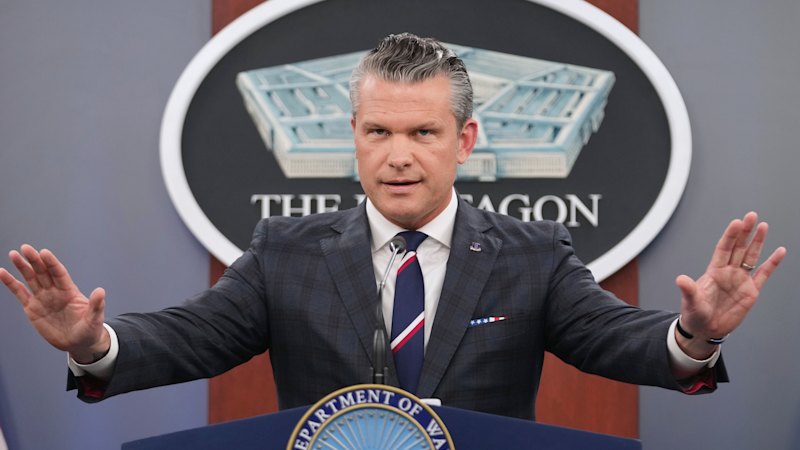
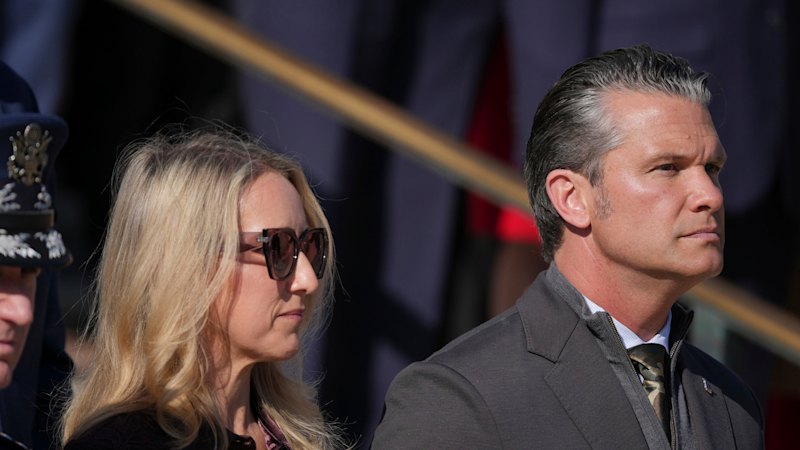
Donald Trump stood before a Veterans Day crowd and drew a straight, unbroken line from a 1983 truck bombing in Lebanon to modern military conflict with Iran. By linking the deaths of 241 American service members in Beirut to current hostilities with Tehran, he bypassed four decades of diplomatic nuance to frame ongoing confrontation as unfinished business. It was a calculated rhetorical maneuver designed to convert historical grief into immediate political capital.
History does not repeat itself, but politicians love to rhyme it when they need public backing for a fight.
For veterans of foreign policy reporting, watching a leader reach forty-plus years into the archives during a holiday speech is a familiar play. You take an unhealed national wound—one where American troops died in their sleep—and attach it to a contemporary adversary. Suddenly, complex geopolitical strategy collapses into a simple, visceral debt that demands collection.
The Architecture of a 43-Year-Old Grievance
To understand why the 1983 Beirut bombing carries such potent emotional weight, you have to look at the sheer scale of the failure that morning. On October 23, 1983, a Mercedes-Benz stake-bed truck packed with the equivalent of roughly 12,000 pounds of TNT crashed through the perimeter of the U.S. Marine barracks at Beirut International Airport. The blast collapsed the four-story concrete building in seconds, killing 220 Marines, 18 sailors, and three soldiers. Minutes later, a second suicide bomber struck the nearby Drakkar building, killing 58 French paratroopers.
It remains the single deadliest day for the United States Marine Corps since the Battle of Iwo Jima in 1945.
At the time, the Reagan administration was caught off guard by a new form of asymmetric warfare. Intelligence intercepts eventually pointed toward Tehran. Specifically, the National Security Agency intercepted communications between Iranian intelligence officials in Tehran and the Iranian ambassador in Damascus, Ali Akbar Mohtashamipur, directing operatives to attack the multinational peacekeeping force. Those operatives would soon coalesce into Hezbollah, the Lebanese Shiite militia that Iran funded, armed, and trained to project power across the Levant.
Trump’s Veterans Day remarks seized on this established intelligence trail. By invoking Beirut, he reminded Americans that the shadow war between Washington and Tehran did not start with nuclear enrichment sites in Natanz, drone strikes in Iraq, or tanker seizures in the Strait of Hormuz. In his framing, the conflict began in 1983, and every subsequent skirmish is merely an extension of an unresolved crime.
Strategic Memory vs. Historical Reality
Politicians rarely invoke history for the sake of accuracy. They invoke it for utility. While the Iranian link to the 1983 barracks bombing is documented—and later affirmed by U.S. federal courts in billion-dollar civil judgments against the Islamic Republic—using that event as a direct justification for modern military escalation ignores the messy reality of why Marines were in Lebanon in the first place.
In 1982, Israel invaded southern Lebanon to drive out the Palestine Liberation Organization. Washington deployed Marines as part of a multinational force to oversee the PLO’s evacuation, pulled them out, and then sent them back after the Sabra and Shatila massacre. What began as a neutral peacekeeping mission rapidly morphed into active military support for the Christian-dominated Lebanese Armed Forces against Druze and Shiite militias. When the U.S. Navy battleship USS New Jersey began shelling militia positions in the Shuf Mountains, American troops ceased to be neutral peacekeepers in the eyes of local factions and their Iranian backers.
Reagan himself eventually recognized the trap. Less than four months after the bombing, in February 1984, he ordered the withdrawal of U.S. forces from Beirut. He chose disengagement over escalation, concluding that the strategic cost of staying outweighed any achievable objective.
Trump’s Veterans Day rhetoric inverts that lesson entirely. Where Reagan saw a quagmire that required an exit, Trump presents Beirut as a debt that went unpaid for four decades because previous presidents lacked the nerve to collect.
The Mechanics of Moral Framing
Why does this framing work so well on a domestic audience? Because modern foreign policy debates are notoriously abstract. Try explaining the technicalities of the Joint Comprehensive Plan of Action, centrifuge cascades, or the Islamic Revolutionary Guard Corps Quds Force procurement networks to a voter worried about grocery prices. You will lose the room in thirty seconds.
Now talk about 241 young Americans killed in their barracks before sunrise.
That is concrete. It requires zero technical background to understand, and it shifts the moral burden immediately. Anyone who argues for diplomatic restraint or de-escalation with Tehran is suddenly cast as someone willing to ignore the blood of fallen Marines. In political communication, tying a current policy objective to a foundational historical grievance immunizes the speaker against standard cost-benefit critiques. You are no longer debating whether a strike on Iranian infrastructure will spike global oil prices or trigger regional retaliation; you are honoring the dead.
What the Veterans Day Speech Leaves Out
When a leader uses a ceremonial platform to connect past casualties to present conflict, the omissions tell you more than the talking points. Several critical realities vanish when Beirut 1983 is grafted directly onto modern Iran war rhetoric.
- The Evolution of the Proxy Network: In 1983, Hezbollah was a nascent, loosely organized collection of radicalized factions operating out of the Bekaa Valley with Syrian acquiescence. Today, the Axis of Resistance is a sprawling, multi-theater network spanning Lebanon, Iraq, Syria, and Yemen. A direct military confrontation with Iran today does not look like a targeted retaliatory strike on a training camp in Baalbek; it involves simultaneous missile, drone, and maritime threats across multiple choke points, including the Red Sea and the Persian Gulf.
- The Domestic Political Calendar: Veterans Day is not a policy rollout event; it is a values-affirmation event. Delivering hardline foreign policy linkages on a holiday dedicated to military sacrifice wraps partisan or executive strategy in the flag. It forces opponents to either stay silent or risk appearing disrespectful on a sacred national observance.
- The Question of Presidential Restraint: Throughout his political career, Trump has walked a tightrope between isolationist impulses—denouncing "endless wars" in Iraq and Afghanistan—and aggressive posture toward Iran, highlighted by his 2020 decision to authorize the drone strike that killed Quds Force commander Qasem Soleimani. Linking Beirut to current hostilities allows him to square that circle. He can claim he still opposes nation-building quagmires while insisting that hitting Iran is pure, overdue retaliation rather than a war of choice.
The Echo Chamber of Escalation
Consider a hypothetical scenario to see how this rhetorical chain operates in practice. Imagine a regional commander in the Pentagon assessing force posture in the Middle East while reading transcripts of White House speeches. When the commander-in-chief publicly frames a current standoff as the continuation of a 43-year-old blood debt, it narrows the diplomatic off-ramps available to negotiators in Oman or Qatar. Tehran reads those transcripts just as closely as Washington does.
To Iranian leadership, linking 1983 to the present signals that no tactical concession—not a freeze on uranium enrichment, not a pause in proxy attacks—will satisfy Washington, because the grievance itself is existential and historical. Once a conflict is defined by permanent historical wounds rather than solvable current behaviors, both sides prepare for attrition rather than compromise.
The Legal and Financial Shadow
There is also a quieter, often overlooked mechanism keeping the 1983 Beirut bombing alive in American policy circles: the federal courts. Over the past two decades, families of the Beirut victims have waged a relentless legal campaign under the Foreign Sovereign Immunities Act state-sponsor-of-terrorism exception.
Judges have awarded billions of dollars in damages against Iran, leading to high-stakes battles over frozen Iranian central bank assets held in Western financial institutions. Every time a court orders the turnover of seized funds to Beirut survivors, the legal system reinforces the exact narrative Trump voiced on Veterans Day—that Iran is an unrepentant debtor whose 1983 actions remain an active, open file in American governance.
Why This Matters Now
Veterans of Washington’s foreign policy establishment know that wars rarely start because of a single speech. They start when the public vocabulary shifts to make conflict feel inevitable, righteous, and long overdue.
By pulling the rubble of the Beirut Marine barracks into a Veterans Day address, Trump did not announce a new military doctrine or reveal fresh intelligence. He did something far more consequential for public perception. He collapsed forty-three years of complicated, contradictory Middle Eastern history into a single moral ledger, leaving the American public to stare at an unpaid balance written in 1983.