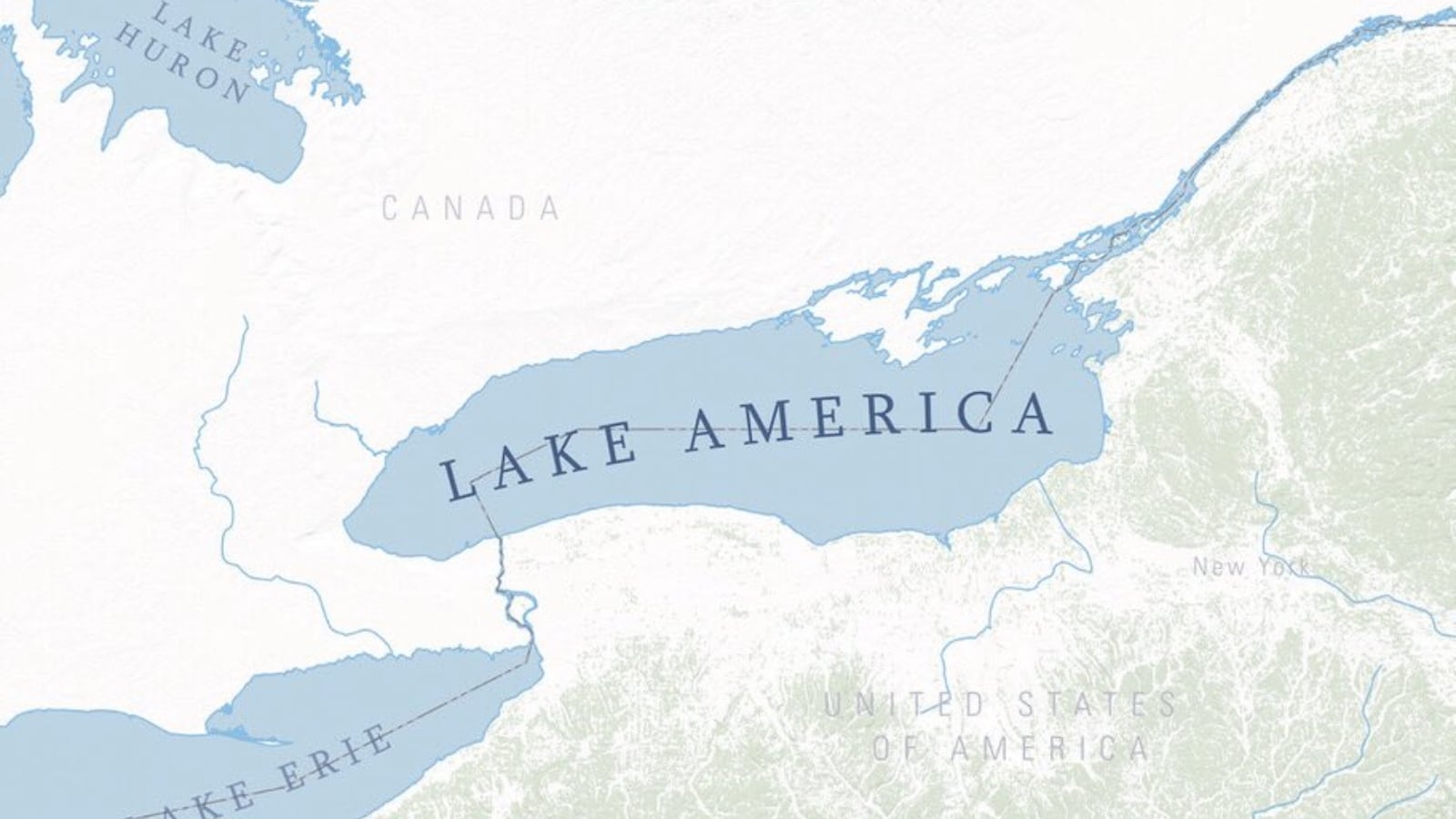
You can't just redraw a border on a map and expect reality to bend to your will, but that hasn't stopped Washington from trying. President Donald Trump signed an executive order directing federal agencies to officially refer to Lake Ontario as Lake America.
This move isn't just a quirky cartographic exercise. It is a calculated escalation in a brutal economic war with our northern neighbor. Trade negotiations between the United States and Canada collapsed after three days of intensive talks. Almost immediately, the White House slapped 50 percent tariffs on roughly $20 billion in Canadian imports, spanning whisky, dairy, and hockey sticks.
Renaming Lake America is the psychological follow-up punch to a heavy economic brawl.
The Mechanics of a One-Sided Name Change
If you are wondering how this actually works in practice, the execution is narrow. Under the new executive order, the Department of the Interior and its geographic naming services have a thirty-day window to update federal maps and internal systems.
It mirrors the administration's playbook from last year, when the Gulf of Mexico was officially designated the Gulf of America for U.S. federal documents.
The limitations are obvious to anyone who understands international geography. Lake Ontario is a shared body of water. Roughly 52 percent of its surface area sits inside Canadian boundaries, while the rest borders New York State.
An executive order signed at the Resolute Desk changes how U.S. federal agencies write reports. It does not change international law, nor does it force private mapmakers, global organizations, or foreign governments to update their globes.
Why Ottawa and New York Are Rolling Their Eyes
Canadian leadership didn't waste time pushing back. Prime Minister Mark Carney pointed out that the 400-year-old name originates from the Wendat word Ontari'io, translating roughly to "the lake is beautiful, the lake is big". He noted that the title predates both the Canadian Confederation and the American Declaration of Independence.
Provincial and state leaders also rejected the new moniker instantly. Ontario Premier Doug Ford dismissed the move out of hand. Even locally, New York Governor Kathy Hochul made it clear that her state won't adopt the federal terminology.
When the local stakeholders who actually fish, ship, and live along the shoreline refuse to use a new name, the policy exists entirely on paper.
The Escalating Tariff Reality
Names matter less than the numbers driving this feud. The breakdown in trade talks has unleashed a tit-for-tat protectionist cycle. Canada announced matching tariffs on hundreds of U.S. goods.
Supply chains are bracing for impact. Manufacturing costs on both sides of the border are creeping upward because politicians cannot compromise on trade terms. When consumer goods face 50 percent taxes overnight, renaming a landmark serves as a loud distraction from the domestic economic friction.
Trump even hinted that oceans could be next on the renaming agenda, joking about altering the Atlantic or Pacific.
Yet cartography won't fix a broken trade deal. Real economic pressure requires actual diplomacy, not a Sharpie and a revised federal database. Until Washington and Ottawa return to serious negotiations, Lake America will remain a U.S. government internal designation while the rest of the world keeps calling it what it has always been.


