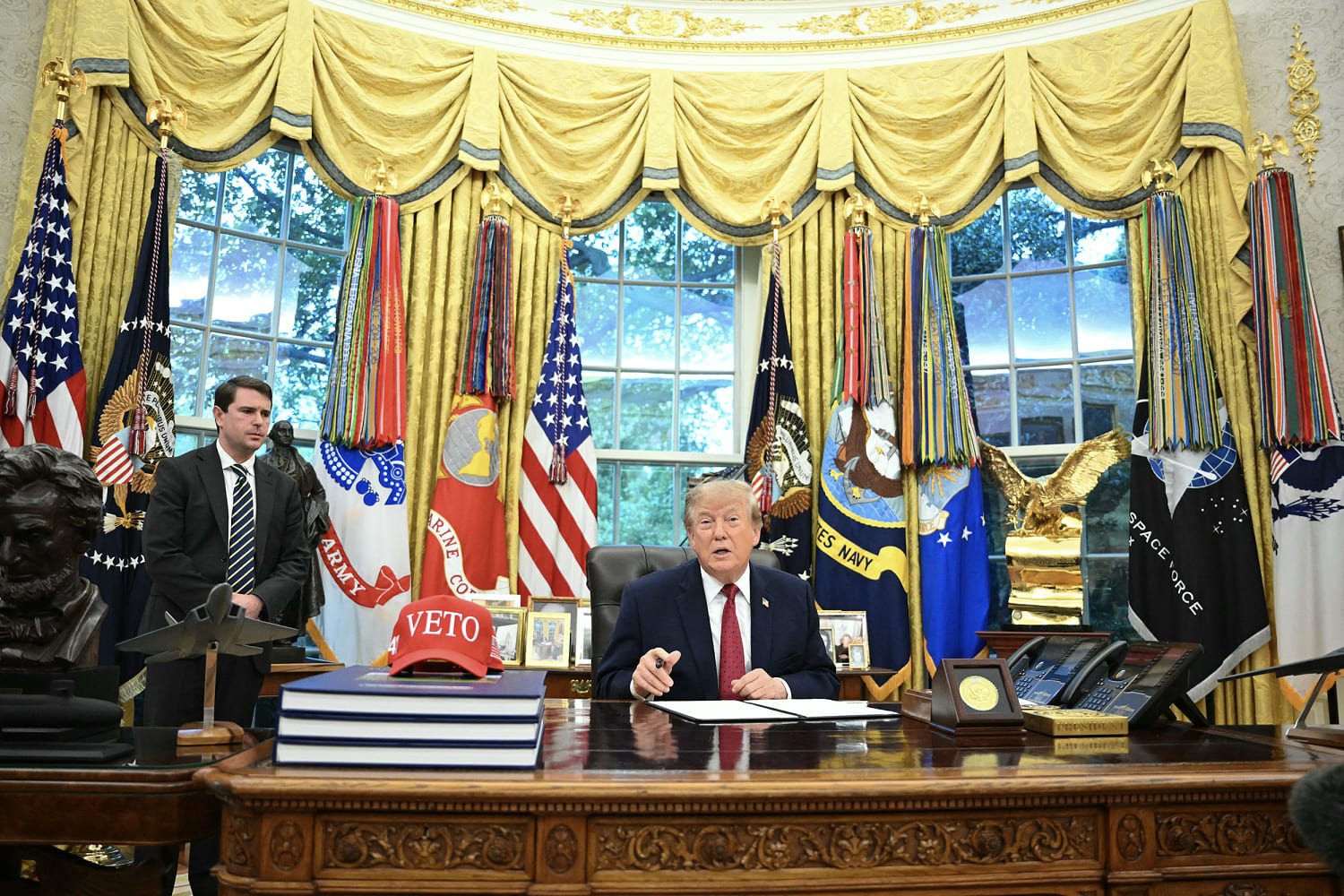
In the immediate aftermath of the midterm elections, President Donald Trump spent consecutive public appearances dissecting White House interior design, architectural renovations, and the aesthetics of the executive mansion rather than delivering traditional post-election policy post-mortems. According to reporting summarized in the headline "Trump focuses on White House decor for second straight day in post-midterm remarks," this fixation on curtains, carpeting, and chandeliers is not an accidental tangent—it is a deliberate communication habit rooted in his background as a real estate developer and his instinct for controlling media narratives during high-stakes political moments.
To understand why a president would pivot from ballot counts and legislative math to fabric swatches and gilding, you have to stop looking at the podium through the lens of traditional Washington consultancy. Standard political operatives treat the days following a midterm election as a time for solemn calibration. They expect talking points about voter mandates, bipartisan outreach, or aggressive legislative pivots. Trump has rarely operated by that manual. For decades, long before entering politics, his primary metric of power, prestige, and competence was physical space.
The Developer’s Instinct in the West Wing
When Donald Trump looks at the White House, he does not merely see a historic museum or a bureaucratic headquarters. He sees a flagship property.
Throughout his career in Manhattan real estate, Trump treated interior finishes as tangible proof of executive success. Marble lobbies, brass fixtures, and custom drapery were never treated as trivial background details; they were the central brand proposition. Bringing that mindset into the presidency means viewing the physical condition of the Executive Mansion as a direct reflection of the administration's standing. If a room looks worn, dated, or poorly lit, to a builder, that signals institutional decline. Fixing it—and talking about fixing it—becomes an exercise in demonstrating hands-on control.
Critics and political analysts frequently interpret these remarks as a distraction tactic. When election results produce mixed signals or complicated congressional arithmetic, shifting the spotlight to a non-ideological, visually concrete topic denies opponents an easy policy target. Yet framing the behavior purely as cynical deflection misses half the picture. Journalists who have covered Trump since the 1980s note that his fascination with renovation details—from the grade of stone to the placement of portraits—is entirely genuine. He enjoys the granular mechanics of physical refurbishment far more than the abstract language of committee markups.
Precedent and the Politics of the Mansion
Trump is hardly the first president to obsess over the appearance of 1600 Pennsylvania Avenue, though his willingness to air those thoughts unscripted at press events sets him apart. Historically, first families have treated White House renovations as quiet, curated legacy projects managed through historical associations and private fundraising.
- Jacqueline Kennedy famously transformed the mansion's interior in the early 1960s, framing her restoration as an effort to turn the building into a cohesive museum of American history, culminating in a televised tour that boosted the administration's cultural capital.
- Richard Nixon overhauled the press briefing room, covering the indoor swimming pool to accommodate a growing White House press corps—a structural change that permanently altered how journalists interacted with the presidency.
- Barack Obama and George W. Bush both oversaw significant Oval Office redecorations, swapping out rugs, wallpaper, and busts to signal tonal shifts in leadership without making the upholstery the centerpiece of their post-election speeches.
What distinguishes Trump’s approach is the removal of the curtain between the private renovation and the public stump speech. Rather than leaving design choices to a press release from the White House Historical Association, he narrates the process himself, treating the public and the press corps like prospective tenants being walked through a newly renovated penthouse.
How Media Ecosystems Amplify the Aesthetic Pivot
The media reaction to consecutive days of decor commentary follows a predictable cycle. Cable news panels and political newsletters seize on the contrast between the gravity of a midterm election and the apparent lightness of interior decorating. Commentators question whether the president is out of touch with kitchen-table economic concerns or attempting to bury unfavorable electoral takeaways beneath viral soundbites.
That reaction, however, is precisely what gives the tactic its durability. In an attention economy driven by friction and novelty, a standard speech about infrastructure funding or tax policy disappears from the news cycle within hours. A president riffing at length about the quality of White House drapes or the restoration of historic rooms generates clips, social media debate, and endless punditry. It forces reporters to cover the spectacle while relegating traditional political analysis to the margins.
Supporters view this candidness differently than detractors do. To his base, unscripted digressions about the state of the White House reinforce the image of an outsider who refuses to speak in sanitized, focus-grouped platitudes. In their reading, a president who notices peeling paint or subpar furnishings is someone paying attention to details that career politicians ignore, treating taxpayer-funded landmarks with the same scrutiny he would apply to a private hotel.
The Strategic Cost of Unscripted Detours
Still, governing by aesthetic commentary carries tangible political risks, particularly in the wake of a midterm cycle when party lawmakers are looking for clear directional signals.
Members of Congress facing the immediate realities of a new legislative session rely on the White House to set a disciplined agenda. When the top of the ticket spends consecutive news cycles discussing architectural trim rather than legislative priorities, vulnerable incumbents and party strategists are left without a unified message to take back to their districts. Over time, repeated detours into personal tastes can complicate efforts to keep coalition partners focused on complex policy negotiations, especially when economic anxieties or foreign policy crises demand sustained presidential focus.
There is also the matter of historical framing. Presidential remarks are archived verbatim, read decades later by historians trying to reconstruct the priorities of an era. A post-midterm transcript dominated by commentary on interior finishes creates a striking dissonance when placed alongside the legislative and economic challenges of the moment.
Reading the Signals Behind the Rhetoric
For observers trying to decode what comes next in the second half of a presidential term, treating decor remarks as mere fluff is an analytical mistake. In political communication, what a leader chooses to talk about when the teleprompter is off reveals their core instincts far more accurately than a scripted address ever could.
The post-midterm focus on the White House itself underscores a presidency that views power in personal, tangible, and visual terms. Whether framed by critics as an avoidance of tough electoral questions or viewed by allies as authentic, unfiltered leadership, the message remains consistent: the man occupying the building intends to leave his physical and stylistic imprint on every square foot of it, regardless of what the political calendar says he should be talking about.