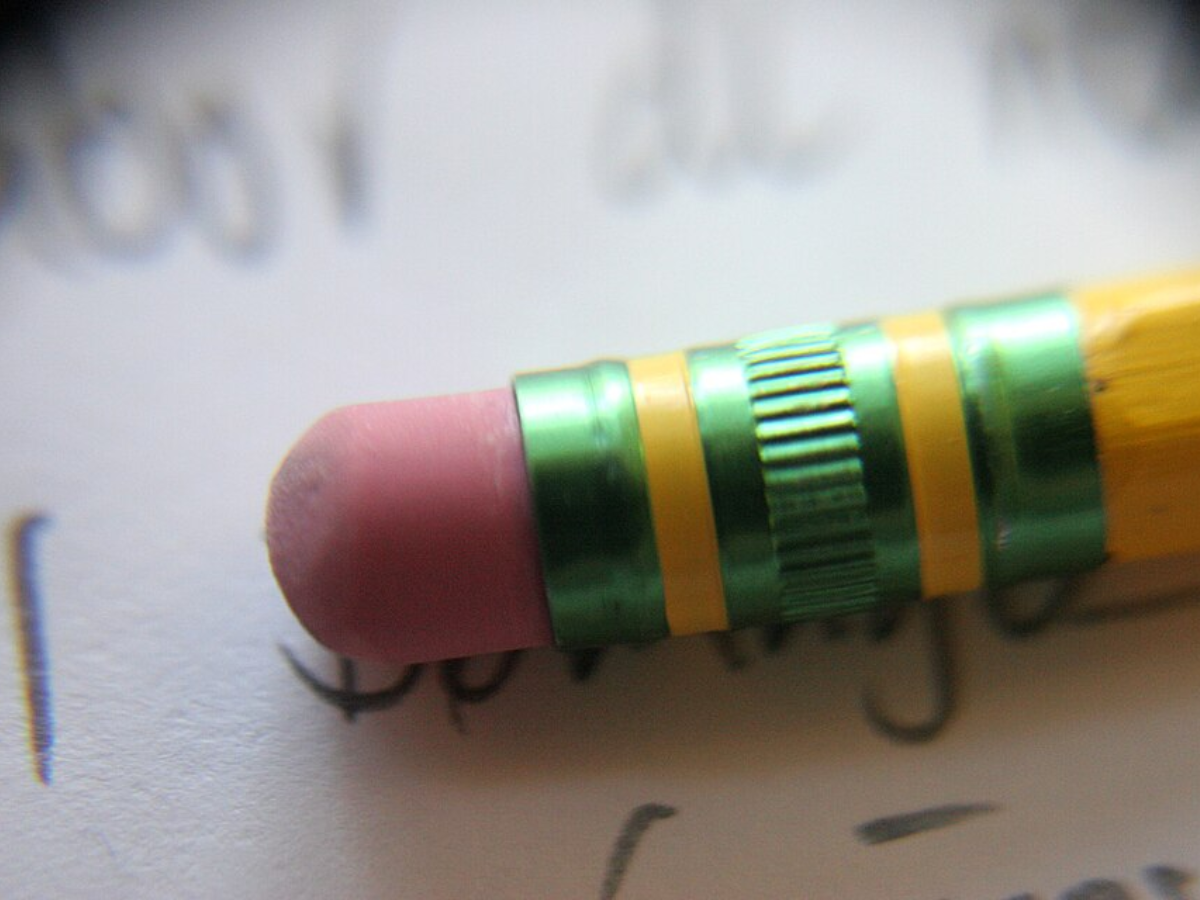
The common pencil eraser is not a passive scraping tool; it is a sacrificial polymer matrix engineered to exploit a precise hierarchy of adhesive forces. Standard writing relies on the mechanical shear of graphite sheets onto the fibrous, porous network of paper. Reversing this process requires an engineered material that introduces a higher affinity for graphite than the paper substrate possesses, while simultaneously managing the thermal and mechanical stresses of friction.
To understand erasure is to analyze a localized material failure sequence. The process operates within a closed tribological system governed by three distinct variables: abrasive friction, interfacial adhesion, and controlled cohesive failure. When an eraser fails, it is rarely due to a lack of effort; it is a failure to balance these three physical vectors. For a different look, see: this related article.
The Mechanical Triad of Graphite Removal
Every instance of erasure requires the systematic execution of three sequential phases. If any phase fails to achieve its threshold, the graphite remains embedded, or the substrate undergoes catastrophic structural failure.
[Phase 1: Friction & Desorption] ---> [Phase 2: Interfacial Adhesion] ---> [Phase 3: Cohesive Shedding]
(Breaking Paper-Graphite Bonds)        (Capturing Particles in Matrix)      (Self-Cleaning Roll-up)
1. Tribological Friction and Desorption
Graphite deposits onto paper through van der Waals forces and mechanical entrapment within cellulose microfibers. To remove these particles, the eraser must first deliver sufficient localized shear stress to overcome this initial adhesion energy. As the rubber or plastic matrix moves across the surface, it generates kinetic friction. This friction temporarily lowers the structural integrity of the substrate's superficial layer, allowing the embedded graphite flakes to dislodge from the paper fibers. Further coverage on this matter has been shared by The Verge.
2. Interfacial Adhesion Superiority
The core mechanism of erasure relies on a strict thermodynamic hierarchy: the adhesive affinity between the eraser matrix and graphite must exceed the adhesive affinity between the paper fibers and graphite. Eraser formulations utilize elastomers and plasticizers that exhibit high surface energy and conformability at the microscopic level. This allows the tool to deform into the microscopic valleys of the paper, wrapping around the graphite particles and bonding with them chemically and mechanically.
3. Cohesive Failure and Crumble Formation
A major failure mode in surface cleaning is the re-deposition of contaminants. Erasers circumvent this through intentional low cohesive strength. As the polymer matrix captures graphite, the shear stress of the stroke causes the material to fail structurally in a controlled manner. The eraser shreds, rolling up into small crumbs that encapsulate the spent graphite. This self-cleaning cycle continuously exposes a pristine, uncontaminated polymer surface for the next stroke.
Material Formulations and Their Performance Profiles
Not all erasers utilize the same chemical frameworks. The industry relies on three primary material archetypes, each presenting distinct trade-offs between paper degradation, erasure efficiency, and mechanical wear rates.
Vulcanized Rubber (The Traditional Paradigm)
Pink or red rubber erasers rely on vulcanized vegetable oil (factice) combined with synthetic or natural rubber and heavy mineral fillers like pumice.
- The Mechanism: The pumice acts as a micro-abrasive, physically wearing down the paper fibers to release deeply embedded graphite.
- The Bottleneck: This formulation exhibits low material conformity. It compensates for poor chemical adhesion by increasing mechanical abrasion. Consequently, vulcanized rubber erasers cause high rates of substrate fatigue, tearing paper fibers and thinning the page over repeated cycles.
Polyvinyl Chloride (The High-Precision Polymer)
Often marketed as "plastic" or "vinyl" erasers, polyvinyl chloride (PVC) formulations represent a significant chemical upgrade over vulcanized rubber. These tools are heavily plasticized with phthalates or alternative polymer softeners to achieve extreme flexibility and surface tack.
- The Mechanism: PVC erasers operate almost exclusively on the principle of high interfacial adhesion. The material deforms readily under minimal pressure, entering the microscopic crevices of the paper to lift graphite without grinding the underlying cellulose.
- The Bottleneck: The crumbs produced by PVC are highly cohesive, rolling together into neat strands rather than scattering. This minimizes clean-up but increases the rate of tool consumption. Furthermore, unreacted plasticizers in PVC can migrate into adjacent plastics over time, softening and damaging storage containers if left in contact.
Art Gum (The Low-Stress Sacrificial Matrix)
Art gum erasers are composed almost entirely of highly crumbly, soft vulcanized rubber with minimal binding agents.
- The Mechanism: They possess incredibly low cohesive strength. The slightest friction causes the material to disintegrate into a fine powder. This powder acts as a dry cleaning agent, absorbing surface graphite and oils without altering the surface texture of fragile substrates.
- The Bottleneck: The kinetic energy is entirely absorbed by the material's destruction. While this protects thin or historic paper, it renders the art gum eraser highly inefficient for dense, high-mass graphite deposits, requiring massive material volume to clear small areas.
The Boundary Conditions of Substrate Damage
The limits of erasure performance are defined by the physical properties of the paper substrate. Paper is an anisotropic web of cellulose fibers held together by hydrogen bonds and sizing agents (such as starch or rosin).
When an eraser is applied, it exerts both vertical force ($F_v$) and horizontal shear force ($F_s$).
   Eraser Motion ------> [Fs (Shear Force)]
   ===================
  |   Eraser Matrix   |
   ===================
          ↓ [Fv (Vertical Force)]
   -------------------
  ~~~~~~~~~~~~~~~~~~~~~  <-- Paper Surface Layer (Cellulose Web)
   -------------------
The structural integrity of the paper is maintained as long as the internal cohesive forces of the cellulose web exceed the shear force applied by the eraser:
$$\text{Cohesive Strength}_{\text{Paper}} > F_s$$
If a hard, abrasive vulcanized rubber eraser is used, $F_s$ quickly spikes, exceeding the binding energy of the paper sizing. The result is the physical delamination of the top layer of cellulose fibers. Once these fibers are frayed, the paper loses its smooth finish, creating a highly porous surface that causes subsequent graphite lines to feather and bleed uncontrollably.
Conversely, highly plasticized vinyl erasers minimize $F_s$ by relying on high surface contact area and chemical affinity, keeping the mechanical stress safely below the paper's damage threshold.
Systemic Failures: Why Certain Marks Resist Erasure
The failure to erase a mark cleanly is rarely an issue of tool quality; it is typically an incompatibility within the chemical system of the mark itself.
The Problem of Polymer-Based Leads
Traditional pencil leads are mixtures of graphite and clay fired at high temperatures, leaving a brittle carbon deposit that rests loosely on paper fibers. Modern mechanical pencil leads, however, frequently incorporate polymer binders like synthetic resins to prevent breakage at thin diameters.
These polymer-infused marks do not merely rest on the paper; they form a semi-permanent bond with the cellulose sizing. Standard erasers cannot match the binding energy of these modern resins, leaving behind a permanent gray ghost image.
Ink and Solvent Penetration
Colored pencils and ballpoint pens introduce waxes, oils, and dyes into the matrix. Unlike dry graphite, which remains superficial, these liquid or low-melting-point solid vehicles migrate deeply into the paper core via capillary action.
Because an eraser can only interact with particles accessible at the immediate surface interface, it cannot contact or adhere to sub-surface dyes. Attempting to erase these marks using standard tools merely smears the wax or tears the paper down to the depth of the ink penetration.
Operational Blueprint for Surface Decontamination
To achieve complete graphite removal without inducing substrate degradation, optimize the erasure process by matching material mechanics to the specific graphite density and paper weight.
- For High-Mass, Low-Pressure Graphite (Drafting/Sketching): Deploy a high-plasticity PVC vinyl eraser. Apply uniform, unidirectional strokes rather than a back-and-forth scrubbing motion. This maximizes the alignment of the polymer chain strands, allowing them to lift graphite while maintaining low shear stress on the paper web.
- For Delicate, Low-Density Fibers (Historic/Tracing Paper): Utilize a soft art gum or a kneaded rubber eraser. Instead of sliding the material across the surface, use a vertical blotting or dabbing technique. This eliminates horizontal shear force entirely, relying purely on the static adhesive differential between the elastomer and the graphite to lift the carbon away from the fragile cellulose matrix.