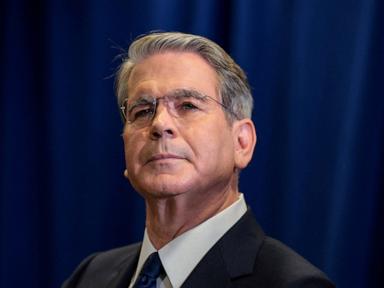
Treasury Secretary Scott Bessent has relocated to a military installation in the Washington, D.C. area following heightened security concerns and logistical demands tied to his cabinet role, according to multiple reports citing administration and defense officials. The move places the nation's top economic official inside a fortified perimeter—a step historically reserved for defense chiefs and national security principals, yet increasingly common among senior civilian officials navigating a volatile threat environment.
The Mechanics of Base Housing for Civilian Officials
Moving a cabinet secretary onto a military base is not as simple as handing over a set of keys. It requires a formal interagency agreement, a reimbursement structure, and a clear statutory justification. Learn more on a similar topic: this related article.
Under federal regulations governing government-furnished quarters, civilian agency heads do not automatically qualify for military housing. When a cabinet member takes up residence at an installation like Joint Base Myer-Henderson Hall or Fort Lesley J. McNair—the two primary enclaves for top brass in the National Capital Region—the hosting service branch must certify that the arrangement serves a direct operational or security purpose.
The money trail matters here. Federal law prohibits the Department of Defense from subsidizing the personal living expenses of civilian cabinet officers out of standard military appropriations. Consequently, the Treasury Department or the official personally must reimburse the Pentagon at rates determined by the Office of Management and Budget, often benchmarked against local fair-market rental values for comparable executive residences. More reporting by BBC News highlights comparable views on this issue.
Security upgrades add another layer of complexity. Even inside a gated installation with armed Military Police at every access control point, the Diplomatic Security Service or the Treasury's own protective detail—the Office of the Secretary Protection Detail, staffed by special agents—must conduct a comprehensive vulnerability assessment. They inspect sightlines, reinforce windows, install secure communications equipment known as Sensitive Compartmented Information Facilities, or SCIFs, and establish dedicated evacuation routes.
Why Civilian Cabinet Members Are Moving Behind the Wire
To understand why a Treasury Secretary would trade a private Georgetown townhouse or a sprawling suburban estate for military quarters, you have to look at how the job itself has changed over the past two decades.
The modern Treasury Department is no longer just a tax collector and debt manager. Through the Office of Foreign Assets Control and the Committee on Foreign Investment in the United States, the Treasury Secretary wields some of the most aggressive national security tools in the federal arsenal. Financial sanctions, secondary banking restrictions, and asset freezes have become primary instruments of American foreign policy, placing the Treasury chief squarely in the crosshairs of hostile foreign intelligence services and transnational networks.
Domestic threat vectors have expanded just as rapidly. Law enforcement agencies have documented a sharp rise in targeted harassment, doxxing, and physical threats directed at senior executive branch officials and their families. Protecting a high-profile principal in a dense, civilian neighborhood creates immense operational friction for federal agents.
Consider the logistics of a standard residential street in Northwest Washington. Protective details must secure adjacent properties, coordinate with local Metropolitan Police patrols, manage motorcade staging areas that block neighborhood traffic, and monitor every delivery vehicle and pedestrian passing the front gate. It is expensive, manpower-intensive, and disruptive to neighbors who did not sign up to live next to a permanent security perimeter.
A military installation solves those problems overnight. Access is strictly controlled through biometric credentials and vehicle inspections. Airspace restrictions are already established. Emergency medical response and tactical backup are minutes away, integrated directly into the base command structure.
Historical Precedents and the Gray Areas of Precedent
Bessent is far from the first civilian official to seek shelter behind military gates, though the practice has always attracted scrutiny from government watchdogs and congressional oversight committees.
During the first Trump administration, several senior officials—including former Defense Secretaries Mark Esper and Jim Mattis, as well as former Secretary of State Mike Pompeo—lived in flag officer quarters on Fort McNair or Joint Base Myer-Henderson Hall. In those instances, proximity to the Pentagon and the State Department, combined with round-the-clock protective requirements, formed the core rationale.
The arrangement has occasionally sparked friction over optics and cost. Critics argue that housing civilian officials in historic quarters meant for four-star generals blurs the traditional line between civilian governance and military infrastructure. There are also recurring questions about transparency: exact rental agreements, renovation costs, and threat assessments are routinely shielded from public disclosure under national security and personal privacy exemptions to the Freedom of Information Act.
Yet supporters of the practice point out the alternative. Securing a private residence to federal protective standards often requires hundreds of thousands of dollars in taxpayer-funded improvements—fencing, guard booths, ballistic glass, and surveillance arrays—installed on private real estate that the government does not own. Moving an official into existing, high-security federal housing can actually reduce long-term expenditure while providing superior physical protection.
The Operational Reality of Life on Post
For an official accustomed to the autonomy of private life—particularly someone like Bessent, who spent decades operating in the private financial sector before entering public service—base living imposes a strict set of trade-offs.
Every visitor, from family members to personal contractors, must undergo advance vetting before clearing the main gate. Spontaneous social gatherings become logistical exercises. Morning commutes shift from navigating city avenues to moving inside coordinated protective convoys departing from hardened checkpoints.
At the same time, the arrangement streamlines the daily grind of crisis management. When global markets convulse overnight or an urgent sanctions package requires immediate sign-off, having secure, accredited communications infrastructure built directly into the residence eliminates the need to travel to the Main Treasury building across from the White House in the middle of the night.
The decision ultimately reflects a sober calculation about modern governance in Washington. As economic policy and national security continue to merge, the physical footprint of the officials managing both is retreating behind the perimeter.