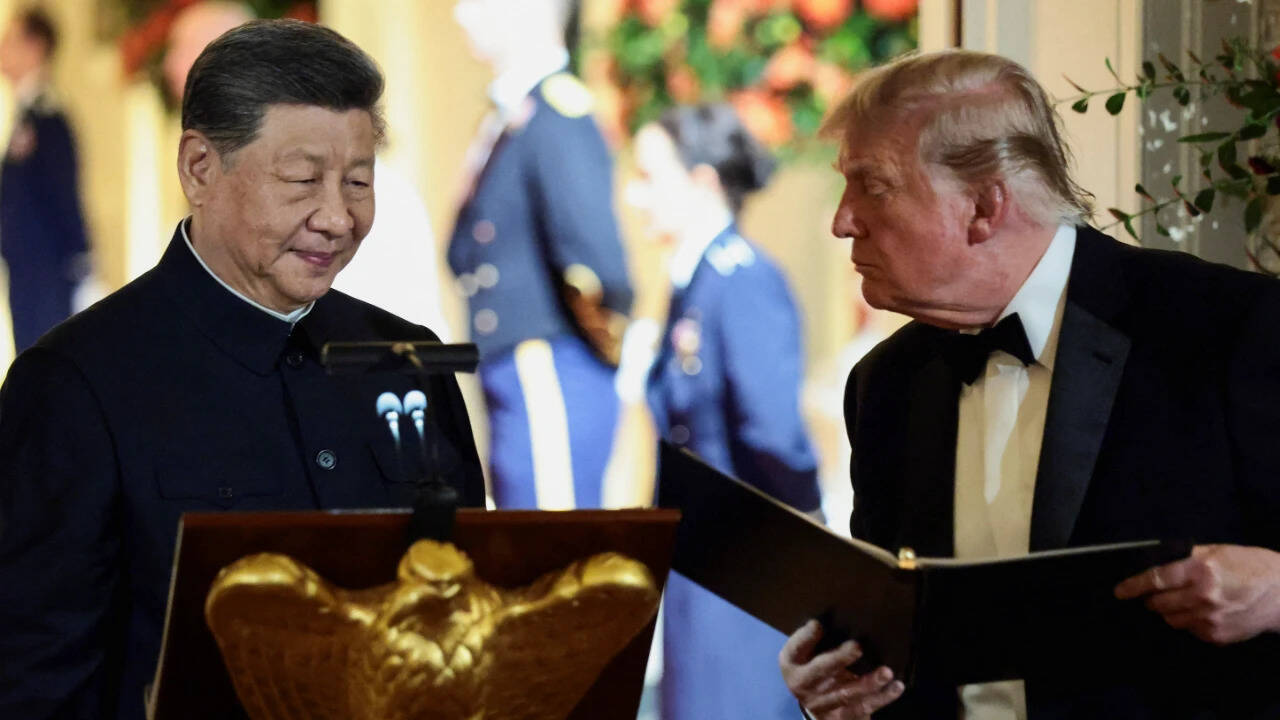
When Donald Trump and Xi Jinping raise glasses together at a White House state dinner, the cameras capture warmth, ceremony, and carefully scripted remarks about friendship between the world's two largest economies. Yet decades of diplomatic history show that friendly relations proclaimed over crystal and silverware rarely erase the structural rivalries sitting directly beneath the tablecloth.
The surface event is pure political theater. Both leaders understand that optics move markets, calm nervous allies, and buy breathing room at home. Behind the formal toasts, however, Washington and Beijing remain locked in long-running disputes over trade balances, semiconductor supply chains, military posturing in the Indo-Pacific, and competing visions of global influence. Meanwhile, you can find similar events here: What the Supreme Court Verdict on Danam Nagender Actually Means for Anti-Defection Law in India.
To understand what a state dinner between an American president and a Chinese leader actually accomplishes, you have to separate the choreography of diplomacy from the mechanics of power.
The Anatomy of State Dinner Diplomacy
State dinners are the highest form of protocol the White House can offer a visiting head of state. Every detail—from the guest list in the East Room to the menu and musical entertainment—is calibrated by the State Department and the White House Social Office to signal respect and political weight. To understand the complete picture, check out the detailed report by The Guardian.
For a Chinese leader, accepting an invitation to Washington carries immense domestic value. State media in Beijing routinely frame these images as proof that the United States treats China as an indispensable equal on the world stage.
For an American president, hosting the Chinese leader demonstrates command of high-stakes foreign policy. Even critics who demand a tougher line on Beijing recognize that direct leader-to-leader contact remains the primary mechanism for preventing miscalculation between two nuclear-armed powers.
Still, protocol is not policy. A warm reception can lower the temperature in the room, yet it cannot rewrite export control regulations or resolve territorial claims in the South China Sea.
Why Both Leaders Need the Optics of Cooperation
Diplomatic warmth rarely happens by accident. It emerges when both sides face domestic or international pressures that make confrontation temporarily expensive.
Economic Pressure on Both Sides of the Pacific
The American and Chinese economies remain deeply entangled despite years of talk about decoupling. American farmers rely on Chinese purchases of soybeans, pork, and grain, while U.S. manufacturers and retailers depend on Chinese components and consumer goods.
At the same time, China's economy faces persistent headwinds, including a prolonged property sector slump, local government debt, and sluggish domestic consumption. Access to Western markets and capital remains vital for stabilizing growth.
When Trump and Xi emphasize mutual respect and cooperation at a state dinner, business leaders in New York, Shanghai, and Tokyo take notice. Even modest signals of stability can temporarily steady currency markets and ease fears of sudden tariff escalations.
Managing Domestic Audiences
Both leaders also speak to audiences far beyond the banquet hall. In the United States, voters are divided between those worried about inflation and supply chain disruptions and those demanding aggressive action against Chinese industrial subsidies and intellectual property practices.
By projecting personal rapport with Xi while maintaining leverage through tariffs and trade negotiations, a U.S. president can argue that strength produces dialogue. Meanwhile, Xi can present himself to the Chinese public as a statesman capable of managing Washington without compromising core national interests.
What the Warm Rhetoric Leaves Unresolved
History offers plenty of warnings against confusing banquet diplomacy with lasting breakthroughs. Past U.S.-China summits—from the Nixon era through the Obama and first Trump administrations—have repeatedly produced upbeat communiqués followed within months by renewed friction.
Several structural flashpoints remain untouched by ceremonial goodwill:
- Technology and Semiconductors. Washington continues to restrict China's access to advanced microchips and artificial intelligence hardware, viewing technological leadership as a direct matter of national security. Beijing views those restrictions as an effort to contain its rise and has poured billions into domestic alternatives.
- Trade Imbalances and Industrial Policy. U.S. officials across administrations have argued that Chinese state subsidies flood global markets with underpriced goods, from electric vehicles to solar panels and steel. Beijing counters that its industries succeed through scale, infrastructure, and innovation rather than unfair practices.
- Taiwan and Regional Security. No amount of diplomatic warmth changes Beijing's insistence that Taiwan is an inalienable part of China, nor Washington's commitment to maintaining peace across the Taiwan Strait and supporting its regional alliances with Japan, South Korea, and the Philippines.
- Global Governance and Alliances. China has expanded its diplomatic footprint through initiatives like BRICS and the Belt and Road Initiative, offering developing nations an alternative to Western-led institutions. The United States continues to reinforce traditional alliances and security partnerships to counter that reach.
Each of these disputes involves core national interests rather than simple misunderstandings. A single evening of conversation cannot bridge gaps that have widened over more than a decade.
The Historical Pattern of U.S.-China Summits
Veterans of Washington foreign policy recognize a familiar cycle in U.S.-China relations. Periods of sharp rhetoric, tariffs, and military tension often give way to high-level meetings designed to stabilize the relationship and establish guardrails.
During the 2017 summit at Mar-a-Lago and subsequent meetings in Beijing, Trump and Xi similarly emphasized personal chemistry and mutual respect. Within a year, however, the two nations were locked in the largest tariff battle in modern history.
The pattern repeats because personal rapport between leaders has real limits in two complex political systems. Even when a president and a general secretary reach an understanding over dinner, bureaucracies, legislatures, militaries, and business lobbies on both sides continue to pursue entrenched priorities.
In Washington, skepticism toward Beijing is one of the few issues that commands broad bipartisan support in Congress. Lawmakers routinely push for stricter investment screening, tighter export controls, and greater scrutiny of Chinese firms operating in the United States regardless of the tone set at the White House.
In Beijing, the Chinese Communist Party's long-term strategic plans—such as achieving technological self-reliance and modernizing the People's Liberation Army—operate on multi-decade timelines that outlast any single diplomatic summit.
How Analysts Measure Real Progress After the Cameras Leave
Seasoned observers rarely judge a state visit by the adjectives used in dinner toasts. Instead, they watch what happens in the thirty to ninety days after the motorcades depart.
Concrete indicators of genuine stabilization usually appear in quieter, technical channels:
- Resumption of Working-Level Dialogues. Real progress requires regular meetings between treasury officials, trade representatives, climate negotiators, and military commanders—not just photo opportunities at the top.
- Crisis Communication Channels. Direct military-to-military hotlines between theater commanders are essential for preventing accidental collisions at sea or in the air from spiraling into broader crises.
- Specific Commercial or Regulatory Actions. Tangible steps might include agricultural purchase commitments, predictable visa processing for journalists and students, or coordinated action against fentanyl precursors.
- Tone in State Media and Official Readouts. When Beijing and Washington publish readouts that emphasize shared goals rather than lecturing one another, it signals that both sides want to preserve diplomatic space.
If none of those follow-through mechanisms materialize, the state dinner functions primarily as a temporary pause button rather than a reset.
The Gray Area Between Partnership and Rivalry
Covering U.S.-China relations for any length of time teaches you to distrust absolute narratives. Washington and Beijing are neither on the verge of seamless partnership nor locked on an inevitable march toward conflict.
They operate in a dense, uncomfortable gray zone where intense competition coexists with unavoidable interdependence. Both countries share an interest in preventing financial crises, managing global debt, addressing climate risks, and avoiding direct military confrontation.
At the same time, neither capital is willing to yield ground on the technologies, alliances, and economic rules that will define the next century.
That tension explains why a White House state dinner can feature genuine smiles, warm toasts, and declarations of friendship while teams of lawyers, trade negotiators, and defense planners on both sides prepare for the next round of pressure. The champagne glasses are real, and so are the fault lines sitting just outside the dining room doors.