Two paces. Thirty-six inches of woven wool, vacuumed to a uniform nap by convention center staff at four in the morning, separating the two most heavily armed men on Earth.
In November 2017, inside a humid, air-conditioned hall in Da Nang, Vietnam, the choreography of the Asia-Pacific Economic Cooperation summit came down to the placement of a single dark suit. On one side stood Donald Trump, newly minted as the forty-fifth President of the United States, chin tilted, eyes scanning the room with the restless energy of a man used to owning the lighting in every ballroom he enters. On the other stood Vladimir Putin, shoulders slightly rounded, face arranged in that familiar, unreadable mask of studied detachment. Don't miss our recent post on this related article.
Between them stood Xi Jinping.
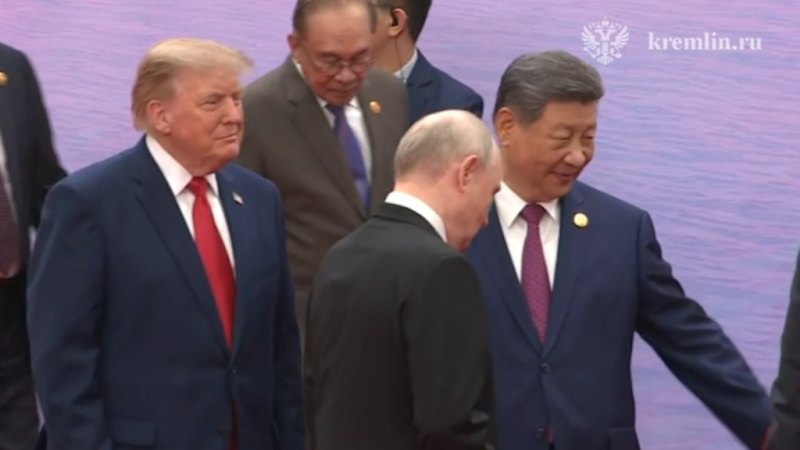
If you blinked while watching the broadcast feed, you missed it. Most people did. The headlines the next morning treated the moment as diplomatic trivia, a footnote to a summit already crowded with speeches about supply chains and tariffs. Protocol officers had arranged the twenty-one leaders of the Pacific Rim in alphabetical order by economy—or rather, by a carefully negotiated diplomatic sequence that placed the United States, China, and Russia in close proximity for the traditional "family photo." Yet when the leaders walked onto the risers, wearing the bespoke blue silk shirts provided by their Vietnamese hosts, Xi did not drift. He did not yield an inch of floor. He planted himself squarely in the center, forming a human firewall between Washington and Moscow. To read more about the context here, USA Today provides an informative summary.
Why? Because in international diplomacy, proximity is never an accident, and distance is never merely physical.
The Architecture of the Unspoken
To understand what happened on that riser in Da Nang, you first have to stop thinking of world leaders as ideological abstractions and start seeing them as anxious animals sharing a very small watering hole.
I spent a decade covering multilateral summits from press pens wedged behind velvet ropes, drinking lukewarm coffee out of paper cups while waiting four hours for a ninety-second photo op. When you watch enough of these gatherings from thirty feet away, you stop listening to the speeches. The speeches are written by committees of deputy ministers six months in advance; they are designed to say nothing in three thousand words. Instead, you watch the shoes. You watch who leans in when the microphones are off, whose jaw tightens when a translator hesitates, and who suddenly develops an urgent fascination with their cufflinks just to avoid making eye contact across a banquet table.
Protocol is the invisible grammar of power. Every inch of carpet is negotiated weeks before a plane touches down. A host nation’s foreign ministry employs dozens of specialists whose entire job is to ensure that two leaders who despise each other do not accidentally collide in a hallway outside the men’s room, or conversely, that two leaders who want to project intimacy are seated next to each other during the third course of dinner.
Consider a hypothetical scenario to see how this works in everyday life. Imagine you are hosting a family wedding, and your estranged uncle and your volatile cousin have been locked in a bitter lawsuit for three years. You cannot uninvite either of them without blowing up the entire family. So you spend four hours agonizing over the seating chart. You put them at different tables, angled away from the bar, and you ask your calmest, most reliable brother-in-law to sit at the edge of the aisle between them. Your brother-in-law doesn't have to say a word. His physical presence alone alters the geometry of the room. It tells both men: The floor belongs to the bride and groom tonight. Do not make a scene.
Now scale that wedding up until the two estranged relatives hold the launch codes to roughly ninety percent of the world's nuclear warheads, and the calm brother-in-law is the General Secretary of the Chinese Communist Party.
That was the geometry of Da Nang.
A Room Full of Ghosts
By the autumn of 2017, the relationship between Washington and Moscow had curdled into something toxic and deeply weird. Special Counsel Robert Mueller’s investigation into Russian interference in the 2016 presidential election was dominating every cable news broadcast in America. Back home in Washington, any handshake between Trump and Putin was treated not as routine statecraft, but as potential evidence in a political crime scene. Trump wanted a warm, television-ready moment that proved he could "get along" with strongmen where his predecessors had failed. His own national security team, terrified of the domestic backlash, was desperate to keep any encounter brief, formal, and heavily chaperoned.
Putin had his own script to protect. Having spent years portraying Russia as an indispensable global power that could not be isolated by Western sanctions, he needed the optics of equality. He wanted the cameras to capture the American president coming to him, seeking him out, acknowledging that nothing in Syria, Ukraine, or North Korea could be solved without Moscow’s blessing.
And then there was Xi.
Just weeks earlier, in October 2017, Xi Jinping had concluded the Nineteenth National Congress of the Chinese Communist Party in Beijing. His political thought had been written directly into the party constitution, elevating him to a stature no Chinese leader had held since Mao Zedong. He had arrived in Vietnam not merely as a participant in the APEC summit, but as the self-appointed standard-bearer of globalized trade—a role the United States had abruptly vacated when Trump pulled out of the Trans-Pacific Partnership on his third day in office.
Think about the psychology of that moment. America was turning inward, loud and unpredictable. Russia was revisionist, testing every boundary in Eastern Europe and the Middle East. China, by contrast, wanted the world to look at Beijing and see the adult in the room.
When the leaders gathered for the group photograph, the cameras were rolling live across four continents. Millions of viewers—from bond traders in Tokyo to defense analysts in Virginia—were watching for a single visual cue: would Trump and Putin find each other?
They did, briefly, at the edge of the stage. Trump walked over, extended a hand, and clapped Putin on the shoulder. They exchanged a few sentences without interpreters, leaning in close enough that lip-readers across the internet immediately went to work trying to decode the syllables. It lasted less than ten seconds.
Then the stage managers signaled for everyone to take their marks.
The Quiet Pivot
Watch the archival footage of that lineup again, and pay attention to the pacing.
Trump steps onto the blue carpet. Putin moves toward the center. For half a beat, there is an opening—a narrow corridor of empty space where the two men might naturally stand side by side, chatting casually while the photographers adjust their lenses. A thirty-second side-conversation on a live global feed would have instantly rewritten the headline of the entire summit. APEC would have vanished from the front pages, replaced by endless split-screen analysis of what Trump whispered to Putin and why Putin smiled.
Xi stepped straight into the gap.
He did not rush. He did not shove. He walked with the deliberate, heavy-footed calm of a man who has spent forty years surviving the labyrinthine politics of Chinese provincial and central bureaucracies, where survival depends on never revealing urgency. Xi took his place directly to Trump’s left, placing Putin immediately to his own left.
Look at the frame once everyone settles.
On the right: Trump, hands clasped in front of his belt buckle, staring straight ahead toward the bank of telephoto lenses. On the left: Putin, standing at a slight angle, his posture rigid, looking slightly past the cameras. And dead center: Xi, broad-shouldered in his blue silk tunic, smiling evenly, flanked by the leaders of the United States and Russia as though they were two wings of a building he had personally commissioned.
In visual terms, it was a masterclass in political framing. Without issuing a single press release, without raising his voice or altering his expression, Xi had turned a potential bilateral spectacle into a trilateral portrait in which Beijing held the center of gravity.
Why Three Feet of Space Matters
It is easy, sitting years later in the comfort of hindsight, to scoff at this kind of political theater. Does it really matter who stands next to whom for forty-five seconds in a Vietnamese convention center? Can a gap of three feet change the price of wheat, the trajectory of a missile, or the fate of a trade war?
Yes. And no.
Diplomacy operates on two distinct tracks at all times. There is the hard track of treaties, tariffs, troop deployments, and sovereign debt—the things you can measure on a spreadsheet. Then there is the soft track of perception, legitimacy, and momentum. The hard track moves slowly; it takes years to build a semiconductor factory or ratify a defense pact. The soft track moves at the speed of light.
When a mid-level diplomat in Jakarta, Seoul, or Canberra looks at that photograph from Da Nang, they do not see three men wearing matching shirts. They see a map of shifting power. They see an American president constrained by domestic turmoil, a Russian president eager for validation, and a Chinese president who looks entirely unbothered by either of them. Over time, hundreds of tiny impressions like that accumulate. They subtly influence which trade delegation gets the first meeting in a foreign capital, whose infrastructure loan looks safer over a twenty-year horizon, and which superpower seems to have the wind at its back.
That is the invisible stake of summit choreography. Every leader in that room knows it, which is why they fight so ferociously over details that look absurd to normal people.
At the 1945 Potsdam Conference, Joseph Stalin, Harry Truman, and Winston Churchill famously argued over who would walk through the doorway into the conference room first, eventually solving the impasse by having all three enter simultaneously through three separate doors. During the Paris peace talks to end the Vietnam War in 1968, negotiators spent more than two months—ten weeks while soldiers were dying in the jungle—arguing over the shape of the table, because a rectangular table implied two equal sides while a round table obscured the status of the South Vietnamese government.
Human beings are territorial creatures. Put a crown on our heads or a Secret Service detail behind our backs, and the ancient wiring in our brains still treats physical space as a direct measure of survival and dominance.
The Illusion of Control
Yet there is a quiet irony buried inside Xi’s smooth maneuver in Da Nang, one that becomes clearer the longer you stare at that photograph.
Summit choreography is designed to project total control over an unpredictable world. You control the lighting, the flags, the order of speakers, the distance between the chairs. For forty-five seconds, the leaders on the riser look like gods arranging the fate of nations with a nod and a handshake.
Step outside the convention center, though, and the illusion dissolves almost immediately.
Within months of that carefully staged photograph in Vietnam, the global order those twenty-one leaders were celebrating began to fracture along lines no protocol officer could contain. By the spring of 2018, Washington and Beijing were locked in the opening salvos of a full-scale tariff war that would rewrite global supply chains for a generation. A few years after that, a microscopic virus shut down the entire planet, turning multilateral summits into grids of pixelated faces on video screens where nobody could stand next to anybody at all. And in February 2022, tanks rolled across the border into Ukraine, shattering whatever fragile diplomatic equilibrium still existed between Moscow and the West, while pushing Beijing and Moscow into an awkward, asymmetrical embrace that neither side fully trusted.
Standing between two rivals on a carpeted riser is easy when the cameras are clicking. Standing between them when the artillery starts firing is another matter entirely.
I remember walking out of the media center in Da Nang late that evening after the family photo had been transmitted around the globe. The humidity outside felt like a warm wet blanket. Down by the Han River, local shopkeepers were pulling down their metal shutters for the night, oblivious to the geopolitical chess match that had just played out two miles away behind concrete barriers and rows of soldiers. A woman on a battered motor scooter stopped at a red light, balancing a plastic crate of dragon fruit between her knees, checking her phone with one hand while the neon reflections of the bridge shimmered on the dark water beside her.
She didn't care who stood on the left or the right on that stage. She cared whether the price of fuel would go up next month, whether her children would find good jobs in ten years, and whether the big countries across the ocean would manage to keep their tempers from burning down the neighborhood.
In the end, that is the real weight resting on those three feet of carpet. When leaders step onto a global stage and carefully measure the distance between themselves, they aren't just protecting their own pride or scoring points for their domestic audiences. They are testing whether the space between nations will be filled by quiet, steady restraint—or by the kind of collision nobody walks away from.
The cameras flash. The silk shirts rustle. The leaders step down from the risers, disappear into armored limousines, and fly back to their respective capitals. And the rest of us are left standing in the gap they left behind, hoping the distance holds.