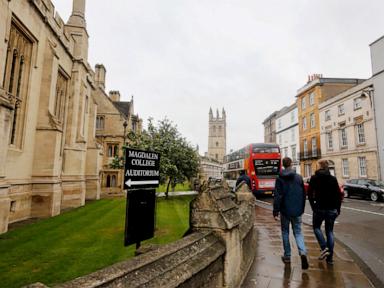
Thirty-two names appear on a press release, and within twenty minutes everyone forgets them.
That is the quiet tragedy of modern news cycles. A cohort of thirty-two Americans is named as Rhodes scholars—young women and men bound for Oxford, chosen out of thousands who wrote essays at two in the morning, sat across from stern committees with sweaty palms, and tried to compress a lifetime of ambition into a single dinner conversation. A wire story runs. Someone scrolls past over lukewarm coffee. Another batch of bright young people gets reduced to a neat statistical bucket: thirty-two scholars, broad interests, bright futures.
Boring.
I have stood in quiet libraries long after midnight, watching graduate students stare at glowing screens with heavy eyelids and cold mugs beside them, wondering what any of our notebooks actually cost the rest of the world. You do not spend years arguing over footnotes, equations, or archives without feeling a strange weight. You start asking yourself who gets to ask the big questions, and whether the questions we ask match the mess outside the window.
When thirty-two Americans earn the Rhodes Scholarship, the real story is not a list of resumes. It is a mirror held up to what we fear, what we cherish, and what we refuse to let go of. From debris circling high above our heads to paintings that survived centuries of war and damp air, these scholars carry obsessions that look eccentric on paper until you realize how tightly they are braided into everyday life.
The Quiet Orbit Above Every Screen
Look up at a clear night sky and you see stars. Above them, invisible to the naked eye, a swarm of metal moves faster than a rifle bullet.
Spent rocket stages. Flecks of paint. Dead satellites spinning silently in dark orbit. Space junk sounds like a joke until you think about what rides on orbital paths: weather warnings before a storm hits a coast, financial timing signals, global maps, emergency beacons when a hiker breaks a leg miles from a road. A single collision at orbital speeds can shatter hardware into thousands of new fragments, turning a clean lane into a minefield.
To make this concrete, let us use a hypothetical scenario rather than a real scholar's biography. Picture a fictional scholar named Maya, a sharp-eyed physicist who spent her college summers tracking radar blips and orbital decay. Maya does not see space junk as sci-fi trivia. She sees a shared highway with no traffic cops and no easy way to tow a wreck. If one careless launch or forgotten booster triggers a chain reaction, the consequences will not stay in orbit. They will show up in disrupted shipping lanes, delayed disaster relief, and bruised economies back on Earth.
Space debris is a metaphor for how humans treat every frontier we touch. We arrive with grand plans and leave behind our trash, assuming the sky—or the ocean, or the atmosphere—is wide enough to swallow it forever.
Yet thinking about orbital trash also forces a hard question about fairness. Who decides which satellites stay up and which old hulls get cleared away? A tiny island nation relying on satellite links for storm alerts has just as much at stake as a spacefaring superpower, yet far less say in orbital rules. Studying space junk is not escaping Earth. It is staring straight at human hubris from four hundred miles up.
Why Old Paint Still Matters in a Noisy Century
Now drop from orbit down to a gallery floor where floorboards creak under soft footsteps.
Art history often gets dismissed by skeptics as a luxury hobby for people who like gold frames and French names. Why spend years studying how pigments cracked in sixteenth-century workshops when people are arguing over housing costs, school budgets, and hospital wait times right now?
Fair question. Honestly, I used to wonder the same thing when I first sat through long lectures on brushwork and patronage. Art history can feel insular, trapped in jargon and hushed rooms.
Then you look closer at what a painting actually is. A canvas is a time capsule of power, belief, grief, and rebellion. Who paid for that altarpiece? Who was left out of the frame? How did a pigment travel across trade routes, and what hands ground the mineral into dust?
Consider another hypothetical scenario—not a real person, just a lens into the work. Imagine a fictional scholar, David, who spends months examining damaged murals and archival letters from centuries past. David is not chasing dust for nostalgia's sake. He is tracing how societies remember themselves, how cultural memory gets stolen or preserved, and how visual symbols still shape modern politics long after the artist is gone.
Look at how often old imagery gets recycled today. Political slogans borrow classical columns. Protest banners echo famous compositions. Even memes lean on centuries-old visual jokes. If you do not understand the history behind the image, you can be steered by symbols whose roots you never bothered to inspect.
Art history teaches patience in a culture addicted to instant outrage. Standing before a work made three hundred years ago reminds you that human beings felt fierce love, petty jealousy, terror, and hope long before smartphones existed. We are not the first generation to think the sky is falling.
The Unspoken Bargain Behind Every Scholarship
Prestige makes people suspicious, and rightfully so.
Mention Oxford or a famous fellowship and eyebrows go up. Critics point out that elite credentials can reward polish over grit, or pull promising minds out of local communities into distant towers. Anyone who cares about fairness should ask whether awards like the Rhodes Scholarship widen the table or simply polish the silver already on it.
That tension is real. Pretending it does not exist makes an essay sound like a brochure.
What makes a cohort of thirty-two scholars compelling is not perfection. It is friction. When thirty-two people from different corners of the United States gather with wildly different passions—ranging from orbital hazards to art history, public health, policy, literature, and science—they cannot stay trapped in one narrow echo chamber.
Think about what happens at a dinner table when the person on your left studies space debris and the person on your right studies Renaissance art. One talks about physics, risk, and international treaties in orbit. The other talks about human memory, visual persuasion, and fragile objects that survived fire and flood. Neither can wave away the other's work as irrelevant without looking small.
That collision of perspectives is the closest thing we have to real education. Not memorizing answers for a test, but learning how another human being sees a problem you thought you understood.
What Thirty-Two Lives Ask of the Rest of Us
You do not need a ticket to England to feel the pull of these questions.
Every day, ordinary people wrestle with versions of the same trade-offs. We decide what to clean up and what to leave for later. We decide which stories deserve to be remembered and which ones get tossed aside. We decide whether our curiosity serves only our own resume or helps keep the shared world livable.
Listen closely to the range inside a group of thirty-two Rhodes scholars. Space junk and art history sit at opposite poles of the imagination—one staring into cold vacuum and mechanical risk, the other studying human craft and lived memory. Together, they sketch a complete human life: we need clear skies and working systems to survive, and we need meaning, beauty, and history to know why survival matters.
There is no neat bow to tie around thirty-two young lives just beginning their next chapter. Some will stumble. Some will change direction completely. Some will write books or policy briefs nobody reads at first, while a few will quietly shape decisions that touch millions.
A single satellite tracks a faint silver arc high above a sleeping town, carrying messages from strangers to strangers while old paintings rest in quiet rooms below, waiting for someone brave enough to look closely and ask what we owe the future.