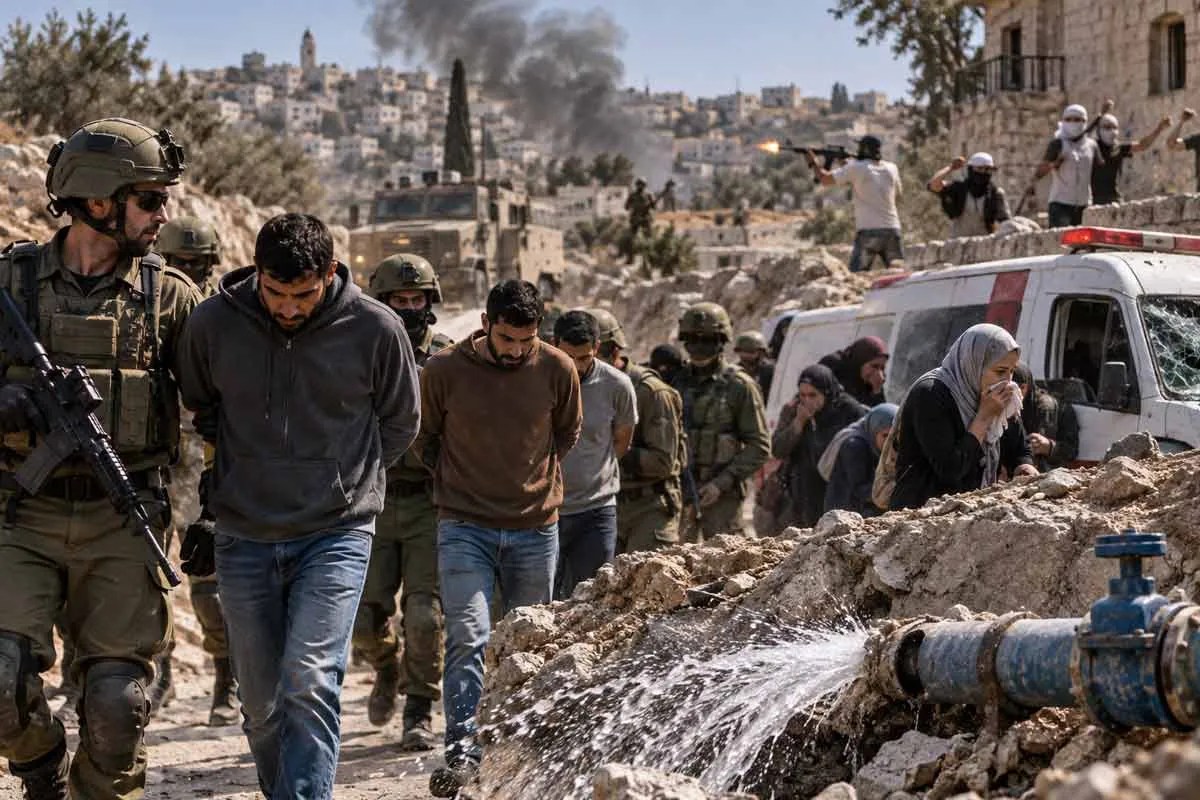
The faucet does not whisper. When it dies, it screams in a sudden, violent cough of metallic air, spitting a final few rusty drops into the tin sink before surrendering entirely.
In the hills of the West Bank, water is not a utility. It is a fragile tether to tomorrow.
Imagine living through an afternoon where the sun beats down like a lead weight, the thermometer creeps past forty degrees Celsius, and the pipe outside your front door goes cold. Permanently. Not because of a drought, not because of a broken valve buried deep in the limestone, but because a bureaucratic stroke of a pen decided that seven hundred souls—men who tend olive groves that have stood for centuries, women who bake bread in clay ovens, children whose laughter usually echoes off the stone alleyways—no longer deserved to drink.
This is the quiet arithmetic of occupation. It does not always announce itself with the roar of an explosion or the blinding flash of white phosphorus. Sometimes, it arrives in silence. It arrives when the taps dry up.
The Geography of Thirst
To understand what is happening right now in these fractured hills, you have to look past the political talk shows and down at the dirt. You have to walk the dusty paths where the soil cracks beneath your sandals like broken pottery.
In many corners of the West Bank, communities live in the shadow of sprawling, green-lawned settlements where water flows abundantly from sprinklers, while Palestinian villages a few hundred yards away must buy their life-saving liquid from tanker trucks at exorbitant, back-breaking prices. When those trucks are blocked, or when the main distribution lines are severed during sweeping military raids, a terrible countdown begins.
Consider Tariq. Let us call him that, though his face belongs to a hundred fathers standing on porches across the region tonight. He is forty-two years old. His calloused hands have shaped the rocky earth since he was old enough to hold a small trowel. On a normal Tuesday, he would be checking the irrigation channels for his tomato plants, watching the green shoots reach hungrily for the light.
Instead, today, Tariq is shaking a half-empty plastic bottle, listening to the slosh of warm, precious fluid. He is rationing it for his youngest daughter, five-year-old Yasmin, whose lips are already dry and cracked from the dust.
"They didn't come with an explanation," Tariq tells his neighbor, his voice dropping to a flat, exhausted whisper as the sun dips below the horizon, offering no relief from the stifling heat. "They came with armored vehicles. They told us to stay inside. And then the water stopped."
It is a specific kind of psychological torture. You are locked inside your own home. Outside, boots march on asphalt. Rifles click. The sharp, metallic crack of live ammunition splitting the night air echoes against the concrete walls, not aimed at a target, but meant to fray the nerves, to keep children weeping in corners, to remind everyone who breathes the air that their existence is entirely conditional.
Raids And The Shattered Night
The reports streaming out of the area read like cold police ledgers: Tabadtod chhapama. Sweeping raids. Homes targeted. Arrests made in the dead of night.
Statistics numb the mind. We read of hundreds of people cut off from basic supplies, of dozens of homes riddled with bullet holes, of young men hauled away into the gray dawn without charges or trials. But numbers do not bleed. Numbers do not cower under woolen blankets while the front door shakes under the heavy kick of a steel-shod boot.
Think about what it means to live in a perpetual state of waiting. You go to sleep fully clothed because you know that at two in the morning, the heavy thud against your door might not be a neighbor in need, but soldiers searching for a phantom threat. You wake up checking if the electricity works, if the internet is cut, if the road out of your village has been blocked by mounds of freshly dumped earth and concrete blocks.
The military logic behind these operations claims security. Every checkpoint, every severed water line, every shattered windowpane is defended in sterile conference rooms miles away as a necessary precaution against terror. But walk through the bullet-scarred rooms of a family home in the West Bank at three in the morning, and the word security loses its shape. It turns into something monstrous. It turns into a weapon wielded against the ordinary rhythm of human survival.
I remember standing once near a concrete barrier, watching an old woman try to carry a heavy plastic jerrycan of water across a checkpoint. Her arms trembled under the weight, the straps biting deep into her shoulders. The young soldier standing behind the concrete slab, barely old enough to shave, looked straight through her as if she were a ghost. Not out of pure malice, perhaps, but out of that terrifying institutional numbness where human beings stop seeing other human beings. That is the true machinery of conflict. It strips away the face of the neighbor until only a target remains.
The Invisible Stakes
Why should anyone thousands of miles away care about seven hundred people whose names they cannot pronounce and whose villages they will never visit?
Because the erosion of humanity in one corner of the globe is a contagion. When we accept that an entire community can be blithely choked of water, terrorized in their beds, and treated as sub-citizens simply because of where they were born, we lower the baseline for what is acceptable everywhere else.
The struggle in the West Bank is not a localized regional dispute that can be neatly filed away under foreign affairs. It is a stress test for our collective conscience. It asks a brutal question: How much suffering can we normalize before our own hearts turn to stone?
Tariq sits on his porch in the dark. The stars overhead are brilliant, indifferent pinpricks of light in an enormous, velvet sky. There is no electricity tonight, so the village is plunged into an inky blackness broken only by the sweeping searchlights of military patrols on the surrounding ridges.
He takes the bottle, unscrews the cap, and pours a single, measured capful into a spoon for Yasmin. She swallows it eagerly, her dark eyes wide and uncomprehending in the gloom.
Down the hill, the distant hum of an armored personnel carrier grinds against the gravel. The water pipes remain dry. The night stretches out, heavy with the weight of unheards screams, waiting for a dawn that brings no answers, only another day of enduring the unendurable.