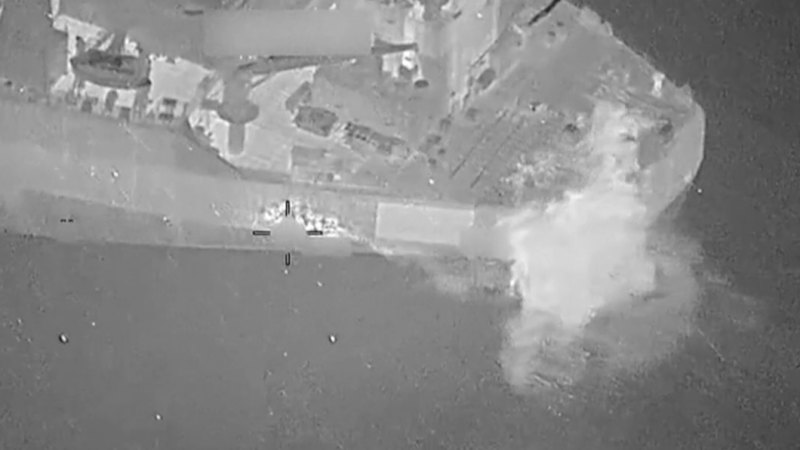
The mainstream media is selling you a countdown to World War III. Every time a US MQ-9 Reaper drone fires a Hellfire missile or an Iranian-backed militia launches a Fateh-110 ballistic rocket across a desert border, the talking heads put on their somber faces and predict a regional conflagration. They treat these military exchanges as chaotic escalations, a sequence of miscalculations dragging two bitter enemies toward total war.
They are fundamentally misreading the board.
The recent exchange of missile strikes between the United States and Iranian forces is not a breakdown of diplomacy. It is diplomacy by other means. What looks like a chaotic spiral toward total war is actually a highly calibrated, deeply understood choreography designed to maintain the status quo. These states are not trying to destroy each other; they are communicating. When you strip away the frantic cable news chyrons, you find a predictable, almost bureaucratic framework where violence functions as a language to prevent, rather than provoke, a wider conflict.
The Myth of the Mad Kinetic Spiral
The standard analysis of US-Iran kinetic friction relies on a flawed premise: that both sides are reactive, emotional actors driven by ideological hatred to the brink of mutual destruction. This perspective ignores the cold logic of deterrence theory.
In international relations, we often talk about the security dilemma, where one state's defensive actions are perceived as offensive threats by its rival. Mainstream coverage suggests Washington and Tehran are trapped in this loop. But true insiders know that both the Pentagon and the Islamic Revolutionary Guard Corps (IRGC) operate under a shared, unspoken playbook of proportional retaliation.
Consider the mechanics of a typical strike cycle. A proxy group fires rockets at an American installation in Iraq or Syria. The US responds forty-eight hours later, hitting specific command nodes or logistics hubs. The targets chosen are rarely high-value political leadership; they are fixed infrastructure assets. This delay is not inefficiency; it is intentional. It gives the adversary time to clear personnel out of the blast zone.
The goal is to trade hardware for deterrence, not to rack up a body count that demands an uncontrollable counter-response. It is a violent system of bookkeeping, where accounts are settled in real-time to keep the baseline peace.
Deciphering the PAA Flawed Premises
When people look at these geopolitical flashpoints, the questions they ask reveal just how deeply they have swallowed the standard narrative. The public framing of this conflict is built on assumptions that crumble under serious strategic scrutiny.
Are the US and Iran on the brink of an all-out war?
No. This question completely misinterprets the objective of limited kinetic strikes. An all-out war requires mobilization, strategic surprise, and an intent to topple a regime or seize territory. Neither Washington nor Tehran desires this outcome. For the US, another major ground war in the Middle East is a strategic nightmare that drains resources away from pacing competitors in the Indo-Pacific. For the Iranian regime, a direct war with a superpower poses an existential threat to its survival. The strikes you see are the alternative to war, acting as a pressure valve to release domestic and regional political tension without tripping the wire into total mobilization.
Why can't deterrence stop proxy attacks entirely?
Because proxy warfare is designed precisely to operate below the threshold of total war. Mainstream commentators treat every drone launch by a regional militia as a failure of American deterrence. That is a fundamental misunderstanding of asymmetric conflict. Iran utilizes the "Axis of Resistance" to project power precisely because it provides plausible deniability and limits direct state accountability. If the US responded to every low-level rocket attack with a full-scale assault on Tehran, it would be violating its own doctrine of proportionality, alienating global allies, and playing directly into a trap of strategic overextension. Deterrence does not mean zero kinetic events; it means bounding those events within an acceptable, manageable parameters.
The Cost of Managing the Status Quo
To understand why this system persists, look at the structural incentives for both sides. I have analyzed defense budgets and procurement cycles for years, and the reality is that the current level of controlled friction serves the institutional needs of both Washington and Tehran.
For Iran, localized resistance against the "Great Satan" is a core pillar of regime legitimacy. It justifies the economic hardships caused by sanctions and cements its position as a regional heavyweight. By engaging in controlled, limited strikes, Tehran proves its revolutionary credentials to its domestic base and regional proxies without risking the destruction of its state apparatus.
For the United States, maintaining a forward military footprint to counter Iranian influence justifies the massive resource allocation to Central Command (CENTCOM). It reassures regional partners like Israel and the Gulf States that Washington remains committed to their security, while simultaneously setting a clear boundary line that those partners must not cross.
The downside of this contrarian reality is brutal: it accepts a baseline level of low-intensity violence as a permanent cost of doing business. Service members remain in harm's way, regional civilian populations suffer the collateral damage of localized strikes, and billions of dollars in ordnance are vaporized to maintain an unstable equilibrium. It is an ugly, cynical system. But pretending that a lasting, peaceful grand bargain is just around the corner if everyone would just stop shooting is dangerous naiveté.
Flipping the Strategic Script
If the current strategy is about management rather than victory, how do you actually alter the dynamic without triggering the very catastrophe everyone claims to fear? The answer does not lie in more precise missile strikes or harsher economic sanctions that have already hit diminishing returns.
The true lever of influence is shifting the calculation of the proxy networks themselves. Right now, Washington treats the proxy groups as mere puppets of Tehran, assuming that if you pressure the center, the limbs will stop moving. This ignores the local grievances and independent political ambitions of these groups, whether they are in Yemen, Iraq, or Syria.
Instead of treating the Middle East as a monolithic chessboard where every move is dictated by Iran, US policy must exploit the inherent frictions between Tehran and its partners. These groups are not ideologically identical; they are marriages of convenience. By addressing local political realities directly and driving wedges into the logistical and financial gaps between the IRGC and its regional allies, the US can degrade the network's effectiveness far more permanently than a Tomahawk missile ever could.
Stop looking at the smoke rising from the latest desert outpost as a sign that the international order is collapsing. It is the sound of the machine working exactly as designed, burning through blood and iron to keep a fragile status quo from tipping into the unknown.