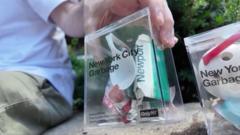
The media is currently laughing at an artist who scooped up literal garbage outside Taylor Swift’s wedding venue and sold it online. They think it’s a joke. They think it’s a symptom of celebrity obsession gone mad, or perhaps a cynical prank.
They are entirely wrong.
What the cultural commentators miss—because they are trapped in a lazy loop of standard outrage—is that this isn't a story about a crazy fan base or a cheap hustle. This is a masterclass in the foundational mechanics of luxury economics. The artist didn't exploit a fandom; they exposed the fragile illusion of value that sustains entire global industries.
If you think buying a piece of plastic found near a pop star's wedding is stupid, but you believe a diamond ring or a limited-edition sneaker holds intrinsic worth, you are lying to yourself. Value is never inherent. It is entirely manufactured.
The Myth of Intrinsic Value
Let’s dismantle the basic premise of how people evaluate worth. The average consumer operates under the delusion that an object’s price should reflect its utility or the cost of its raw materials.
It doesn't.
In the art and luxury sectors, value is a social contract built on scarcity, provenance, and narrative.
- Utility is what you pay for a plastic fork.
- Provenance is why someone pays $100,000 for a plastic fork that touched a historic figure's hand.
Marcel Duchamp proved this over a century ago when he turned a urinal upside down, signed it "R. Mutt," and called it art. The art world didn't collapse; it adjusted. The urinal became priceless because the context changed.
The trash collected outside that wedding operates on the exact same mechanism. The artist transformed worthless debris into a scarce commodity by anchoring it to a cultural epicenter. It is a pure distillation of supply and demand, stripped of all pretense.
Why the Art World is Falsely Outraged
Traditional art critics look down on this kind of stunt because it threatens their gatekeeping power. If a random person can pick up a crushed soda can from a sidewalk, frame it, and sell it for three figures based purely on proximity to a celebrity, it proves that the elaborate ecosystem of galleries, curators, and elite auctions is largely a theatrical performance.
I have spent years watching institutional art markets operate. Wealthy collectors buy canvas covered in single-color house paint for millions, justifying it with dense, academic jargon. They are doing the exact same thing as the Swiftie buying the wedding trash: purchasing a token of cultural relevance to signal status within their peer group.
The only difference is that the Swiftie is being more honest about it.
The Economics of Hyper-Proximity
To understand why this works, you have to look at the concept of hyper-proximity. In a world where digital assets can be copied infinitely, physical connection to an unrepeatable moment becomes the ultimate luxury.
Imagine a scenario where two identical pieces of paper exist. One was sitting on a desk in Ohio. The other was in the room when the treaty ending World War I was signed. Chemically, they are identical. Logically, their utility is the same. Yet, one is a historical artifact worth a fortune, and the other is recycling.
Celebrity culture has replaced historical statecraft as the primary driver of modern mythology. Taylor Swift's wedding isn't just a personal event; it is a historic flashpoint for a massive, global community. The debris generated at that event functions as a secular relic.
Historically, churches made fortunes selling splinters of the "true cross" or the bones of obscure saints. Modern society hasn't outgrown this desire for physical connection to the divine; we have just outsourced our deities to stadium tours.
The Financial Risk of Disruption Art
Is this a sustainable business model? Absolutely not. And that is the nuance the critics miss.
The artist selling this garbage is riding a hyper-perishable wave of momentum. The downside to buying or selling manufactured cultural relics is that their value is entirely dependent on the cultural relevance of the anchor entity. If the public interest shifts, the asset liquidity drops to zero instantly. Unlike gold or real estate, you cannot borrow against a bag of wedding-adjacent confetti.
But as a short-term disruption, it is flawless. It forces the viewer to confront a uncomfortable truth: the difference between high art and high garbage is purely a matter of marketing.
Stop asking how people can be stupid enough to buy trash. Start asking why you still believe the things you buy have any real value either. Treat everything as a construct, or get left behind clinging to worthless assets.