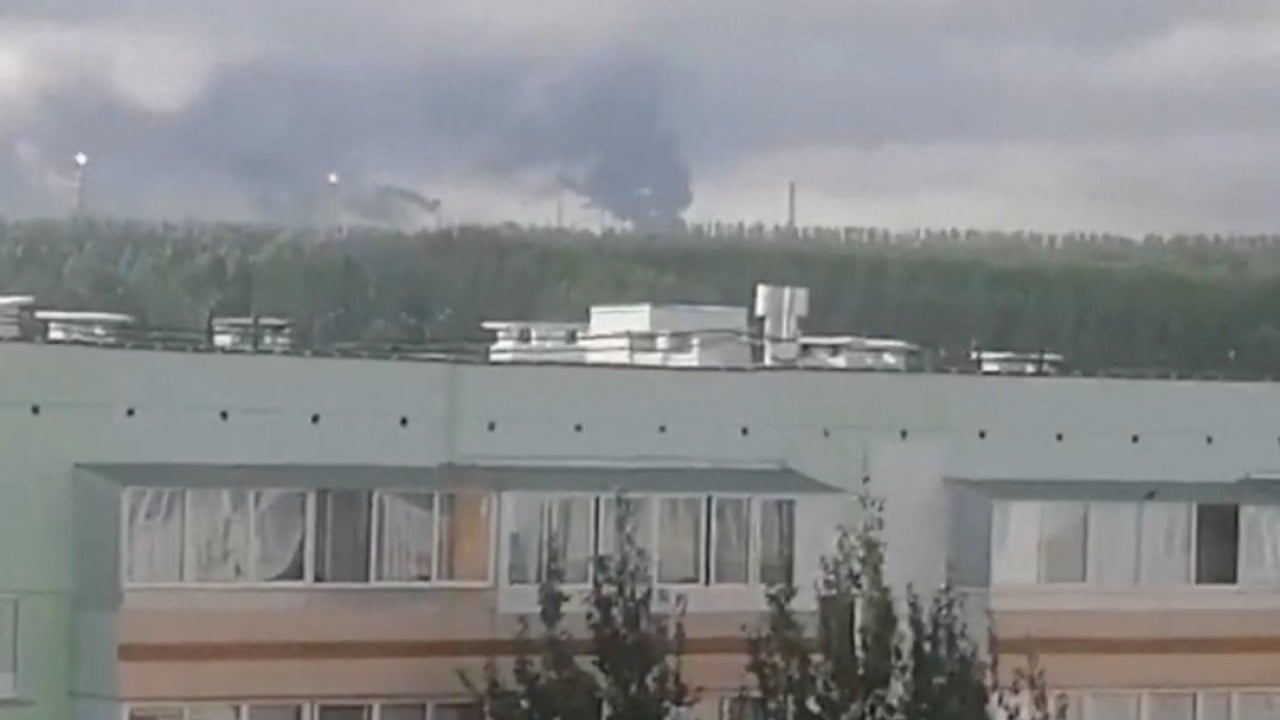
The headlines cheer every time a long-range drone strikes a processing unit nine hundred kilometers inside Russia. Analysts on cable news point to the map, draw a neat little arc from the Ukrainian border to some provincial refinery, and declare that the energy chokehold is tightening. It sounds clean. It fits neatly into the conventional playbook of modern attrition warfare.
It is also largely a distraction from how modern industrial economies actually absorb shock.
I have spent years analyzing energy logistics and supply chain vulnerabilities under extreme stress. When you watch the mainstream commentary obsess over isolated refinery strikes, you are watching people mistake tactical pyrotechnics for strategic disruption. Thelazy consensus assumes that hitting a distillation column brings the Russian war machine one step closer to starvation.
Physics and market economics tell a very different story.
The Geography of Redundancy
To understand why these deep-strike drone attacks fail to deliver the knockout blow everyone prays for, you have to look past the dramatic footage of burning storage tanks. Russia is not a boutique economy running on just-in-time delivery. It is a sprawling, heavily fortified energy fortress built on massive redundancy and regional self-sufficiency.
When a drone hits a facility deep in the interior, the immediate knee-jerk reaction in Western capitals is to calculate the repair bill and the lost barrels of gasoline. But refineries are not microchips. They are modular complexes of pipes, valves, and cracking units. While a precision hit can take a primary atmospheric distillation unit offline for weeks or even months, it rarely stops the crude from moving.
Crude oil does not care where it gets refined. If Facility A is smoking, the pipeline network simply diverts the raw flow to Facility B, C, or D, assuming local spare capacity exists. More importantly, Russia exports the vast majority of its crude out of the country in raw form anyway. Domestic product markets absorb the rest.
Refinery capacity inside the Federation exceeds domestic consumption by a comfortable margin. Taking out a fraction of that capacity creates local supply pinches, high retail prices in specific oblasts, and logistical headaches for regional governors. It does not stop a single tank from rolling toward the front lines.
The Fallacy of the Strategic Choke Point
People love the idea of a single silver bullet. A magical weapon or a targeted strike that brings a belligerent economy to its knees. We saw this delusion in the strategic bombing campaigns of the Second World War, where generals genuinely believed that flattening ball-bearing factories would instantly end the conflict.
It never works that way. Complex industrial systems adapt, decentralize, and route around damage faster than attackers can generate it.
When long-range drones hit targets hundreds of kilometers from the border, they force an operational dilemma. Are those drones better spent on tactical air defense suppression near the actual front lines, where Russian glide-bomb carriers are actively flattening defensive positions? Or are they better spent on psychological victories that make good television packages in London and Washington?
Every airframe allocated to a deep-interior refinery strike is an airframe not taking out a radar installation or a mobile artillery piece fifty kilometers from the trenches. That is the trade-off nobody on morning television wants to talk about. We are trading immediate tactical survival at the front for a distant, highly aesthetic economic paper cut.
The Domestic Politics of Burning Metal
There is another layer here that gets entirely ignored by the armchair generals. High-profile explosions deep inside enemy territory serve a vital domestic political function for Kyiv, keeping morale high and demonstrating that the war has a cost for the aggressor population. That is understandable. Morale is a quantifiable military asset.
However, confusing a morale booster with a systemic economic collapse is a dangerous analytical error.
Inside Russia, localized fuel shortages or rising pump prices do not spark anti-regime revolutions. The domestic apparatus has spent decades perfecting the management of public discontent. If anything, external attacks on domestic infrastructure tend to harden the population's resolve, feeding directly into the Kremlin narrative of a nation encircled by hostile powers bent on its destruction.
We have seen this script play out historically. Heavy bombing campaigns against civilian or industrial centers rarely fracture the political will of a population under authoritarian or centralized control. They consolidate it.
The Real Vulnerability Nobody Wants to Touch
If you actually want to disrupt the Russian war economy, targeting domestic gasoline production is looking at the wrong end of the barrel. The real vulnerability is not downstream refining; it is upstream financial clearing, high-tech catalyst imports, and specialized engineering maintenance software.
Refineries require sophisticated Western-designed catalysts and proprietary software to run efficiently at scale. Without access to specialized technical maintenance components, industrial plants degrade over time, shifting from high-efficiency output to inefficient, sluggish operation. That kind of slow-motion strangulation does not produce a satisfying fireball. It does not make for a viral video on social media.
It just quietly bleeds an economy over five years instead of five weeks.
Wars of attrition are won by cold math, not by cinematic explosions. Until Western analysts and military planners stop chasing the dopamine hit of deep-range infrastructure strikes and start focusing on systemic, unglamorous supply chain blockades, the map will keep changing, but the stalemate will remain untouched.
Stop cheering the smoke. Look at the logistics.