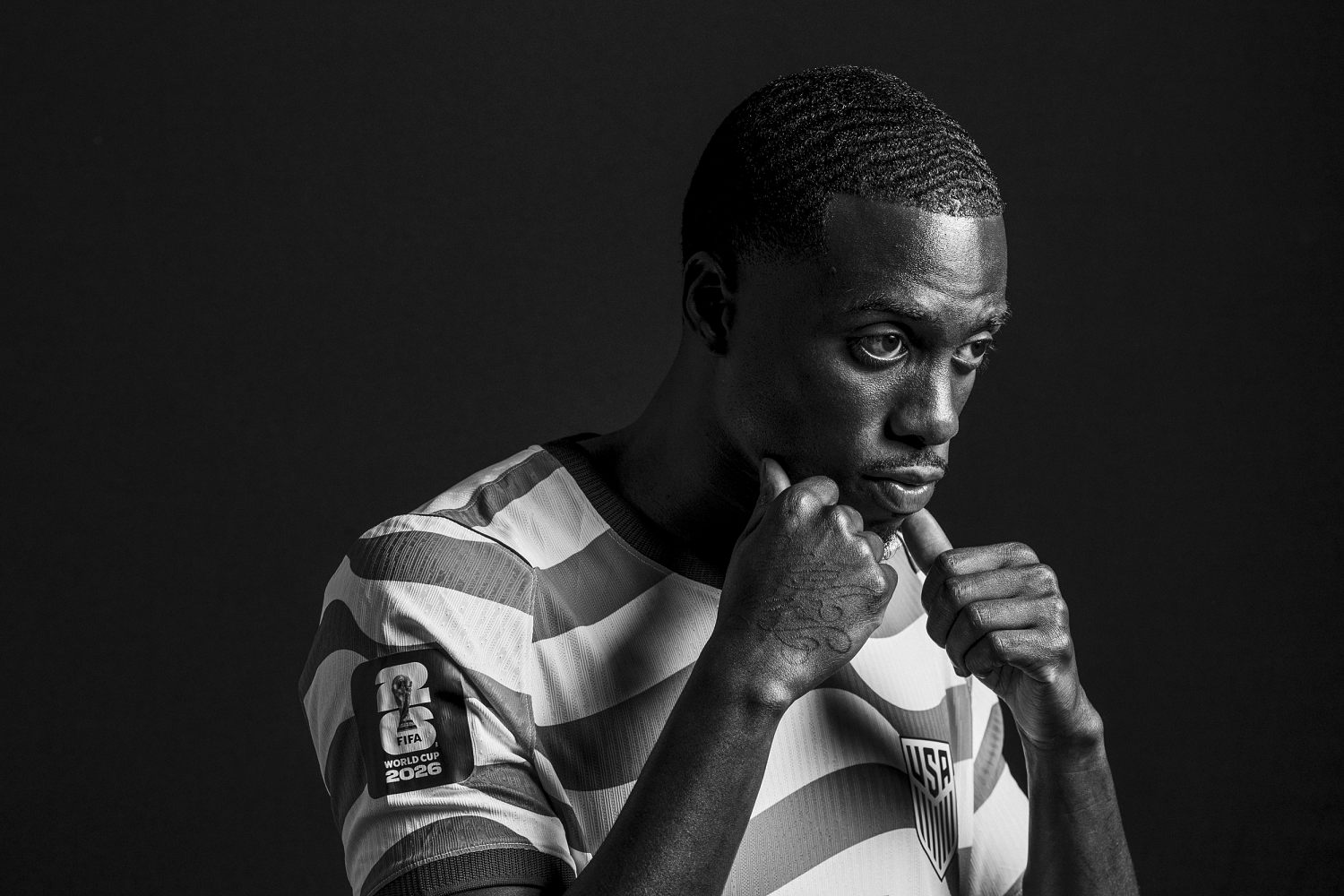
Tim Weah is no longer just the son of African soccer royalty; he is the tactical engine driving the United States Men’s National Team into its most critical era. While early career narratives focused entirely on the heavy burden of his surname, Weah has quietly engineered a complete reinvention of his game that makes him indispensable to the American tactical setup. By transitioning from a traditional, line-hugging winger into a defensively disciplined, high-pressing wing-back and wide forward, he solved the USMNT's glaring structural imbalances. He did not escape his father's shadow by mimicking George Weah's explosive central dominance, but by mastering the modern, multi-functional roles that define contemporary elite soccer.
The obsession with lineage was always a lazy analytical shortcut. George Weah won the Ballon d'Or in 1995 as a towering, elegant center-forward who terrorized Serie A defenses with devastating solo runs. For years, scouts and pundits watched the younger Weah through that specific lens, expecting a replicating mutation of a classic number nine. Discover more on a similar subject: this related article.
They missed the shift in the global game.
Modern football has largely phased out the pure, static winger, replacing them with dynamic athletes who can manipulate space and track back with equal intensity. Tim Weah’s breakthrough did not come from trying to match his father’s goal-scoring tallies, but from recognizing where European football was heading. Further analysis by CBS Sports delves into comparable views on the subject.
The Juventus Reconditioning
To understand Weah’s value to the national team, you have to look at Turin. His move to Juventus was the catalyst for his tactical maturation. Under rigid Italian defensive systems, a winger who refuses to defend is a liability who rides the bench. Weah was asked to drop deeper, operating as a esterno—a wide player in a five-man midfield who carries immense defensive responsibilities.
This was not a demotion. It was a masterclass in positional awareness.
He learned to track opposing overlapping fullbacks, choke passing lanes, and time his tackles with precision. For the USMNT, this evolution altered how the team structures its attack. When Weah plays on the right flank, his defensive work rate allows the right-sided central midfielder or fullback to push higher into the half-spaces without leaving the backline completely exposed.
Consider the mechanics of a typical transition phase. When the USMNT loses possession high up the pitch, Weah does not jog back or wait for a counter-attack. His Serie A training triggers an immediate recovery run, often covering sixty yards to form a compact defensive block. This defensive reliability gives the team tactical flexibility, allowing the manager to switch between a back four and a back five mid-match without changing personnel.
Exploiting the Blind Spots
Offensively, Weah's impact is measured in verticality and gravity. Many modern wingers prefer to cut inside on their stronger foot, crowding the central areas of the pitch and slowing down the tempo of the attack. Weah does the opposite. He maintains width, stretching the opposing defensive line to its absolute limits.
This creates massive gaps.
By hugging the touchline, Weah forces the opposing left-back to step out out of the central defensive cluster. Once that space opens up, Christian Pulisic or an advancing central midfielder can exploit the vacancy in the box. It is an unselfish way to play, one that rarely shows up in the traditional goals-and-assists columns but is constantly highlighted in modern expected goals (xG) buildup metrics.
His movement off the ball is highly calculated. Instead of demanding the ball to his feet, Weah prefers to make blind-side runs behind the defensive line. He waits for the exact moment an opposing center-back turns their head toward the ball, then flashes into the space behind them. This directness gives the USMNT an escape valve when facing high-pressing opponents who attempt to suffocate the midfield.
The Mental Armor of the National Team
Playing for a national team undergoing a massive cultural shift requires more than just physical tools. It requires an emotional resilience that Weah developed under the intense scrutiny of both his family name and the demanding fanbases of Paris Saint-Germain, Lille, and Juventus.
Within the USMNT locker room, Weah functions as a stabilizing presence. He belongs to a generation of American players who moved to Europe as teenagers, navigating foreign languages, intense media pressure, and the cutthroat nature of top-tier academies. This shared experience has created a tight-knit core, but Weah’s specific journey gives him a unique perspective on pressure.
When you grow up with a father who is both a sporting legend and a head of state, the pressure of a World Cup qualifier in San Pedro Sula or an intense match against Mexico becomes manageable. It is simply another day at the office. This calmness influences his decision-making on the field, preventing the frantic, rushed plays that often plague younger squads during high-stakes tournaments.
Striking the Balance of High Risk and High Reward
The transformation is not without its flaws. Weah’s aggressive positioning and desire to stretch the pitch mean he occasionally suffers from periods of isolation during games where the midfield cannot progress the ball. If the opposing team successfully cuts off the passing lanes to the right flank, Weah can become a spectator for stretches of the match.
Furthermore, his final ball remains an area requiring refinement. While his low, driven crosses across the face of the goal are highly effective, his aerial crossing from deep positions can be inconsistent. To maximize his impact, the USMNT coaching staff must ensure that the midfield dynamic supports quick, decisive switches of play to catch the opposition before they can shift their defensive block toward Weah's side.
The evolution of Tim Weah mirrors the evolution of American soccer itself. The squad has moved past the era of relying solely on grit, fitness, and individual moments of brilliance. Today’s team relies on tactical sophistication, European pedigree, and players who understand their specific roles within a complex system. Weah embodies this shift perfectly, carving out a legacy defined by modern tactical utility rather than ancestral shadow boxing.