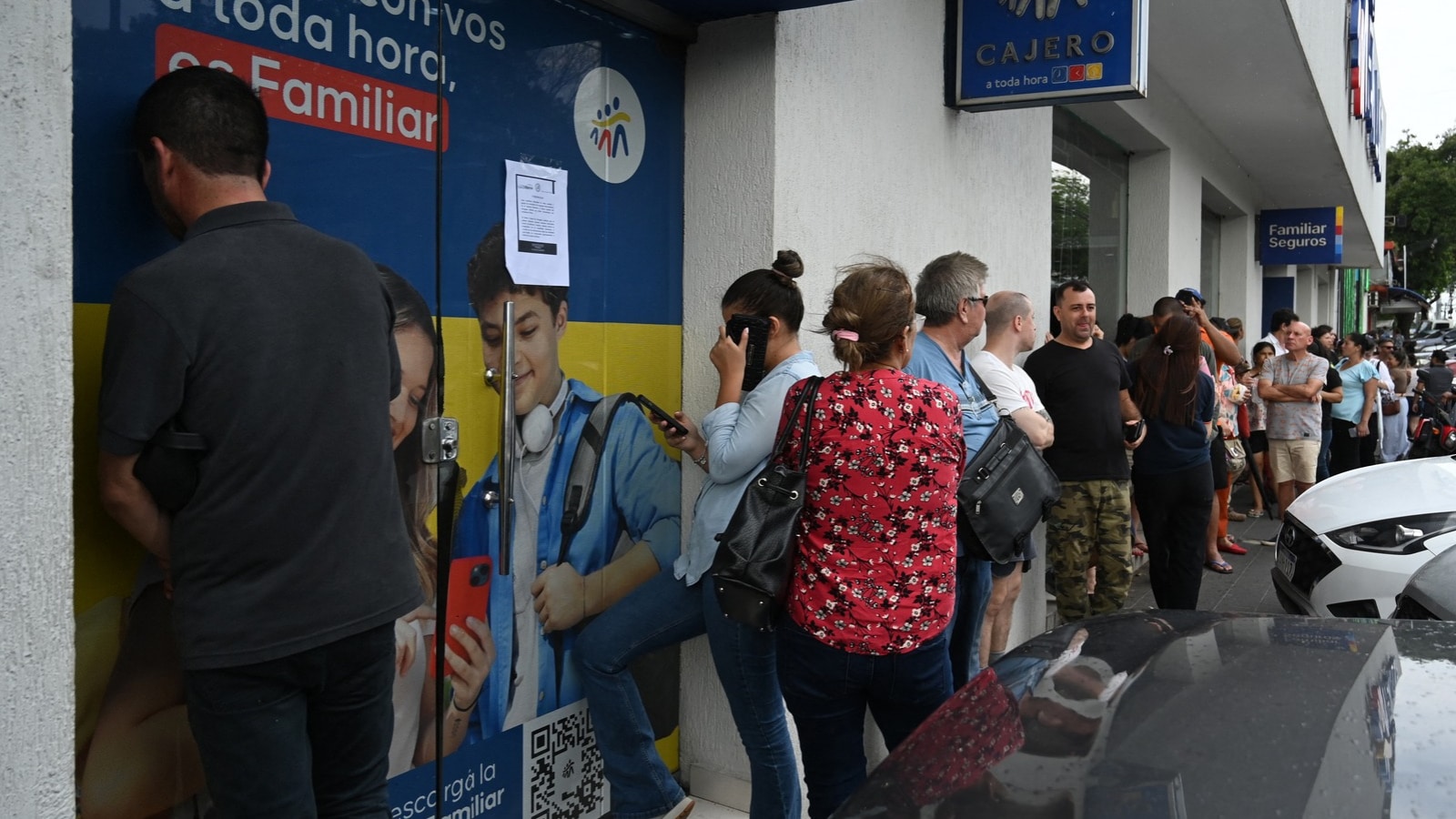
When a financial institution holding three million customer accounts collapses in a country of roughly seven million people, the resulting crisis is never confined to the central bank’s balance sheet. In Paraguay, the regulatory seizure of a dominant retail bank has immediately escalated into a formal impeachment push against the sitting president, exposing the structural fragility that binds sovereign political stability to retail banking solvency in emerging markets. Understanding this crisis requires separating the mechanics of liquidity contagion from the constitutional friction of executive removal, mapping how an institutional capital shortfall transforms into an existential threat to state governance.
The Mechanics of Retail Concentration Risk
Standard financial reporting treats the seizure of a three-million-customer bank as a discrete regulatory event. That framing misses the operational reality of market concentration. In a population of seven million, three million accounts represent nearly half of the entire demographic base and a significantly higher proportion of the economically active adult population.
When a single institution achieves this level of penetration, it ceases to function merely as a commercial lender and becomes the primary clearinghouse for daily household liquidity, payroll distribution, and small-enterprise working capital. The seizure of such an entity triggers three immediate operational bottlenecks across the domestic economy:
- The Payment Rail Freeze: Even when deposit insurance mechanisms exist to protect retail balances up to statutory limits, the administrative freeze required to audit the loan book halts outgoing transfers. Suppliers cannot pay vendors, and employers cannot clear automated payroll batches, creating an instant velocity-of-money contraction.
- Asymmetric Information Panic: Retail depositors do not read capital adequacy ratios. When a regulator intervenes in an institution of this scale, depositors at peer institutions assume the underlying asset impairment—typically concentrated in over-leveraged agricultural credits, sovereign debt mark-to-market losses, or unhedged currency mismatches—is systemic rather than idiosyncratic.
- The Fiscal Backstop Dilemma: The central bank and the deposit guarantee fund face a binary choice: absorb the balance sheet hole using public reserves, which degrades sovereign creditworthiness and spikes borrowing costs, or enforce strict haircuts on uninsured institutional depositors, which bankrupts domestic pension funds and corporate treasuries.
Because Paraguay’s economy relies heavily on formalizing cash transactions through high-volume, low-margin retail accounts, the sudden immobilization of three million accounts acts as a regressive tax on the exact middle- and working-class demographics that form the electorate. The transmission belt from central bank intervention to street-level political anger operates without a lag.
The Architecture of Executive Contagion
Financial crises topple governments when the public perceives that regulatory failure is indistinguishable from executive complicity. In presidential systems with concentrated executive authority, the head of state owns the macroeconomic environment by default, regardless of the statutory independence of the central bank superintendency.
The causal chain driving the removal bid relies on three distinct political vulnerabilities:
- Regulatory Forbearance as Political Liability: A bank with three million customers does not become insolvent overnight. Insolvency is the terminal stage of prolonged capital erosion, masked by accounting extensions, evergreened loans, and delayed asset write-downs. Opposition lawmakers inevitably frame this timeline as deliberate regulatory forbearance—arguing that the executive branch suppressed enforcement to avoid economic pain during prior electoral cycles or to protect politically connected borrowers.
- The Custody of Public Funds: In emerging markets, large retail banks frequently serve as custodians for state-owned enterprise deposits, municipal tax collections, and social security reserves. If public entities maintained high-balance, uninsured deposits at the seized bank right up until the intervention, legislative investigators will treat that exposure as gross negligence or insider self-dealing, providing the factual predicate required to draft articles of impeachment.
- Coalition Defection Incentives: A removal bid in a bicameral legislature rarely succeeds on opposition votes alone; it requires defections from the president’s own party or governing coalition. A banking collapse alters the survival calculus for sitting legislators. Facing furious constituents locked out of their savings, lawmakers from the ruling bloc must choose between defending an unpopular executive or voting to oust the president to distance themselves from the financial wreckage before the next election cycle.
Constitutional Thresholds and Procedural Friction
Initiating an impeachment bid and executing a removal are separated by steep procedural hurdles. Under Paraguay’s constitutional framework—historically defined by the juicio político mechanism—the process operates as a strictly political trial rather than a criminal proceeding, meaning the evidentiary standard is flexible, but the mathematical threshold is rigid.
The removal pipeline moves through two distinct institutional chambers, each with its own friction points:
- The Chamber of Deputies (Accusation Phase): The lower house holds the exclusive authority to formulate the accusation. Advancing the removal bid out of this chamber typically requires a two-thirds supermajority of members present. At this stage, the opposition does not need to prove criminal corruption; they only need to establish "poor performance in office" (mal desempeño de sus funciones). The unmitigated collapse of a systemically important bank provides ample rhetorical cover to satisfy that definition.
- The Senate (Trial and Removal Phase): Once impeached by the lower house, the president is tried by the Senate, where a separate two-thirds supermajority is required for conviction and immediate removal. Unlike criminal courts, the Senate’s rules of procedure allow for compressed timelines—historically, Paraguayan impeachment trials have concluded within days rather than months, denying the executive branch the time needed to stabilize the financial sector and regain political footing.
The primary limitation of this constitutional weapon is that it solves a political grievance while exacerbating the underlying financial emergency. Removing a sitting president during a banking intervention introduces regime uncertainty at the exact moment foreign correspondent banks and international institutional investors are deciding whether to maintain credit lines to the country. A caretaker administration lacks the democratic mandate to negotiate emergency liquidity facilities with multilateral lenders or push painful fiscal recapitalization bills through Congress.
Distinguishing Known Mechanics from Strategic Hypotheses
Analyzing a live sovereign-financial crisis requires separating verified structural realities from speculative political outcomes.
Established Operational Facts:
- A retail bank servicing three million accounts constitutes a systemically important financial institution (SIFI) within the Paraguayan market, regardless of its formal tier-one asset ranking.
- Regulatory seizure necessarily freezes non-guaranteed liabilities while central bank auditors establish the true net present value of the loan portfolio.
- The initiation of a removal bid forces the executive branch to divert bandwidth from macroeconomic crisis management to legislative whip-counting and coalition preservation.
Educated Hypotheses on Crisis Trajectory:
- The Sovereign Spread Spillover: Unless the central bank immediately guarantees full liquidity access for small-to-medium retail depositors within seventy-two hours of seizure, sovereign bond yields will widen as external creditors price in both fiscal bailout costs and executive instability.
- The Scapegoat Equilibrium: If the president survives the initial supermajority vote in the Chamber of Deputies, the survival price extracted by coalition partners will almost certainly be the immediate dismissal of the central bank leadership, the finance minister, and the superintendent of banks. Replacing the technical crisis-management team mid-intervention will slow down the asset-resolution process, trading long-term financial efficiency for short-term political survival.
- Deposit Flight to Tier-One Foreign Subsidiaries: Regardless of how the legislative vote resolves, domestic retail capital will migrate rapidly away from locally owned mid-tier banks toward foreign-owned institutions with parent-company balance sheets, permanently consolidating the Paraguayan banking sector and reducing credit availability for domestic small businesses.
Tactical Risk Mitigation for Institutional Stakeholders
For capital allocators, corporate treasurers, and policy strategists operating inside or adjacent to the Paraguayan market, waiting for the legislative vote to conclude before adjusting exposure is a guaranteed loss-making posture. The intersection of a three-million-account freeze and an active impeachment threat dictates an immediate defensive posture across three operational fronts:
- Corporate Treasury Realignment: Immediately sweep operating cash out of domestically capitalized banks and concentrate liquidity in foreign-headquartered banking subsidiaries operating under local licenses, or hold short-term sovereign paper directly through primary dealers. Do not rely on statutory deposit insurance limits for corporate payroll accounts; statutory payouts operate on administrative timelines that lag commercial payable cycles by weeks.
- Currency and Hedging Execution: Expect sustained downward pressure on the Paraguayan guaraní as domestic corporate treasuries convert local currency reserves into U.S. dollars to hedge against political paralysis. Lock in forward foreign exchange contracts for all imported inventory and dollar-denominated debt obligations covering the next two quarters before central bank FX intervention reserves deplete.
- Legislative Whip-Count Monitoring: Track the public statements of faction leaders within the ruling party’s legislative bloc rather than the opposition’s rhetoric. The impeachment bid will fail if the ruling party maintains discipline in the Chamber of Deputies; if even fifteen percent of the ruling bloc signals support for opening formal committee hearings, price in an immediate executive transition and a sixty-day freeze on all public-sector infrastructure payments and sovereign procurement contracts.