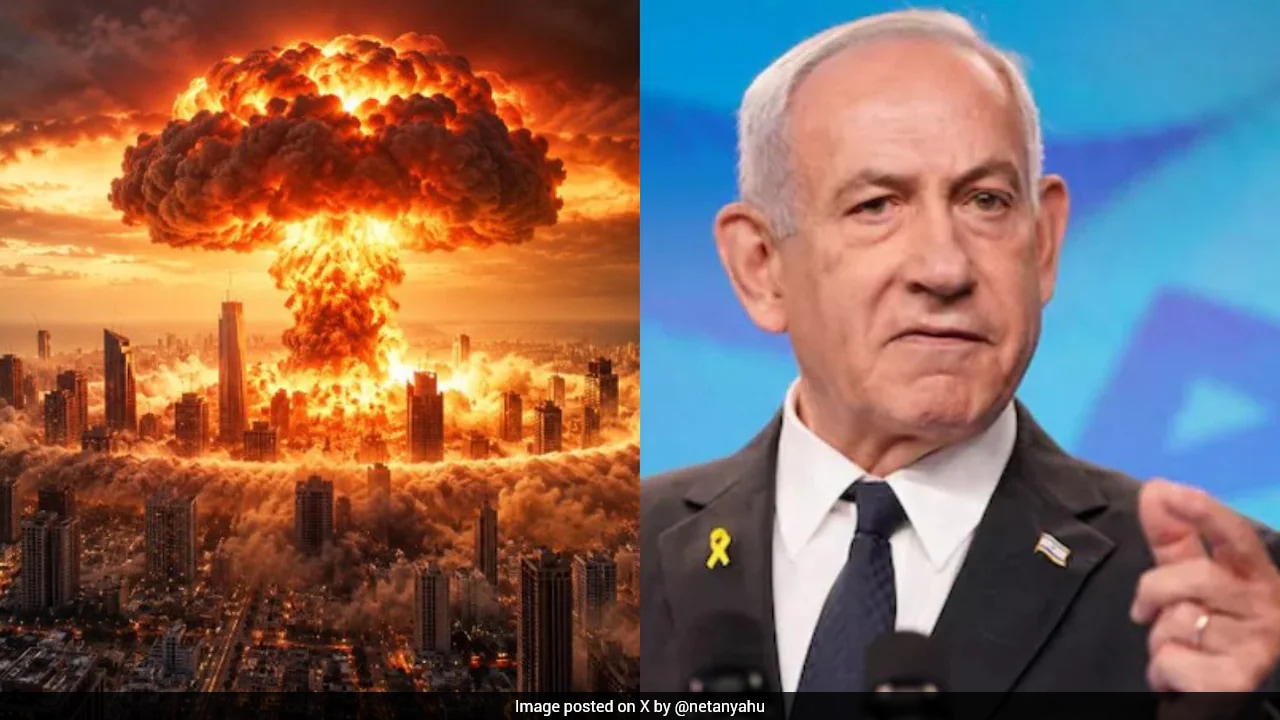
State actors have moved beyond text-based diplomatic signaling into the deployment of generative visual media to manufacture immediate existential urgency. When a head of government distributes an artificial intelligence rendering of a nuclear detonation over their own primary economic hub—specifically Benjamin Netanyahu circulating imagery depicting a nuclear blast over Tel Aviv alongside warnings of existential danger—the communication operates as a calculated instrument of strategic coercion, domestic mobilization, and international narrative control. Understanding this mechanism requires stripping away the sensationalism of the image itself and analyzing the underlying geopolitical calculus, cognitive psychology, and information warfare architectures that drive synthetic deterrence.
The Architecture of Visual Deterrence
Traditional deterrence theory, established during the Cold War by strategists such as Thomas Schelling and Herman Kahn, relied on the credible communication of capability and resolve. Historically, this required physical demonstrations: troop movements, missile tests, or nuclear detonations at remote testing sites. The cost of signaling was extraordinarily high, and the timeline between political decision and physical manifestation was measured in weeks or months.
Generative artificial intelligence collapses both the financial cost and the temporal delay of existential signaling to near zero. By substituting an actual kinetic event or military mobilization with a high-resolution synthetic simulation, a political leader achieves immediate psychological saturation without crossing an irreversible military threshold.
This shift alters the mechanics of brinkmanship across three distinct vectors:
- The Compression of the Escalation Ladder
In classical escalation theory, states climb rungs sequentially—diplomatic protests, economic sanctions, covert operations, conventional strikes, and finally, strategic nuclear posturing. Visual depictions of catastrophic outcomes bypass intermediate rungs entirely. The audience is presented immediately with the terminal state of conflict, forcing allies and adversaries alike to react to a simulated end-state rather than an incremental military posture. - Asymmetric Emotional Resonance
Textual warnings regarding nuclear proliferation or ballistic missile threats suffer from abstraction. Populations and policymakers experience habituation to repeated verbal warnings over decades. Visual representations of recognizable urban geography—such as the Tel Aviv coastline or dense commercial districts—under catastrophic destruction override analytical processing. Neurologically, visual threat cues trigger immediate amygdala activation, bypassing the slower prefrontal evaluation of probability and technical feasibility. - Plausible Deniability and Narrative Fluidity
Unlike an official military doctrine document or a formal ultimatum, a shared synthetic image exists in a gray zone of state communication. If the international response proves counterproductive, the state apparatus can frame the asset as an illustrative warning, a rhetorical metaphor, or an amplification of public discourse rather than a binding policy shift.
The Three Audiences of Catastrophic Imagery
A state leader deploying apocalyptic visuals is rarely addressing a single constituency. The distribution of an image depicting the destruction of Tel Aviv functions simultaneously across three separate target audiences, each requiring a distinct behavioral outcome.
1. The Domestic Constituency and Coalition Cohesion
In parliamentary democracies facing internal political fragmentation, external existential threats serve as the primary mechanism for consolidating executive authority. When domestic governance is challenged by judicial disputes, economic strain, or prolonged conventional conflict, shifting the public focus to absolute survival neutralizes routine political opposition.
The visual depiction of the nation's cultural and economic capital under nuclear attack frames all internal dissent as secondary to physical survival. It alters the domestic cost-benefit calculation: citizens who might oppose specific tactical military operations or prolonged mobilization are pressured to accept executive continuity when the alternative is framed visually as total annihilation.
2. Allied Decision-Makers and Diplomatic Leverage
For states reliant on external security guarantees, intelligence sharing, and weapons supply chains—specifically Israel's reliance on the United States and European partners—diplomatic friction often centers on the proportionality of military responses and the timing of ceasefires. Allied governments frequently advocate for restraint to prevent regional escalation and protect global economic stability.
Deploying catastrophic imagery directly counters allied calls for restraint by reframing the conflict from a localized security dispute into an existential threshold event. When a leader visually equates inaction or diplomatic compromise with a nuclear strike on a major Western-aligned metropolis, they impose a moral and political cost on allied leaders who counsel de-escalation. The implicit message to Washington and European capitals is clear: restricting offensive latitude today guarantees catastrophic failure tomorrow.
3. Regional Adversaries and Deterrence Credibility
To adversaries—specifically Iran and its regional proxy network—the image communicates a shift in risk tolerance. In game theory, a state enhances its bargaining position by convincing an opponent that it perceives itself to be backed into a corner, thereby increasing its willingness to execute preemptive or disproportionate strikes.
By publicly visualizing the worst-case scenario, the signaling state indicates that it has already priced catastrophic outcomes into its strategic calculus. This reduces the adversary's confidence that incremental pressure or war-of-attrition tactics will force concessions, raising the perceived probability of a massive preemptive strike against nuclear or missile infrastructure.
The Cost Function of Synthetic Alarmism
While synthetic visual brinkmanship generates immediate attention and short-term political leverage, it introduces severe structural vulnerabilities into a state's long-term security posture. Strategists must weigh the immediate tactical gains against four compounding liabilities.
Erosion of Epistemic Trust
Governments rely on institutional credibility to issue actionable warnings during genuine emergencies, such as incoming ballistic missile salvos or civil defense evacuations. When state channels distribute fabricated, AI-generated imagery of catastrophic events alongside factual intelligence, they degrade the public's ability to distinguish between verified threat assessments and political messaging. Over time, this induces warning fatigue, where subsequent alerts—even those backed by hard intelligence—are discounted as partisan manipulation.
Amplification of Adversary Propaganda
A fundamental rule of information operations is never to generate visual assets that fulfill an adversary's propaganda objectives. Militant organizations and hostile state media invest heavily in producing visual simulations of enemy capitals in ruins to boost recruitment, demonstrate projected capability, and signal ideological victory to their domestic populations.
When a targeted state's own leadership generates and distributes high-production imagery of its primary city being destroyed, adversary information networks immediately appropriate the asset. The image circulates globally without the original cautionary framing, serving as proof of vulnerability rather than a call for vigilance.
Economic and Market Destabilization
Tel Aviv functions as the primary engine of the Israeli technology sector, financial markets, and foreign direct investment. Capital markets price geopolitical risk based on perceived stability and the probability of catastrophic disruption. High-level state officials normalizing the visual reality of the city's destruction increases the perceived tail-risk for institutional investors, multinational corporations, and credit rating agencies. Even without a kinetic strike, persistent existential signaling elevates borrowing costs, depresses currency valuation, and accelerates capital flight.
Distortion of Strategic Planning
Repeated reliance on apocalyptic framing narrows the diplomatic off-ramps available to leadership. Once a threat is defined publicly and visually as an imminent nuclear holocaust, any subsequent diplomatic agreement, phased withdrawal, or negotiated containment strategy appears to the domestic public as capitulation in the face of mortal danger. Leadership becomes trapped by its own rhetoric, forced to maintain a posture of permanent escalation even when strategic conditions favor consolidation.
Evaluating the Credibility Gap in AI-Generated Threat Signaling
To analyze the actual strategic weight of synthetic threat imagery, intelligence analysts and policy practitioners separate the visual artifact from underlying material capabilities. A rigorous assessment requires evaluating four empirical indicators rather than reacting to the emotional intensity of the graphic.
- Force Posture Alignment: Does the visual warning correlate with observable shifts in military readiness? Genuine existential threats are accompanied by measurable changes: dispersal of air assets, activation of reserve logistics, movement of naval deterrence platforms, and heightened air defense alert statuses. If the visual rhetoric escalates while physical force posture remains static, the signaling is primarily political rather than operational.
- Intelligence Community Consensus: Do formal intelligence assessments from the signaling state and its primary allies support the timeline implied by the visual? Nuclear weapons development and ballistic missile deployment follow observable physical timelines involving fissile material enrichment, warhead miniaturization, and delivery vehicle testing. A divergence between technical intelligence estimates and political imagery indicates an effort to manufacture urgency ahead of the actual threat horizon.
- Civil Defense Preparation: When a leadership genuinely anticipates a catastrophic strike on an urban center, state resources shift immediately toward physical mitigation—reinforcing subterranean shelters, stockpiling medical supplies, decentralizing critical infrastructure, and conducting mass evacuation drills. The absence of corresponding civil defense mobilization confirms that the imagery is intended for psychological impact rather than physical preparation.
- Channel Selection: Where the asset is deployed reveals its primary intent. Messaging directed at serious diplomatic or military counterparts occurs through classified channels, formal diplomatic demarches, or structured defense briefings. Deployment via public social media platforms optimized for algorithmic virality demonstrates that the primary objective is mass perception management.
The Evolution of State-Sponsored Synthetic Media
The integration of generative AI into high-level statecraft marks a permanent structural change in international relations. The barriers to creating photorealistic depictions of geopolitical events have vanished, creating an environment where visual evidence can no longer be treated as an objective baseline for public discourse.
Historically, state propaganda required dedicated ministries, graphic design teams, and weeks of production to create persuasive visual narratives. Today, executive communications teams can generate and deploy tailored visual scenarios within minutes of a breaking news cycle. This speed allows state actors to dominate the framing of an event before independent verification or allied counter-messaging can organize.
This dynamic creates an arms race in visual escalation. If one state successfully uses synthetic imagery of catastrophic destruction to secure legislative funding, silence domestic critics, or extract diplomatic concessions, competing states will adopt identical tactics. The global information environment becomes saturated with simulated atrocities, preemptive depictions of war, and fabricated crisis scenarios.
The primary danger of this trajectory is miscalculation during a genuine crisis. In a high-tension environment where multiple actors are deploying synthetic visuals for domestic political gain, an adversary's intelligence apparatus may misinterpret a domestically targeted political graphic as an authentic indicator of imminent preemptive war. Conversely, an authentic warning leaked or released during a rapid escalation might be dismissed as another AI fabrication until kinetic strikes begin.
Operational Protocol for Information Resilience
For policymakers, institutional analysts, and communications strategists operating in an environment defined by synthetic brinkmanship, reacting to the surface content of state-sponsored AI imagery is a strategic error. Mitigating the destabilizing effects of visual alarmism requires strict adherence to verification protocols and disciplined counter-messaging.
- Decouple Visual Rhetoric from Material Indicators
Analysts and decision-makers must enforce a strict separation between public visual messaging and verified intelligence metrics. Policy adjustments, market decisions, and diplomatic responses must be anchored exclusively to observable logistical, financial, and military movements rather than executive social media output. - Establish Cryptographic Provenance Standards
State institutions and major media organizations must implement rigorous content authenticity protocols—such as the Coalition for Content Provenance and Authenticity (C2PA) standards—to cryptographically sign verified photographic and intelligence assets. Establishing a clear binary between verified sensor data and synthetic illustrative media prevents the erosion of institutional trust during actual civil emergencies. - Deny Algorithmic Amplification to Unverified Catastrophism
When state actors deploy synthetic apocalyptic imagery to force diplomatic concessions, allied governments and institutional commentators must avoid validating the framing by repeating or debating the visual scenario. Counter-messaging should immediately pivot to empirical facts: current deterrence capabilities, active defense systems, and verifiable intelligence timelines. - Maintain Diplomatic Off-Ramps Through Private Channels
Because public visual brinkmanship locks leaders into rigid, maximalist positions before their domestic audiences, foreign ministries must maintain insulated, non-public communication channels. De-escalation requires giving signaling leaders a mechanism to claim strategic victory privately without forcing them to publicly retract their existential visual rhetoric.
States will continue to deploy synthetic imagery because it offers an immediate, low-cost mechanism to command global attention and reshape domestic political reality. Navigating this environment demands clinical discipline: recognizing the image not as a window into an inevitable future, but as a calculated tactical maneuver designed to manipulate perception in the present.