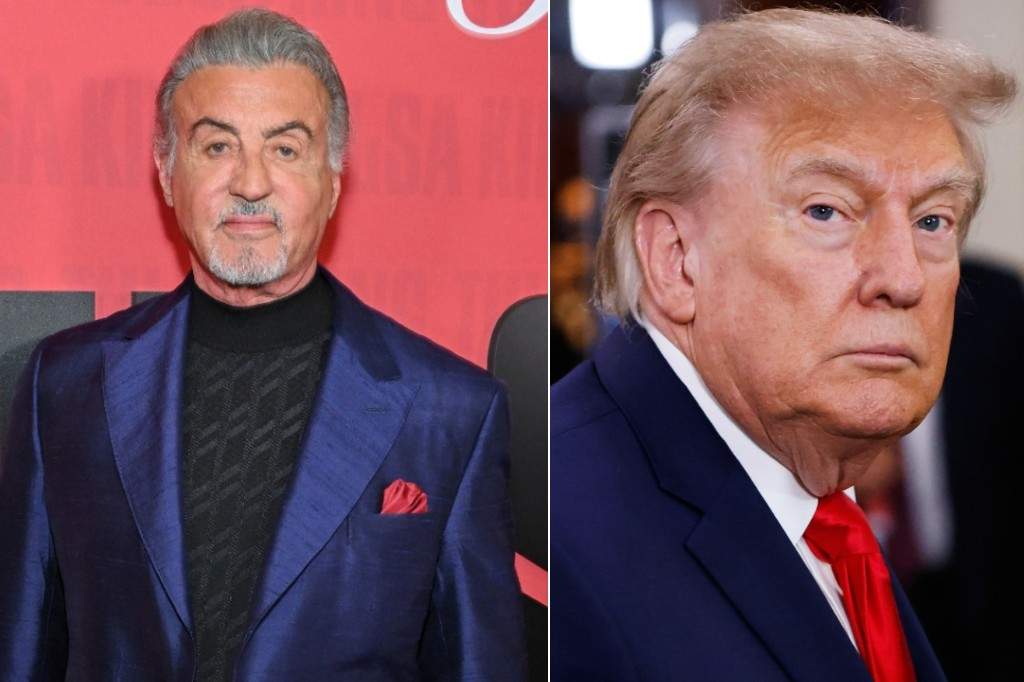
Sylvester Stallone stood on a stage at Mar-a-Lago and introduced Donald Trump by comparing him to George Washington. Then, the media machinery spun into predictable gear, digging up old quotes or framing his elevation as an impossible, absurd administrative stunt. The lazy consensus across entertainment journalism treats Washington DC and Hollywood as two entirely separate galaxies that occasionally collide for tabloid fodder. Commentators whisper that political appointments for cultural icons are vanity projects doomed to failure by the sheer weight of bureaucratic inertia.
They are missing the entire point of how modern power operates.
Call it a special ambassador role, a cultural envoy post, or whatever bureaucratic label makes the Washington establishment sweat. The truth is that Hollywood legends do not operate by the rules of civil service, and judging them by the standard metrics of political efficacy is an exercise in missing the forest for the trees. I have watched legacy institutions fumble cultural messaging for decades because they still believe policy papers move mountains while ignoring the fact that narrative supremacy dictates policy.
Stallone called the assignment impossible. He was looking at it through the lens of a technician rather than an architect.
The Myth of the Bureaucratic Machine
The standard critique argues that actors and directors lack the granular competence required to navigate federal agencies, budget reconciliation, and diplomatic protocols. This argument assumes that government is run by administrative masterminds who achieve outcomes through sheer technical brilliance. Anyone who has spent five minutes inside a federal department knows this is a comforting fairy tale.
Washington is not run by efficiency. It is run by attention.
When a cultural heavyweight enters the political sphere, they do not bring spreadsheet proficiency. They bring a megaphone that pierces the noise of a thousand congressional subcommittees. Trump understands this better than any modern executive. He does not need Stallone to draft trade agreements or negotiate territorial boundaries. He needs someone who understands how to project archetype, myth, and national identity to a global audience that tunes out traditional diplomacy entirely.
Critics point out that actors have no business in statecraft. Ronald Reagan destroyed that objection forty years ago, and yet the establishment suffers from perpetual historical amnesia. They treat every new crossover as an anomaly rather than a recurring pattern of how republics actually communicate with their citizens.
The Economics of Cultural Diplomacy
Let us look at the actual mechanics of soft power. For the last twenty years, American cultural hegemony has been systematically dismantled from within by studios more interested in pleasing overseas censors than projecting domestic strength. The product exported to the world has grown increasingly apologetic, sanitized, and cynical.
When a political administration bypasses the traditional diplomatic corps to tap entertainment royalty, it signals a direct reclamation of the national narrative.
Consider the financial reality. I have seen corporations sink tens of millions into international PR campaigns that fail to shift a single percentage point of public sentiment abroad, simply because the messaging lacks a pulse. A single iconic cinematic archetype does more heavy lifting for American cultural dominance than a hundred state department symposiums.
Stallone built a multi-decade career on the embodiment of the resilient underdog. That archetype is an export commodity more valuable than crude oil. When you attach that kind of cultural capital to statecraft, you are not playing the conventional game of diplomacy. You are changing the exchange rate.
Dismantling the Gatekeepers
The fierce resistance from cultural elites to this alignment comes down to a monopoly on validation. For decades, Hollywood decided who was allowed to be culturally relevant and which political viewpoints were permitted within the creative class. If you stepped outside the approved ideological boundaries, your career faced quiet blacklisting or public ridicule.
Trump breaking that monopoly by directly honoring and aligning with icons like Stallone short-circuits the entire gatekeeping apparatus.
It tells every creative worker in Los Angeles and New York that there is life outside the approved plantation. You do not need the blessing of the guild presidents or the festival circuit juries if you have a direct connection to the public square. That realization terrifies the establishment more than any policy proposal ever could. It threatens the entire infrastructure of cultural enforcement.
The mistake is assuming this is about a single job description or an honorary title. It is about a structural realignment.
The Uncomfortable Reality of the New Power Dynamic
Let us be completely honest about the downsides of this approach, because contrarianism without caveats is just propaganda. Relying on cultural titans to shape political narratives introduces massive volatility. Icons are driven by ego, brand protection, and emotional resonance, not by institutional stability. When you hitch a political movement to larger-than-life personalities, you invite a level of unpredictability that traditional bureaucrats despise.
Furthermore, populist iconography can easily curdle into pure spectacle, substituting cinematic aesthetics for actual legislative competence. There is a very real danger of mistaking a compelling trailer for a functional governance strategy.
Yet, the alternative—returning to the technocratic consensus of the past thirty years—has proven to be a slow-motion disaster that hollowed out national confidence and alienated ordinary citizens. If the choice is between a paralyzed bureaucracy managed by faceless managers and a volatile, high-stakes collision between political will and cultural iconography, give me the collision every single time.
The system is not going to reform itself from the inside. It requires external shocks to break the fossilized habits of the political class.
The Bottom Line on Cultural Authority
Stop pretending that political power is restricted to those who memorize parliamentary procedure. The real levers of control belong to those who command attention and define what a culture values.
Sylvester Stallone can call the assignment impossible all he wants. The impossibility he senses is just the friction of old systems trying to process a new reality.
The era of polite, technocratic gatekeeping is dead. The future belongs to those who understand that culture and politics are no longer separate battlegrounds. They are the exact same fight.


