For seven years, Sarah carried two distinct pairs of shoes in her trunk. One pair was for the concrete sidewalks of the city; the other, a pair of worn-out rubber boots she kept just in case she had to carry her seven-year-old son, Leo, across mulch beds, wood chips, and gravel paths that looked entirely harmless to everyone else.
To the untrained eye, a neighborhood park is a simple rectangle of joy. To a parent whose child uses a wheelchair, it is often a fortress with an impenetrable moat.
You pull up. You turn off the ignition. You look out the window at the bright yellow slides, the spinning cups, and the towering climbing nets. And then you see it: the invisible barrier. The thick, fibrous mulch that swallows small front caster wheels whole. The wooden steps leading up to the tower that mock every effort of a child who scoots on the ground. You watch your child look at the other kids, and then you watch them look down at their lap.
That silence is heavy. It sits in the car long after you shift back into drive.
But things shifted in Kingston.
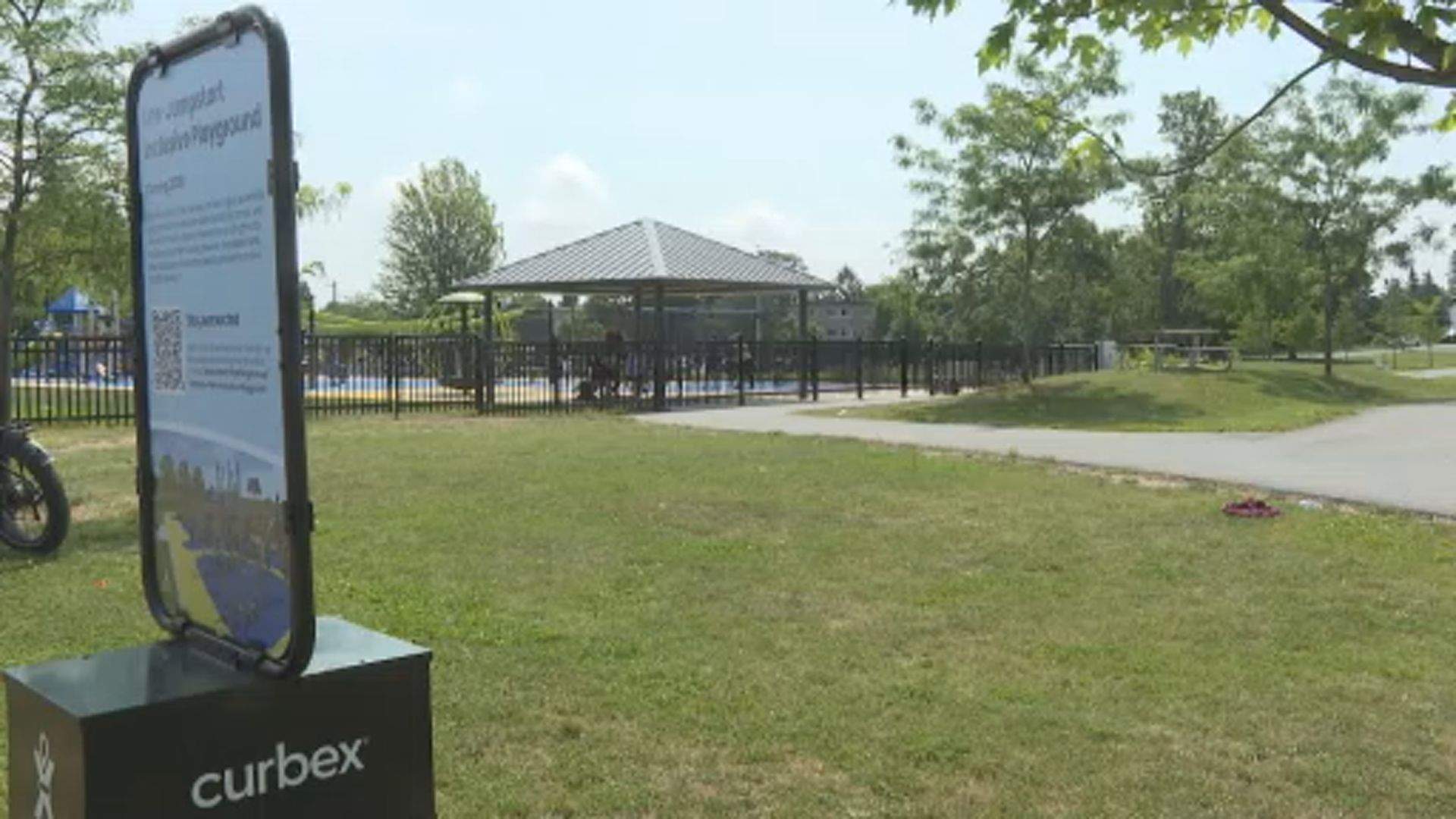
Quietly, without the grand fanfare that usually accompanies municipal ribbon-cuttings, something remarkable took root on a patch of land that used to be standard grass. The city built a playground that refused to draw lines between who gets to play and who has to watch.
Let us be entirely clear about what standard parks actually are. For decades, civic planners designed for the statistical average. They built for the child who can run fast, grip tight with two strong hands, and pull their own weight up a ladder. They did not design for Leo. They did not design for the child with sensory processing differences who hears a squeaking metal chain as a siren of absolute terror. They did not design for the grandparent recovering from a stroke who wants to push their grandchild without tripping over uneven terrain.
When you design for the average, you end up excluding nearly twenty percent of the population right out of the gate.
Consider what happens next when you change that equation.
The new inclusive playground in Kingston did not happen by accident. It is the result of thousands of hours of consultation with occupational therapists, structural engineers, and, most importantly, parents who were tired of keeping two pairs of shoes in their trunks.
The ground is no longer a trap of loose wood chips. Instead, a seamless, poured-in-place rubber surface stretches across the entire footprint. It absorbs impact. It bounces slightly underfoot. More importantly, a wheelchair glides across it with the effortless whisper of a skater on fresh ice.
There are ramps. But these are not the steep, utilitarian concrete ramps you see behind a municipal building, shoved off to the side like an afterthought. These are wide, sweeping architectural ribbons that bring children of all mobility levels directly to the highest tower, side-by-side. No one has to wait at the bottom. No one has to be hoisted up like cargo.
Accessibility is often misunderstood as a checklist. A ramp here. A wider gate there. Done.
Real inclusion is psychological. It is the absence of humiliation.
Leo went there last Tuesday.
I watched him roll up to a specialized swing. This wasn't the flat canvas seat of standard swings, nor was it the baby bucket seat that squeezes too tight. It was a high-backed, molded harness swing that supported his torso while leaving his arms completely free to reach for the sky.
As the swing lifted, his head fell back. He laughed. It was that rich, unfiltered sound that parents hold onto during the hard nights.
Nearby, a little girl with autism was lying inside a sensory pod, shielded from the visual noise of the afternoon sun, spinning slowly while her brother tossed wood-free beanbags into a low-set target. No one was staring. No one was whispering. For the first time in his life, Leo was simply another kid at the park.
Municipal budgets are tight. Taxpayers always ask where the money goes, and city councils feel the squeeze of competing priorities. Fixing roads, updating water mains, funding emergency services. These are the heavy items on the ledger.
Parks often get the leftovers.
Yet, treating inclusive design as a luxury line-item is a profound miscalculation of human infrastructure. When a city builds a space where every child can play, it stops being merely a recreation area. It becomes a civic anchor. It teaches empathy before prejudice has a chance to take root. A child who grows up sharing a slide with a peer who uses a walker does not grow up to be an adult who views disability as an inconvenience or an afterthought. They grow up seeing humanity in its full, vibrant spectrum.
The economic argument matters too, even if it feels cold next to the sound of children laughing. Accessible tourism brings families into local business districts. When a family travels, they look for destinations that accommodate their entire unit. A truly inclusive park draws regional foot traffic, filling nearby cafes and ice cream shops on a Tuesday afternoon.
Yet, numbers rarely capture the texture of the moment.
Back at the park, the sun began to dip behind the treeline. The afternoon chill rolled in, turning breath into faint mist.
Sarah didn't open her trunk to swap shoes. She didn't have to. She walked beside Leo on the same flat, forgiving rubber surface, pushing his chair toward the parking lot while he hummed a tune he had made up on the swings.
The rubber boots stayed in the dark.
Kingston built a park. But what they really constructed was an invitation.
An invitation to belong.
And once you feel that ground beneath your feet, you realize there is no going back to the way things were.