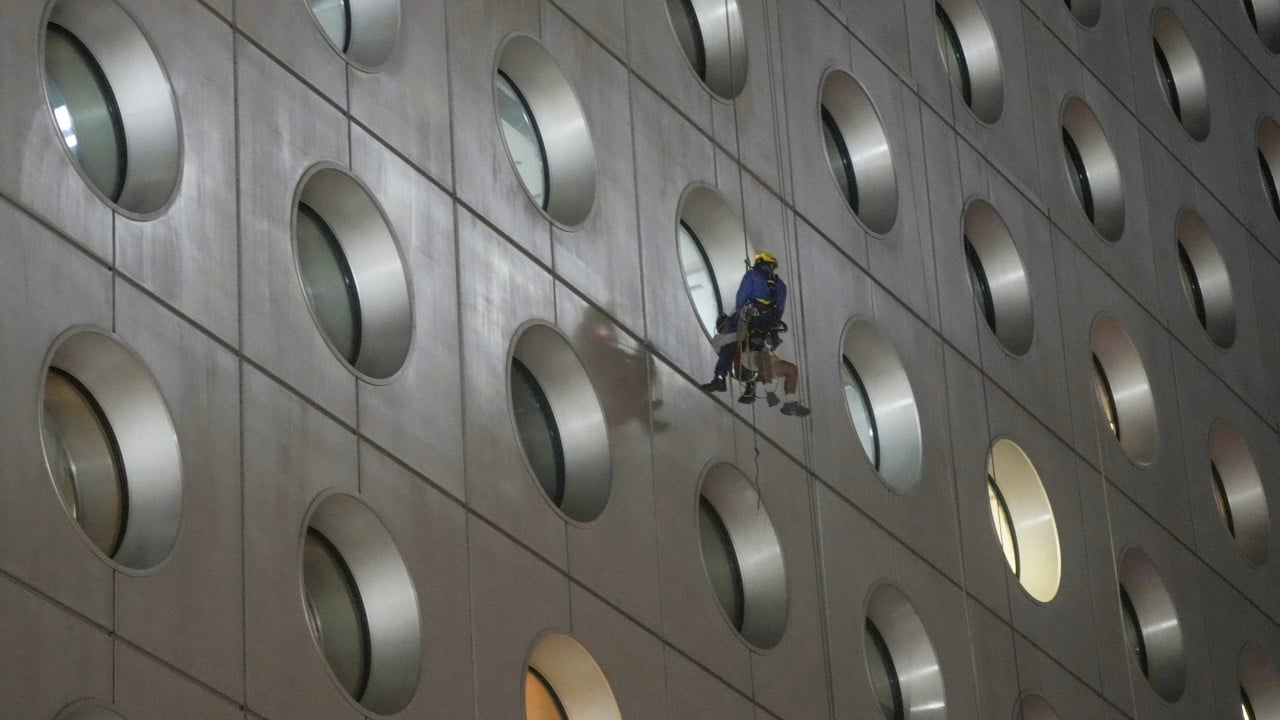
Two exterior maintenance workers were left dangling more than 30 storeys above Hong Kong's Central district after a mechanical fault crippled their suspended gondola on the facade of Jardine House. Fire Services Department rescue teams deployed to the iconic porthole-windowed skyscraper, executing a high-angle extraction to bring both men safely back inside the building without life-threatening injuries. While emergency responders prevented a tragedy, the incident exposes the fragile mechanical realities, aging infrastructure, and intense commercial pressures governing high-altitude facade maintenance in one of the world's densest vertical cities.
Anatomy of a Mid-Air Stalling
To understand how two seasoned technicians end up stranded hundreds of feet above Connaught Place, you have to look at the hardware holding them up. A Building Maintenance Unit, commonly called a gondola or suspended working platform, is not a simple elevator hung from a rope. It is a complex, counterweighted crane system mounted on a rooftop track, lowering an aluminum cradle via galvanized steel wire ropes.
Gravity does not negotiate. When a gondola stalls mid-air, the failure rarely stems from a single snapped cable. Modern platforms utilize dual-wire systems—a primary suspension rope and a secondary safety rope—paired with centrifugal overspeed locks. If the primary hoist motor loses power, strips a gear, or suffers a control-panel short circuit, the braking mechanism engages automatically. That fail-safe is designed to stop a plummet, which is precisely what saves lives. Yet the exact mechanism that prevents a fall also turns the platform into a steel cage suspended in open air.
Once those mechanical brakes lock onto the steel wire, restarting the system from inside the basket is often impossible. Weather shifts rapidly at 400 feet. Crosswinds funneling between Victoria Harbour and the Mid-Levels create localized gusts that slam a stalled cradle against curtain walls and concrete mullions. In the case of Jardine House, whose distinctive circular windows are set into a sheer, unyielding facade, a swinging platform poses an immediate crushing hazard to the workers inside and a falling-glass hazard to pedestrians on the street below.
The Structural Reality of Aging Trophy Towers
Jardine House is not a newly minted glass box. Completed in 1973 as the Connaught Centre, it was once the tallest building in Asia and remains a flagship asset in the Hongkong Land portfolio. Maintaining a 52-storey structure that has weathered more than five decades of subtropical typhoons, salt-laden harbor air, and relentless humidity requires continuous external intervention.
Building Maintenance Units on legacy skyscrapers face a distinct engineering challenge. While internal elevators are routinely modernized with solid-state drives and predictive diagnostics, rooftop gondola systems often operate on a different replacement cycle. Retrofitting a rooftop track and jib assembly on a 1970s high-rise involves severe structural load constraints. You cannot simply bolt a heavier, modern crane onto an older roof slab without extensive steel reinforcement. Consequently, facilities managers frequently rely on heavy maintenance and component overhauls of existing BMU architectures rather than full-scale replacements.
Salt corrosion is the silent enemy of rooftop machinery. Steel wire ropes, limit switches, and hoist drums exposed to Hong Kong's coastal atmosphere degrade from the inside out. A wire rope can pass a visual inspection while harboring internal micro-fractures or core corrosion caused by trapped moisture. Electrical relays inside rooftop control cabinets suffer similar degradation, where high humidity triggers intermittent faults that only manifest under full load—such as when two workers and their heavy cleaning or glazing equipment are suspended 30 floors above the pavement.
The Invisible Economy of Facade Maintenance
Look up in Central on any clear morning and you will see dozens of cradles creeping down the faces of banks, hotels, and commercial towers. The financial district runs on appearances. A streak of grime on an executive floor window or a degraded sealant joint letting in typhoon rain is unacceptable to Grade-A commercial tenants paying some of the highest rents on earth.
To keep these towers pristine, property management companies outsource exterior work to specialized contractors. Here lies the economic friction that industry insiders rarely discuss publicly. Contracts for window cleaning, sealant replacement, and cladding inspection are fiercely competitive. Margins are thin. Work is strictly dictated by weather windows; a single week of rain or black rainstorm warnings wipes out billable days, creating a backlog that contractors must clear as soon as the sky opens.
When schedules compress, human factors enter the equation. Pre-operation checks—testing the upper and lower limit switches, inspecting the safety lock triggers, verifying the emergency descent manual release—are supposed to be exhaustive. Under pressure to beat the midday heat or finish a drop before afternoon gusts pick up, routine inspections risk becoming perfunctory. Even when a contractor follows every protocol to the letter, they are often operating equipment owned and maintained by the building's management, creating a split responsibility between the crew in the basket and the engineers maintaining the rooftop rig.
Why High-Angle Rescues Are So Dangerous
When a gondola fails, the clock starts ticking against exposure, panic, and wind. Hong Kong's Fire Services Department maintains specialized High Angle Rescue Teams trained specifically for the city's vertical topography, yet every deployment carries acute operational risks.
Rescuers cannot simply fly a helicopter next to a skyscraper; rotor wash in a tight urban canyon would turn a stalled gondola into a wrecking ball. Instead, firefighters must access the roof or an upper mechanical floor, rig their own independent anchor systems, and rappel down to the stranded workers.
Consider the physics of that transfer. A firefighter descends on a single rope, battling wind shear, to reach a suspended platform that may be tilted at a dangerous angle. They must secure the trapped workers into secondary rescue harnesses while the workers are already harnessed to the gondola's lifelines. Unclipping a panicked worker at 350 feet requires absolute precision. A single dropped carabiner becomes a lethal projectile for anyone standing on the street below, forcing police to cordon off entire blocks of Central and paralyzing traffic across the harbor tunnel approaches.
In the Jardine House incident, the building's architecture added a unique wrinkle. Unlike modern curtain-wall towers with operable ventilation panels or wide, flat glass panes that can be removed from the inside, Jardine House features thick concrete cladding punctuated by circular windows. Extracting workers through a porthole opening or hauling them upward to a mechanical refuge floor demands complex rigging and sheer physical endurance from the rescue team.
The Regulatory Blind Spot in Vertical Cities
Hong Kong enforces strict statutory frameworks for suspended working platforms, notably under the Factories and Industrial Undertakings (Suspended Working Platforms) Regulation. Equipment must be inspected by a competent examiner before use, certified every six months, and operated only by workers holding valid training certificates. On paper, the compliance regime is airtight.
In practice, regulatory compliance and real-world mechanical reliability are not the same thing. A six-month certification proves that a machine met safety tolerances on the day the engineer signed the form. It does not guarantee that a limit switch will not fail 14 weeks later after a tropical cyclone dumps ten inches of rain into the control housing.
Furthermore, emergency descent systems on many older gondolas rely on manual gravity-lowering valves. In theory, if power fails, a worker inside the basket can pull a release lever to lower the platform smoothly to the ground. In reality, mechanical jams, asymmetrical cable tension, or tilted platforms often render manual descent useless. If one side of the cradle lowers while the other remains locked by an overspeed brake, the platform tips, risking dumping the occupants out of the basket. That is why standard safety training instructs stranded workers to stay put, remain clipped to their independent vertical lifelines, and wait for professional extraction rather than attempting improvised self-rescues.
The Shift Toward Autonomous and Sensor-Driven Alternatives
The Jardine House scare arrives at a moment when the commercial real estate sector is quietly reconsidering whether human beings should be hanging off the sides of skyscrapers at all. Across Asia's major financial hubs, facility managers are testing autonomous facade-cleaning drones and magnetic climbing robots to handle routine washing and thermal imaging inspections.
These technologies are far from a complete solution. Drones struggle in the unpredictable wind tunnels of Central, lack the payload capacity to carry heavy replacement glass or apply structural sealants, and face strict civil aviation restrictions near Victoria Harbour. For deep structural maintenance, caulking, and heavy repairs, human hands remain irreplaceable.
What can change immediately is how legacy gondolas are monitored. Industrial Internet of Things sensors—capable of tracking motor amperage spikes, cable tension imbalances, and brake wear in real time—cost a fraction of a single emergency shutdown. Predictive maintenance alerts rooftop engineers to a failing relay or a binding gearbox days before a technician ever steps over the parapet. Until building owners mandate continuous telemetry on aging rooftop rigs alongside mandatory six-month paper inspections, workers high above the city will continue to bet their lives on mechanical fail-safes that stop them from falling, leaving them nowhere to go but hanging in the wind.