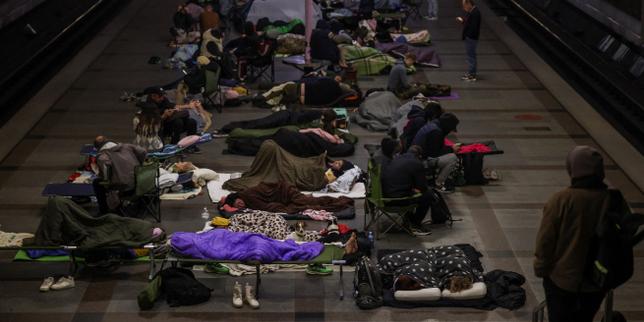
Recent kinetic strikes targeting metropolitan Kiev illuminate the recurring vulnerabilities of point-defense networks when confronted with high-volume missile salvos. Two fatalities and localized infrastructure damage resulting from this engagement demonstrate that interceptor economics and radar horizon limits remain the primary constraints in modern air defense engineering, regardless of the technological sophistication of the deployed systems.
Evaluating this tactical environment requires moving past binary reports of success or failure. Defense architectures operate on strict cost-per-intercept calculations, radar track capacity ceilings, and physical debris dispersion parameters. When a barrage saturates a designated sector, the resulting outcomes are governed by systemic friction points rather than isolated tactical anomalies.
The Interceptor Economics and Saturation Threshold
The foundational problem of contemporary urban air defense is asymmetrical expenditure. Interceptor missiles are low-volume, high-precision industrial goods, whereas offensive delivery systems can incorporate simpler, mass-produced guidance packages and airframes. This economic disparity creates a distinct vulnerability profile.
Incoming Volley (High Volume / Low Cost)
       │
       ▼
[Radar Track Capacity] ──(Saturated)──> Unengaged Vectors
       │
       (Engaged)
       ▼
[Fire Control Unit] ──(Resource Depletion)──> Stockpile Attrition
       │
       ▼
[Terminal Phase Interception] ──(Debris Dispersion)──> Ground Impact & Kinetic Damage
When a salvo exceeds the track capacity of the fire control units, the system must prioritize targets based on predicted impact coordinates. This prioritization creates defensive gaps. Secondary or tertiary targets—such as residential sectors situated adjacent to critical administrative nodes—frequently fall outside the primary defended asset perimeter.
Furthermore, interceptor inventory management dictates conservation protocols. A defender cannot expend finite surface-to-air assets on every incoming signature if intelligence indicates a subsequent, higher-density wave is inbound. This conservation imperative forces commanders to absorb calculated risks on peripheral vectors, directly correlating with unmitigated civilian infrastructure impact during high-saturation events.
The Ballistic and Cruise Trajectory Problem
Different delivery mechanisms impose distinct computational challenges on tracking algorithms. Cruise missiles operate at low altitudes, utilizing terrain masking to compress the detection window of ground-based radars. Ballistic assets, by contrast, utilize exoatmospheric or high-altitude trajectories, descending at terminal velocities that demand rapid course calculations and high-g interceptor maneuvers.
In a mixed-type engagement, the cognitive and processing load on the command-and-control network increases exponentially. Radar systems must simultaneously filter clutter, track multiple target profiles characterized by radically different radar cross-sections, and assign guidance beams or active radar homers.
- Detection Latency: Low-altitude cruise vectors operating below line-of-sight radar horizons delay the initial warning and engagement timeline, compressing the decision window for automated defense systems to mere seconds.
- Kinetic Sorting: Differentiating between decoy payloads, debris fields from prior intercepts, and active warheads consumes processing cycles within the battery fire-control computers.
- Terminal Engagement Geometry: Intercepting a high-speed projectile directly above a densely populated urban center introduces severe collateral hazards, as the kinetic energy and explosive payload of the destroyed threat do not simply vanish; they disperse downward across a predictable ballistic footprint.
Debris Dispersion and Secondary Kinetics
A fundamental misconception in public analyses of air defense engagements is that an interception equates to total mitigation of danger. In practice, destroying a missile mid-air converts a single coherent kinetic threat into a diffuse cloud of high-velocity shrapnel and unspent fuel.
When an interception occurs at low altitudes directly over an urban area, the debris field retains the forward momentum of the original trajectory. This debris acts as unguided kinetic projectiles, capable of puncturing roofs, rupturing gas lines, and causing structural collapses independent of the original warhead's intended detonation point.
The physical mechanics of this phenomenon mean that defending an urban center inherently carries a baseline level of structural risk from defensive operations themselves. The altitude of the interception point dictates the spread of the debris cone. High-altitude intercepts minimize ground-level shrapnel density but require long-range, high-cost interceptors. Low-altitude terminal defense, necessitated by low-flying cruise vectors or saturated upper-tier layers, guarantees that the resulting debris field intersects populated terrain.
The Information Asymmetry and Attribution Cycle
Operational reporting during active engagements suffers from systematic data degradation. Real-time assessments provided by municipal authorities are constrained by operational security mandates, fog of war, and the physical danger of immediate post-strike reconnaissance. Consequently, early casualty figures and structural damage assessments are provisional approximations rather than exhaustive audits.
This information vacuum is frequently filled by speculative commentary that conflates strategic intent with tactical execution errors. To analyze these events accurately, observers must decouple the political narrative from the physical reality of the engagement parameters. The destruction of civilian structures in Kiev is not an isolated tactical choice by the striking force, nor is it a complete failure of the defensive network; it is the statistical outcome of kinetic warfare executed within a densely populated urban theater where defense-in-depth is spatially constrained by geography.
Resource allocation for future urban defense optimization will depend on closing the gap between radar horizon limitations and low-altitude detection networks. Until distributed sensor grids can provide instantaneous, unmasked tracking of terrain-hugging vectors across all approaching azimuths, urban centers will remain vulnerable to the compounding effects of saturation attacks and the unavoidable physics of terminal debris dispersion.