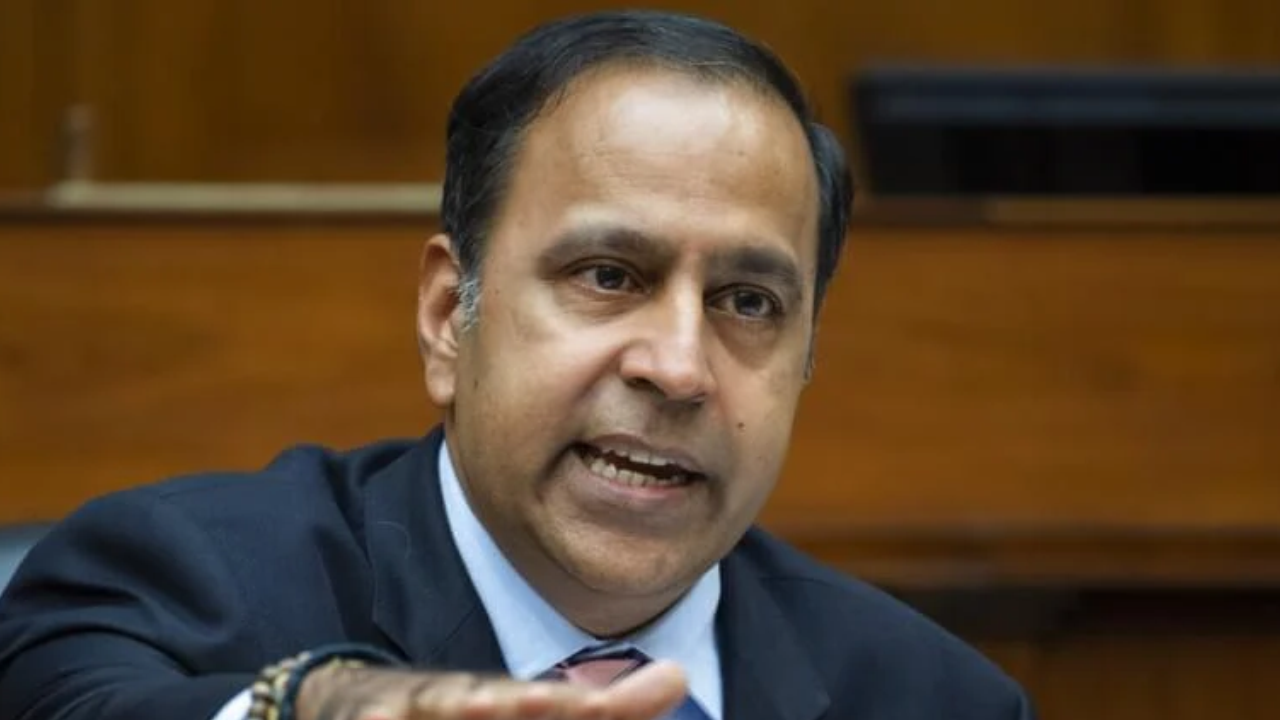
Political discourse regarding immigrant communities frequently oscillates between emotional appeals and demographic data points, ignoring the foundational mechanics of labor economics and civic integration. When public figures characterize debates over immigration status and national belonging as xenophobic, they are observing the surface-level symptom of a deeper structural friction: the tension between national identity paradigms and globalized human capital flows. To analyze statements made by political figures like US Congressman Raja Krishnamoorthi regarding Indian Americans requires stripping away the rhetorical veneer to examine how modern nation-states process demographic transitions, economic dependency, and cultural assimilation.
The traditional nation-state model assumes a closed-loop system where geographic borders, cultural norms, and economic productivity completely overlap. In a globalized economy, this triad fractures. Human capital moves across borders at scale, while socio-political institutions lag behind, relying on archaic taxonomies of belonging. This creates an institutional bottleneck. Recently making news in this space: The Structural Mechanics of Bilateral Equilibrium The India China Border Calculus.
The Tripartite Framework of Civic Inclusion
To evaluate claims of xenophobia or nativism within political debates, one must separate public discourse into three distinct vectors: the rhetorical vector, the economic vector, and the institutional vector.
The rhetorical vector encompasses public statements, media framing, and political posturing. This is the domain of identity politics, where terms like American identity are weaponized for political mobilization. When political figures intervene to label specific debates as racist, they are reacting to the weaponization of this vector. However, treating the rhetorical output as the root cause misdiagnoses the system. Rhetoric is merely the lagging indicator of systemic economic and social anxieties. Additional information on this are covered by NBC News.
The economic vector operates on entirely different principles. Immigrant groups, particularly high-skilled cohorts from South Asia, occupy a critical structural position in labor markets ranging from technology and engineering to medicine and academia. The economic dependency of advanced economies on imported human capital contradicts the isolationist impulses found within the rhetorical vector. This contradiction generates cognitive dissonance within domestic populations, manifesting as political friction.
The institutional vector represents the legal, regulatory, and bureaucratic frameworks governing naturalization, labor certification, and residency. Because institutional frameworks were designed for mid-twentieth-century migration patterns, they fail to accommodate contemporary professional mobility. Backlogs in permanent residency processing, caps on employment-based visas, and vulnerabilities in dependent visa statuses create an artificial precarity for populations that are economically integrated yet institutionally marginalized.
The Cost Function of Labor Market Friction
When examining the integration of immigrant communities, public policy discussions often treat human capital as a static commodity rather than a dynamic asset. The economic contribution of demographic groups such as Indian Americans can be modeled through productivity metrics, entrepreneurship rates, and fiscal contributions.
Data from labor economics demonstrates that high-skilled immigrant cohorts exhibit higher-than-average rates of business formation and patent generation. This is not driven by cultural exceptionalism, but by self-selection mechanics. Individuals who clear stringent legal and bureaucratic hurdles to immigrate possess higher risk tolerance and specialized educational capital.
[Immigration Bureaucracy] ---> [High Self-Selection Barrier] ---> [Concentrated Human Capital] ---> [Disproportionate Innovation Output]
Despite this productivity, institutional frictions impose a hidden tax on the economy. Employment-based visa systems tie residency status directly to specific employers, suppressing wage growth and dampening entrepreneurial risk-taking for workers who would otherwise scale new ventures. The debate over immigration is therefore inextricably bound to labor market efficiency. Restrictive political rhetoric does not merely create social discomfort; it introduces regulatory uncertainty that misallocates human capital.
The Assimilation Paradox and Social Cohesion
Critics of contemporary immigration patterns frequently invoke concerns over social cohesion, assuming that cultural assimilation is a zero-sum game where incoming populations erode existing national identities. This perspective ignores the sociological mechanics of pluralistic integration.
Assimilation is rarely a binary choice between total erasure of heritage and complete cultural replacement. In advanced pluralistic societies, it operates as a multi-generational matrix. First-generation immigrants typically prioritize economic establishment and institutional navigation. Second-generation cohorts negotiate dual cultural frameworks, often producing hybrid professional and social networks that enhance, rather than diminish, national competitiveness.
The friction arises when political actors exploit the transition phases of this matrix. By framing demographic shifts as an existential threat to cultural continuity, political narratives capitalize on status anxiety among native-born populations experiencing economic stagnation or regional decline. The debate is reframed from an optimization problem regarding labor and capital into a zero-sum conflict over identity.
Strategic Policy Forecasting
Resolving the structural tensions highlighted by public debates over immigration requires moving past rhetorical denunciations and focusing on institutional redesign. The current model—characterized by arbitrary caps, multi-decade green card backlogs, and vulnerable non-immigrant work authorizations—is optimized for political friction rather than economic output.
Future economic resilience depends on decoupling legal residency from immediate employer sponsorship, modernizing employment-based green card allocations, and treating human capital attraction as a core national security and competitiveness metric. Until institutional mechanisms align with economic realities, public discourse will continue to cycle through reactionary nativism and defensive rhetoric, leaving the underlying systemic inefficiencies unaddressed.