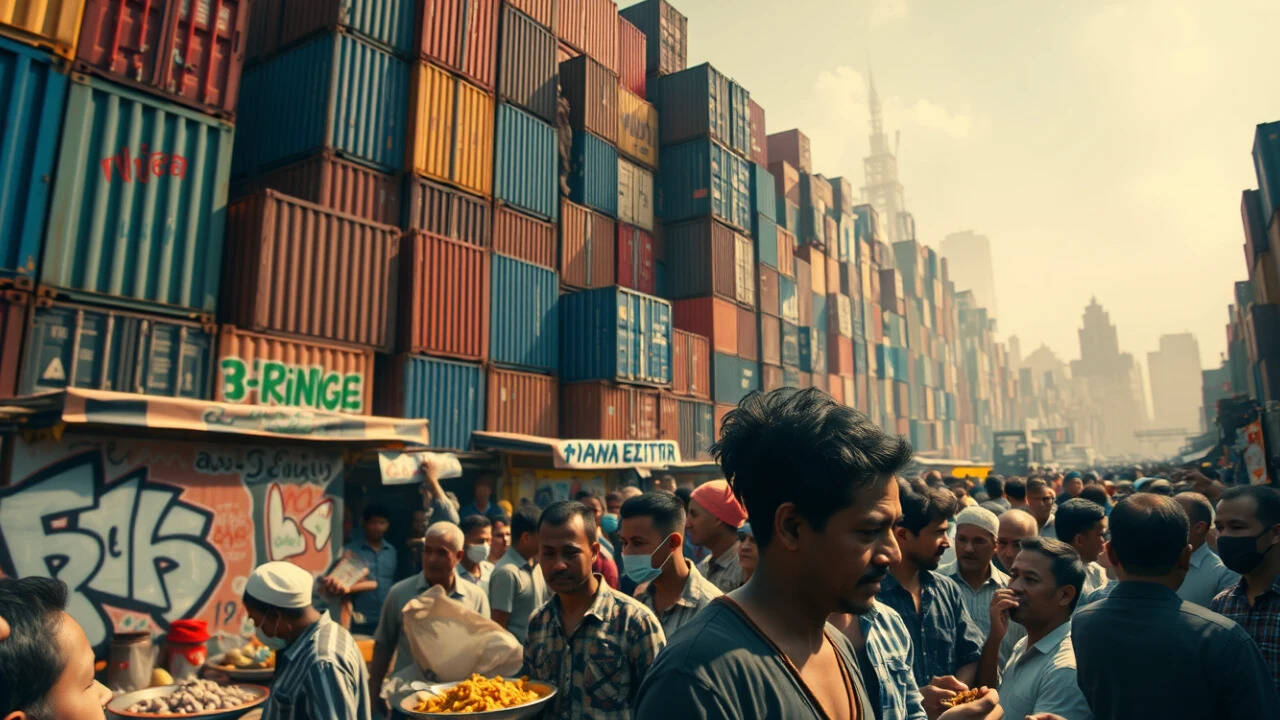
Dordoi Bazaar operates on the northern outskirts of Bishkek, Kyrgyzstan, functioning as a primary commercial entrepôt connecting Chinese manufacturing output with consumer markets across Central Asia, Kazakhstan, and the Russian Federation. Spanning over 100 hectares, this trading hub demonstrates how modular infrastructure can replace conventional commercial real estate under conditions of high regulatory fluidity and capital scarcity. Deconstructing the mechanics of this marketplace reveals the underlying economic variables that sustain informal and semi-formal trade networks in post-Soviet states.
The Physical Architecture of Adaptive Infrastructure
The structural foundation of the market relies on the adaptive reuse of corrugated steel shipping containers, numbering between 6,000 and 7,000 units historically, with broader agglomerations expanding into tens of thousands. The deployment model utilizes a vertical stacking configuration:
- Lower Level: The bottom container is modified with cut-out access points, security shutters, and interior shelving, functioning as a point-of-sale retail or wholesale shop.
- Upper Level: The top container remains structurally unmodified or lightly altered, serving as high-density inventory storage accessible via external metal staircases.
This vertical integration minimizes land-use footprints while maximizing inventory turnover per square meter. Overhead canopy structures—consisting of expansive tensile shade roofs spanning entire rows—mitigate extreme thermal fluctuations, protecting merchandise and operators from continental weather extremes ranging from sub-zero winters to high summer temperatures.
The Supply Chain Mechanics and Re-Export Dynamics
The commercial viability of the market rests entirely on its position within a transnational logistics corridor. Goods originating primarily in industrial centers across China enter Kyrgyzstan via cross-border trucking routes traversing mountain passes. Secondary import vectors originate in Turkey, South Korea, and European markets, supplying higher-margin apparel and consumer electronics.
The operational workflow inside the market follows a strict sequence:
- Bulk Ingestion: Freight arrives via heavy transport vehicles, unloading bulk commodities directly into storage modules or immediate wholesale distribution bays.
- Value-Reworking and Compression: Specialized packing stations located near the market peripheries process soft goods, utilizing mechanical presses to compress clothing and textiles into dense, waterproof bales optimized for long-distance transit.
- Secondary Distribution: Shuttle traders (chelnoki) purchase inventories in wholesale lots, transferring goods onto minibuses and long-distance transport fleets bound for distribution points in Kazakhstan, Uzbekistan, and Siberia.
This re-export economy functions as a macroeconomic stabilizer for Kyrgyzstan, capturing value through logistical arbitrage rather than domestic manufacturing.
The Cost Structure and Informal Regulatory Equilibrium
Operating within a transitional economic zone requires a cost structure that avoids the capital expenditure and regulatory overhead of institutional brick-and-mortar retail. Container acquisition and placement costs remain low due to persistent trade imbalances that strand shipping containers inland.
The regulatory environment operates through an equilibrium between formal state oversight and informal taxation. Ownership of distinct market sectors is fragmented among multiple private operating entities—such as Alkan Bazary, Muras Sport, and Dordoi Bazaary LLC—which collect space-rental fees. Concurrently, security agencies and municipal entities enforce compliance through informal extraction mechanisms, such as variable fee collections. This hybrid structure maintains operational continuity for tens of thousands of workers—ranging from manual freight handlers (cart pullers) to international wholesale brokers—without requiring complete bureaucratic formalization.
Vulnerabilities and External Exposure
The high concentration of economic activity within a single physical node creates systemic risks. Because the marketplace depends heavily on cross-border trade agreements, tariff adjustments, and currency stability within destination economies like Russia and Kazakhstan, external macroeconomic shocks immediately compress trading volumes. Furthermore, political pressures regarding urban modernization and labor safety standards threaten the longevity of the container-based model, as state authorities push for structural upgrades modeled after conventional commercial complexes in Dubai or Istanbul.
Deploy capital into regional logistics optimization and automated inventory tracking systems for secondary distribution networks to mitigate margin erosion caused by increasing regulatory scrutiny and cross-border friction.
A walking tour through Dordoi Bazaar
This video provides a visual overview of the layout and operational scale of the container market described in the analysis.