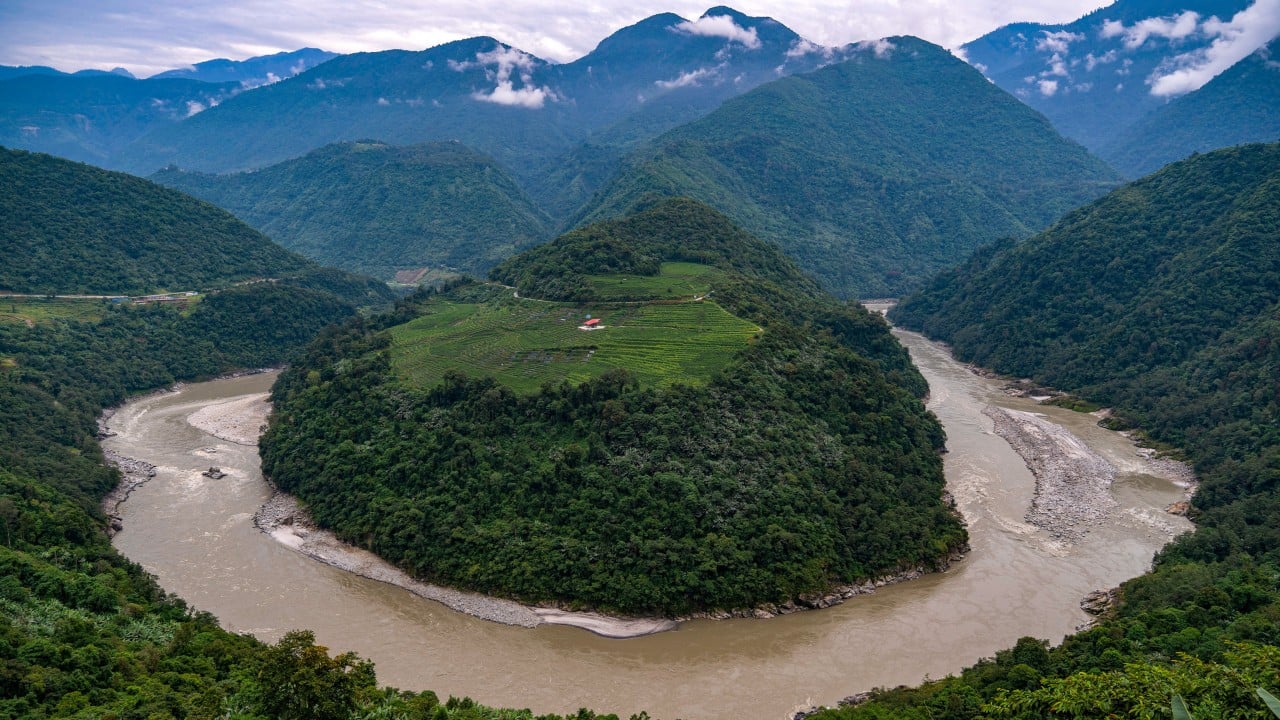
The proposed 60-gigawatt hydropower facility on the Yarlung Tsangpo river in the Tibet Autonomous Region represents a concentration of kinetic energy without historical precedent. Engineering a dam at the Great Bend, where the river drops 2,000 meters over a short distance, shifts the discussion from standard infrastructure development to the management of extreme physical and seismic variables. The project’s viability depends not on political will, but on the mitigation of three specific risk vectors: seismic instability in the Himalayan collision zone, the logistics of high-altitude materials science, and the hydrologic volatility of the Brahmaputra basin.
The Triple Constraint of Himalayan Engineering
Constructing a mega-dam in the Medog County region requires a departure from the engineering templates used for the Three Gorges Dam. The technical challenges are defined by the intersection of tectonic activity, hydraulic pressure, and logistical isolation.
1. Seismic Loading and Crustal Stress
The project site sits directly above the collision point of the Indian and Eurasian plates. This is not a passive variable; it is a fundamental constraint on the dam’s "Factor of Safety"—the ratio between the structure’s capacity and the actual loads applied to it.
- Active Faulting: The Main Himalayan Thrust (MHT) generates recurring high-magnitude events. Any structure must be designed to withstand Peak Ground Acceleration (PGA) values that exceed current international standards for gravity dams.
- Reservoir-Induced Seismicity (RIS): The sheer mass of the impounded water can alter the stress state on underlying faults. In a region already under extreme tectonic compression, the addition of billions of tons of water creates a risk of triggering "slip events" that could lead to catastrophic structural failure.
2. High-Altitude Material Fatigue
Standard concrete performance degrades under the thermal cycling typical of the Tibetan plateau. At altitudes exceeding 3,000 meters, the freeze-thaw cycles are more frequent and intense than in lowland environments.
- Thermal Gradient Management: The core of a mega-dam generates significant heat during the curing process. In an environment where external temperatures can drop well below zero, the internal-to-external temperature differential can cause micro-cracking. This reduces the impermeability of the structure, leading to long-term erosion of the internal matrix.
- Aggregate Quality: The "Quality First" mandate often cited in state media refers to the chemical composition of the stone and sand used in the concrete. High-alkali aggregates can lead to Alkali-Silica Reaction (ASR), a "concrete cancer" that causes internal expansion and cracking over decades.
3. Sedi-Kinetic Energy and Turbine Erosion
The Yarlung Tsangpo carries one of the highest sediment loads of any major river. This is a mechanical problem for power generation.
- Silt Abrasion: High-velocity water carrying quartz-heavy silt acts as an industrial sandblaster on turbine blades. To maintain a 60-gigawatt output, the project requires specialized coating technologies (such as High-Velocity Oxygen Fuel or HVOF) or frequent, high-cost maintenance cycles that could undermine the project’s Energy Return on Investment (EROI).
The Hydrologic Zero-Sum Game
The engineering of the dam is inseparable from the downstream flow requirements of India and Bangladesh. The "Great Bend" project introduces a control mechanism over the headwaters of the Brahmaputra, creating a structural dependency for downstream nations.
Flow Regulation vs. Flow Diversion
A primary source of friction is the distinction between a "run-of-river" project and a "storage" project.
- Run-of-River (ROR): Theoretically, the dam generates power using the natural flow of the river without significant water storage. However, even ROR projects at this scale require diurnal storage to manage peak demand, which fluctuates the downstream flow every 24 hours.
- Storage and Silt Entrapment: Even if water volume is maintained, the dam will inevitably trap nutrient-rich silt. This sediment is the lifeblood of the agricultural plains in Assam and Bangladesh. Removing it from the water column increases the "hungry water" effect—where the sediment-free water flows faster and erodes downstream riverbanks more aggressively.
Quantifying the Scale of the Energy Harvest
The 60-gigawatt target is roughly triple the capacity of the Three Gorges Dam. To achieve this, the project must exploit the hydraulic head (the vertical distance the water falls).
- The Tunneling Strategy: Most models suggest the construction of massive diversion tunnels across the neck of the Great Bend. This allows the water to bypass the natural curve of the river, dropping through turbines at a much steeper angle.
- Transmission Loss: The primary consumers of this power are located thousands of kilometers away in China's eastern coastal provinces. The project's success is contingent on Ultra-High Voltage (UHV) transmission technology. If the efficiency of these lines drops below a specific threshold, the cost-per-kilowatt becomes uncompetitive compared to coastal nuclear or offshore wind.
Geological Risk as a Strategic Liability
The "top priority" of safety is a recognition that a failure in Medog would not just be a local disaster; it would be a regional kinetic event.
- Glacial Lake Outburst Floods (GLOFs): Climate data indicates that Himalayan glaciers are retreating, increasing the number and size of proglacial lakes. A GLOF upstream of the mega-dam could create a surge of water and debris that exceeds the spillway capacity.
- Landslide-Dammed Lakes: The steep canyons of the Yarlung Tsangpo are prone to massive landslides. If a landslide blocks the river upstream, a subsequent breach would create a "wall of water" effect. The dam must be designed not just for a 1-in-1,000-year flood, but for a multi-hazard scenario where a seismic event triggers both a landslide and a flood surge simultaneously.
The Economic Logic of High-Risk Infrastructure
Why pursue a project with such extreme risk parameters? The answer lies in the shift toward "Pumped Hydro Storage" (PHS) as a backbone for renewable energy grids.
- Intermittency Buffering: Solar and wind power are variable. A mega-dam of this scale acts as a massive battery. When solar output is high, the dam can restrict flow (storing potential energy); when solar output drops, the dam releases water to stabilize the grid.
- Decarbonization Targets: The sheer scale of the Yarlung Tsangpo project is one of the few ways to meet national carbon neutrality goals without a massive expansion of the nuclear fleet.
Operational Constraints and Maintenance Cycles
Long-term structural health monitoring is the hidden cost of the Medog project.
- Fiber-Optic Sensing: To manage seismic and thermal risks, the dam will likely be embedded with thousands of fiber-optic sensors to monitor real-time strain and temperature changes within the concrete.
- Autonomous Desilting: To combat the sediment problem, the project will require automated dredging systems or specialized "low-level outlets" designed to flush sediment during the monsoon season. These systems increase the complexity of the dam's internal plumbing and create more potential points of mechanical failure.
The strategic play for the Yarlung Tsangpo complex is the transition from a passive energy generator to an active grid-stabilization asset. However, this utility is balanced against a "Fat-Tail Risk"—a low-probability, high-consequence event where seismic activity or climate-driven hydrologic surges exceed the design specifications. The project is an experiment in the limits of materials science and crustal stress management. Future stability in the Brahmaputra basin will be determined by whether the engineering can decouple the kinetic potential of the river from the inherent volatility of the Himalayan geography. If the "Factor of Safety" is miscalculated by even a narrow margin, the infrastructure becomes a permanent liability rather than a generational asset.