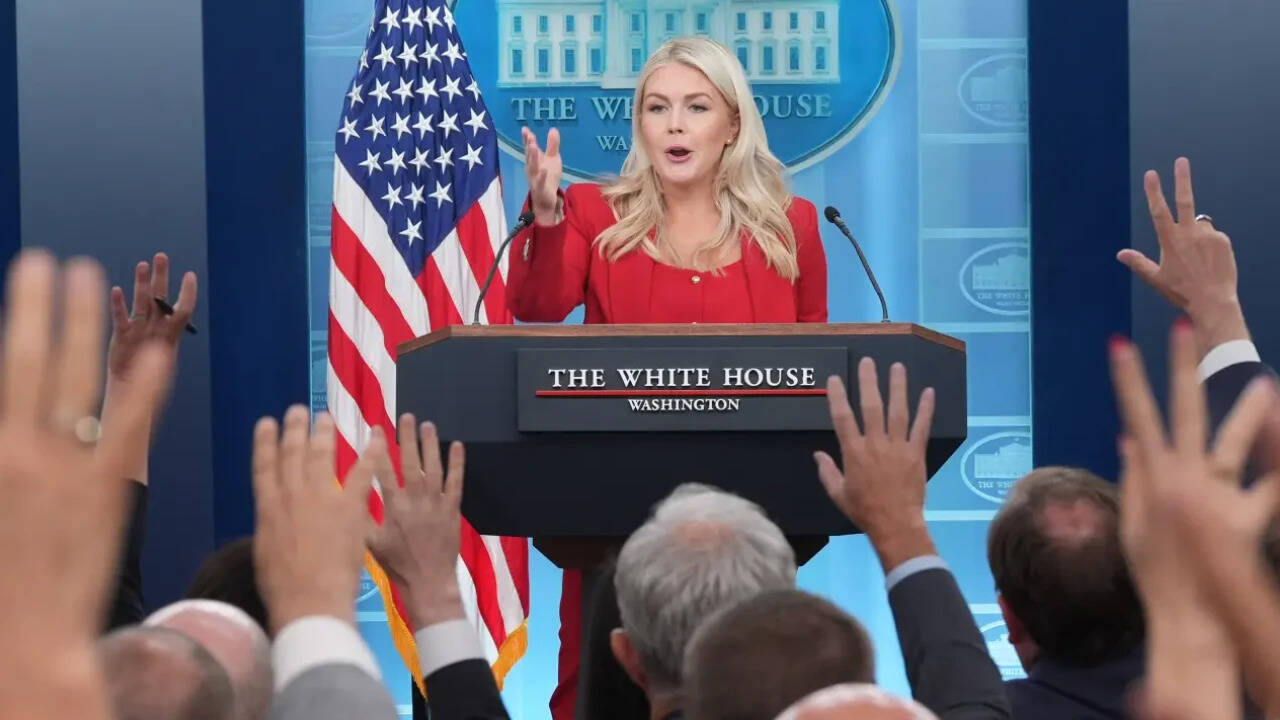
The departure of a primary administrative mouthpiece serves as a diagnostic indicator of how political communication infrastructure adapts under structural stress. When Karoline Leavitt announced her transition from the White House podium to an external advisory role, legacy commentary focused heavily on personal narratives and media friction. A rigorous examination requires moving past surface-level media friction to analyze the mechanical evolution of executive messaging, operational burn rates inside high-intensity organizations, and the strategic reallocation of partisan influence ahead of midterm electoral cycles.
The Operational Mechanics of the Podium Burn Rate
The White House press secretary position operates under an intense cost function. The role demands continuous public defense of an executive agenda against an adversarial institutional press corps, resulting in high cognitive fatigue and rapid depletion of personal bandwidth.
Three primary vectors drive this high attrition rate:
- The Temporal Friction of Media Saturation: Modern cycles require real-time defensive and offensive posture adjustments across fragmented digital channels, multiplying the traditional workload of daily briefings.
- The Adversarial Output Index: The institutional shift away from traditional press pool mechanics toward digital-first and independent commentary channels alters the target audience, forcing staff to manage dual communication tracks simultaneously.
- The Structural Tension of Personal Life Stages: Balancing high-visibility executive communication roles with infant childcare introduces logistical bottlenecks that conflict with the 24-hour availability demanded by modern white house operations.
Leavitt’s tenure, spanning roughly eighteen months following her appointment as the youngest press secretary in executive history, tested the limits of this operational model. Her return from maternity leave in July followed by an August departure highlights a clear structural realization: the physical podium demands a level of continuous public confrontation that becomes mathematically incompatible with sustainable long-term bandwidth management.
The Evolution from Institutional Spokesperson to External Strategic Unit
The transition from official government spokesperson to external political operative represents a deliberate pivot in influence management. Within modern executive strategy, official spokespersons are bound by statutory and institutional norms that restrict direct partisan mobilization. By moving outside the West Wing structure while retaining proximity to executive decision-making, an operative gains structural flexibility:
- Unrestricted Campaign Advocacy: External advisors operate outside the formal constraints of executive branch communication offices, allowing for aggressive messaging targeted at midterm electoral outcomes.
- Digital-First Message Distribution: Operating without the physical confines of the briefing room enables direct engagement through decentralized networks, podcasts, and digital ecosystems without filtering through institutional gatekeepers.
- Message Diversification: The executive office can separate day-to-day administrative defense from broader ideological alignment, insulating the formal policy apparatus while empowering external surrogates to drive movement cohesion.
This structural relocation mirrors previous instances where high-profile communications figures step away from institutional constraints to maximize external leverage during critical legislative or electoral windows.
Resource Reallocation Ahead of Electoral Bottlenecks
The timing of staff reconfigurations is rarely accidental. Administrations facing low approval metrics or complex legislative environments typically restructure communication assets to optimize narrative control. Moving high-recognition assets into external advisory roles shifts the organizational focus from defensive containment to proactive voter mobilization.
The strategic utility of this shift relies on brand retention. An internal press secretary absorbs daily criticism; an external advisor deploys established authority to shape external perception, fundraise, and coordinate narrative alignment across allied media networks. The architecture of political communication no longer centers solely on the physical briefing room; it relies on multi-channel dissemination where external surrogates hold higher conversion value than institutional mouthpieces.
Reallocate institutional communication assets toward decentralized digital networks and deploy high-recognition surrogates into external advisory roles to bypass legacy gatekeepers and drive targeted voter alignment ahead of upcoming electoral thresholds.