Deploying 1,500 tons of recycled concrete across three distinct sites in the Gulf of Mexico is not merely a conservation milestone; it is a capital allocation exercise in benthic engineering and waste-stream arbitrage. Most public reporting on artificial reef installations reduces the event to a binary narrative of environmental altruism. That framing obscures the underlying operational mechanics. When coastal municipalities and state agencies sink decommissioned civil infrastructure—bridge pilings, culverts, and precast concrete—they are executing a dual-purpose strategy: offsetting terrestrial landfill liabilities while manufacturing high-relief marine real estate designed to concentrate biomass and stimulate local fisheries economics.
Understanding the true yield of this 1,500-ton deployment requires dissecting the physical, biological, and economic variables that govern artificial reef performance. Without a rigorous framework, stakeholders confuse tonnage dumped with ecological productivity produced.
The Benthic Real Estate Deficit and The Attraction-Production Paradox
The eastern Gulf of Mexico is characterized by a broad, gently sloping continental shelf composed largely of unconsolidated quartz sand and carbonate mud. While biologically active at the microbial and infaunal levels, this flat substrate lacks the vertical relief required to support dense populations of reef-associated teleosts such as red snapper (Lutjanus campechanus), gag grouper (Mycteroperca microlepis), and greater amberjack (Seriola dumerili). In benthic ecology, hard-bottom substrate is the primary limiting factor for sessile invertebrates and the trophic cascades they anchor.
Introducing 1,500 tons of concrete alters the local hydrodynamic and structural profile immediately. However, marine resource managers must navigate a fundamental ecological debate known as the Attraction-Production Paradox.
- The Attraction Hypothesis: Artificial structures act merely as fish aggregation devices (FADs). They pull existing adult fish populations away from natural hard-bottom reefs, concentrating them into predictable, easily mapped coordinates. Under this mechanism, total regional biomass remains static, while fishing mortality increases dramatically due to concentrated angling pressure.
- The Production Hypothesis: Artificial substrates generate net new biomass by providing settlement surfaces for planktonic larvae—barnacles, bryozoans, sponges, and scleractinian corals—that would otherwise perish in the water column for lack of hard attachment points. This epifaunal colonization creates a localized food web that supports juvenile survival and somatic growth, expanding the carrying capacity of the broader ecosystem.
In practice, a 1,500-ton concrete deployment operates along a continuum between these two poles. During the first six to eighteen months post-deployment, the sites function almost exclusively as aggregation points. Apex predators and opportunistic feeders colonize the bare concrete within weeks, drawn by the physical shelter from strong bottom currents and the acoustic signature of the new structure. Net ecological production only begins once the concrete undergoes biological conditioning—a successional process where calcifying organisms encrust the substrate, creating micro-habitats for cryptic invertebrates like polychaetes and decapod crustaceans.
Material Science and The Chemistry of Recycled Concrete
Not all demolition debris qualifies for marine deployment. Using unverified construction waste introduces severe toxicological risks, including heavy metal leaching, hydrocarbon contamination, and structural degradation. Consequently, the 1,500 tons deployed across these three Gulf sites must meet strict engineering and environmental specifications established by the Florida Fish and Wildlife Conservation Commission (FWC) and the U.S. Army Corps of Engineers (USACE).
The selection of cured Portland cement concrete over alternative materials—such as scuttled steel vessels or composite modules—is dictated by specific chemical and mechanical properties:
- Surface Alkalinity and Biofouling: Fresh concrete exhibits a high surface pH (typically 12 to 13) due to calcium hydroxide formed during hydration. In seawater, carbonation and leaching gradually lower this surface pH toward the ambient marine baseline of 8.1. Once the surface alkalinity drops below 9.5, pioneer organisms such as diatoms, filamentous algae, and tubeworms rapidly attach. Recycled concrete that has already weathered on land experiences accelerated surface neutralization, shortening the lag time between deployment and primary colonization.
- Specific Gravity and Scour Resistance: Concrete possesses a bulk density of approximately 2,400 kilograms per cubic meter. In the shallow-to-mid-depth waters of the Gulf shelf, storm surge and hurricane-induced orbital wave velocities generate immense shear stress at the seafloor. Low-density materials—such as decommissioned tires used in catastrophic 1970s reef projects—fail structurally and become mobile benthic battering rams. Heavy precast concrete slabs and culverts resist lateral displacement, though they remain vulnerable to hydrodynamic scouring. As bottom currents accelerate around the base of a concrete pile, turbulence erodes the surrounding sand, causing the structure to settle vertically into the substrate over a decade-long horizon.
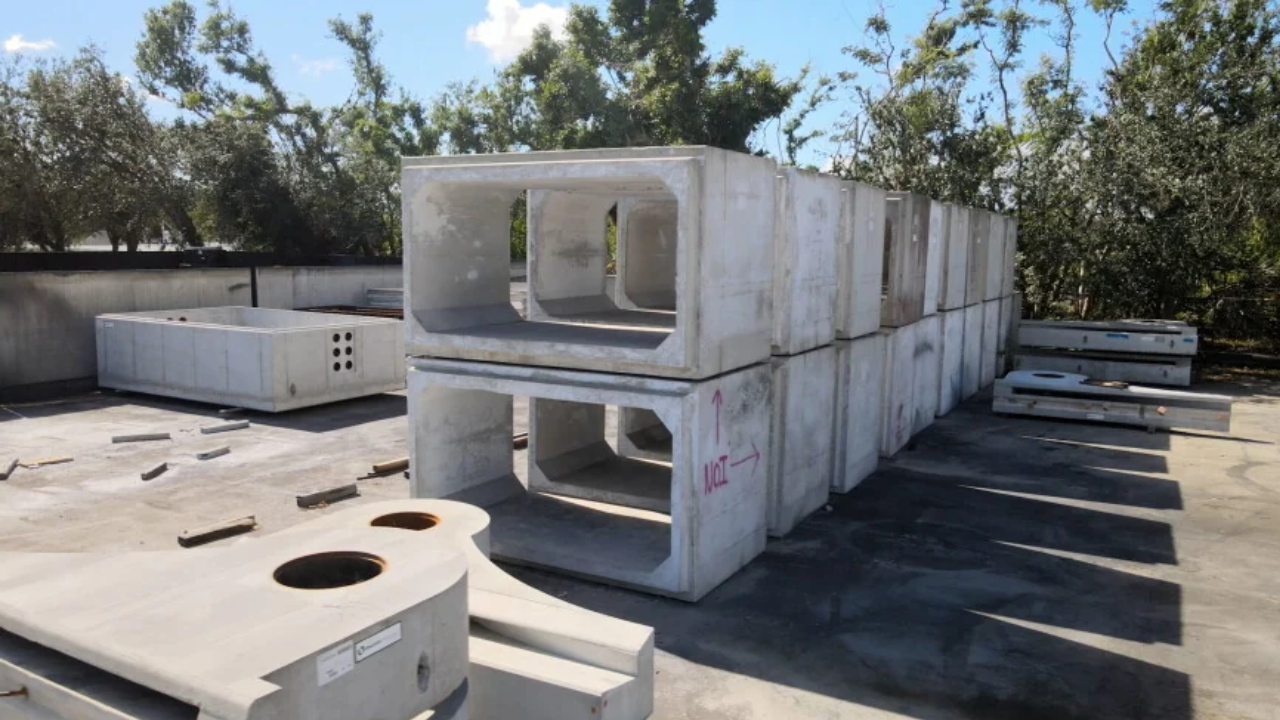
- Interstitial Void Space: A solid block of concrete provides surface area, but it fails to protect juvenile fish from predation. Effective reef engineering requires high structural complexity—specifically, a wide distribution of interstitial void spaces. When 1,500 tons of irregular concrete culverts, junction boxes, and broken bridge decking are stacked, the resulting matrix creates shaded overhangs, swim-through tunnels, and narrow crevices. These micro-habitats allow smaller forage fish and juvenile snappers to evade larger predators, directly increasing survival rates and shifting the reef's function from pure attraction toward net biological production.
Spatial Distribution and The Three-Site Strategy
Dividing 1,500 tons across three distinct locations—averaging 500 tons per site—represents a deliberate spatial optimization strategy rather than an arbitrary administrative split. Concentrating all 1,500 tons onto a single coordinate creates a massive localized biomass hotspot, which immediately attracts commercial and recreational fleets. Heavy, localized extraction can strip a single mega-reef of its resident breeding stock within a single fishing season.
Distributing the tonnage across three separate footprints mitigates this risk through three operational mechanisms:
- Fleet Dispersion: Multiple sites spread angling pressure across a broader geographic area, reducing gear entanglement, vessel congestion, and acute harvest mortality at any single node.
- Metapopulation Connectivity: When spaced within an ecologically relevant dispersal radius (typically several kilometers apart along similar depth contours), the three reefs function as stepping stones. Larvae spawned at Site A can ride prevailing longshore currents to settle at Site B, buffering the local population against localized hypoxic events or red tide blooms (Karenia brevis) that frequently plague Gulf waters.
- Depth Stratification: While exact bathymetric profiles vary by county permit, distributing modules across slightly different depth zones accounts for ontogenetic habitat shifts. Many Gulf reef species settle in shallower, lower-relief structures as juveniles and migrate toward deeper, higher-relief structures as they reach sexual maturity.
The Financial Ledger of Waste-Stream Arbitrage
The economic logic underpinning Florida's artificial reef program relies on waste-stream arbitrage. Terrestrial demolition generates millions of tons of inert concrete waste annually. Tipping fees at municipal landfills, combined with overland trucking costs, represent a significant capital drain for state infrastructure projects and private contractors.
By diverting 1,500 tons of clean, oversized concrete from terrestrial landfills to coastal staging yards, state and county agencies capture immediate cost avoidance. The contractor eliminates tipping fees, while the municipality acquires raw marine construction material at zero commodity cost. The capital expenditure is thus shifted entirely to logistics: crane operations at the staging port, tug and barge charter rates, and differential GPS positioning during the offshore drop.
The Cost Function of Deployment
To evaluate the efficiency of a 1,500-ton project, coastal economists analyze the total cost per ton deployed ($C_t$), which is governed by a strict logistical equation:
$$C_t = \frac{L_s + M_t + P_m}{W}$$
Where $L_s$ represents onshore sorting, cleaning, and loading costs; $M_t$ represents marine transport (barge mobilization, fuel burn, and crew day-rates); $P_m$ represents permitting, side-scan sonar bathymetric surveys, and post-deployment monitoring; and $W$ equals total tonnage (1,500 tons).
Marine transport ($M_t$) is the primary nonlinear variable in this equation. A standard ocean-going deck barge typically carries between 1,000 and 2,000 tons of deck cargo. Consequently, a 1,500-ton project maximizes single-barge capacity, avoiding the massive capital penalty of a second mobilization cycle. However, every nautical mile offshore increases fuel burn and transit time, eroding the tonnage-per-dollar ratio. Staging yards must be located directly on deep-water channels to prevent double-handling of the concrete, which quickly destroys the economic viability of using recycled material over purpose-built reef modules.
Return on Investment and Economic Multipliers
Once deployed, the capital asset transitions from a civil engineering cost into an annuity generating recreational and commercial economic activity. Studies conducted by the University of Florida IFAS Extension consistently demonstrate that artificial reefs generate substantial economic multipliers in coastal counties through direct expenditures on fuel, bait, tackle, charter bookings, lodging, and food services.
However, standard economic impact assessments frequently rely on flawed attribution models. They often count total angler spending in a county as net new economic value generated by the reef, ignoring the substitution effect. If a local angler fishes a newly deployed concrete reef instead of an existing natural limestone ledge five miles away, no net new economic activity has been created within the regional economy—spending has simply been reallocated spatially.
True economic return on investment (ROI) occurs only under two conditions:
- Non-Resident Inflow: The new reef complex expands total regional catch-per-unit-effort (CPUE) sufficiently to attract out-of-state or out-of-county anglers who inject external capital into the local economy.
- Congestion Relief: Existing natural and artificial reefs have reached carrying capacity for vessel traffic, and the three new 500-ton sites absorb latent demand from local boaters who would otherwise forego trips due to overcrowding.
Operational Limitations and Failure Modes
Treating 1,500 tons of concrete as a permanent ecological fix ignores severe operational vulnerabilities inherent to Gulf of Mexico marine engineering. Coastal managers must account for four primary failure modes that degrade reef performance over a 10-to-30-year lifecycle.
1. Episodic Hypoxia and Harmful Algal Blooms
The Gulf shelf experiences recurring summer hypoxia ("dead zones") driven by nutrient runoff and water column stratification, alongside severe Karenia brevis red tide events. Because artificial reefs lack the vast geographic footprint of natural carbonate banks, a localized benthic anoxic event can wipe out the entire sessile invertebrate community and kill resident demersal fish within 48 hours. When this occurs, the concrete reef resets to baseline zero, requiring another 18 to 24 months of biological succession before regaining trophic productivity.
2. Subsidence in Unconsolidated Sediments
If pre-deployment bathymetric and sub-bottom profiling fail to identify deep pockets of soft silt or mud beneath a thin veneer of sand, the sheer weight of 500-ton concrete clusters will cause rapid subsidence. Within five years, high-relief culverts can sink completely below the sediment-water interface, rendering the capital investment biologically inert and invisible to fish-finding sonar.
3. Overfishing via Precision Electronics
Modern recreational vessels utilize chirp sonar, high-resolution bathymetric mapping, and spot-lock trolling motors that hold a boat stationary over a 10-meter target without dropping an anchor. Because artificial reef coordinates are published publicly to satisfy federal permitting transparency rules, every recreational angler possesses the exact latitude and longitude of the 1,500 tons of concrete on day one. Without dynamic harvest restrictions or seasonal closures around newly deployed sites, precision fishing technology can harvest reef residents faster than biological production can replace them, turning the reef into an ecological sink rather than a source.
4. Rebar Corrosion and Structural Spalling
While specifications require the removal of protruding steel reinforcement bars to prevent entanglement hazards for marine mammals and sea turtles, internal rebar remains embedded within recycled concrete. Over decades, chloride ions penetrate the concrete matrix, causing the steel to oxidize and expand. This internal pressure induces spalling, fracturing the concrete into smaller, lower-relief rubble. While rubble still provides benthic habitat for invertebrates, the loss of vertical profile reduces the reef's capacity to hold pelagic and semi-pelagic species.
The Strategic Play for Coastal Resource Managers
Deploying 1,500 tons of concrete across three Gulf sites is a sound tactical execution of waste-stream arbitrage, but tonnage alone is an obsolete metric for measuring success. To maximize both ecological production and long-term economic yield, state agencies and county reef coordinators must transition from volume-based deployment to architecture-based deployment.
Future deployments must enforce three strict operational mandates:
- Mandate High-Relief Hybrid Stacking: Stop deploying flat concrete slabs that rapidly sand over. Require contractors to segregate high-profile bridge pilings, large-diameter culverts, and junction boxes, stacking them vertically during barge offloading to guarantee a minimum vertical relief of three to five meters above the seafloor.
- Establish Nursery Reserves: Dedicate at least one of every three deployed sites as a temporary or permanent no-take marine reserve, or withhold its exact coordinates from public registries for 24 months post-deployment. Allowing the epifaunal community and juvenile fish populations two full spawning cycles without extraction pressure transforms the site from a mere fish trap into a genuine biomass exporter that replenishes surrounding open-access reefs.
- Standardize Post-Deployment Photogrammetry: Replace anecdotal diver reports with annual side-scan sonar and 3D photogrammetric surveys. Track volumetric subsidence rates and epifaunal colonization density empirically, reallocating future state grant funding exclusively toward counties that demonstrate measurable structural persistence and net biomass gains per ton deployed.