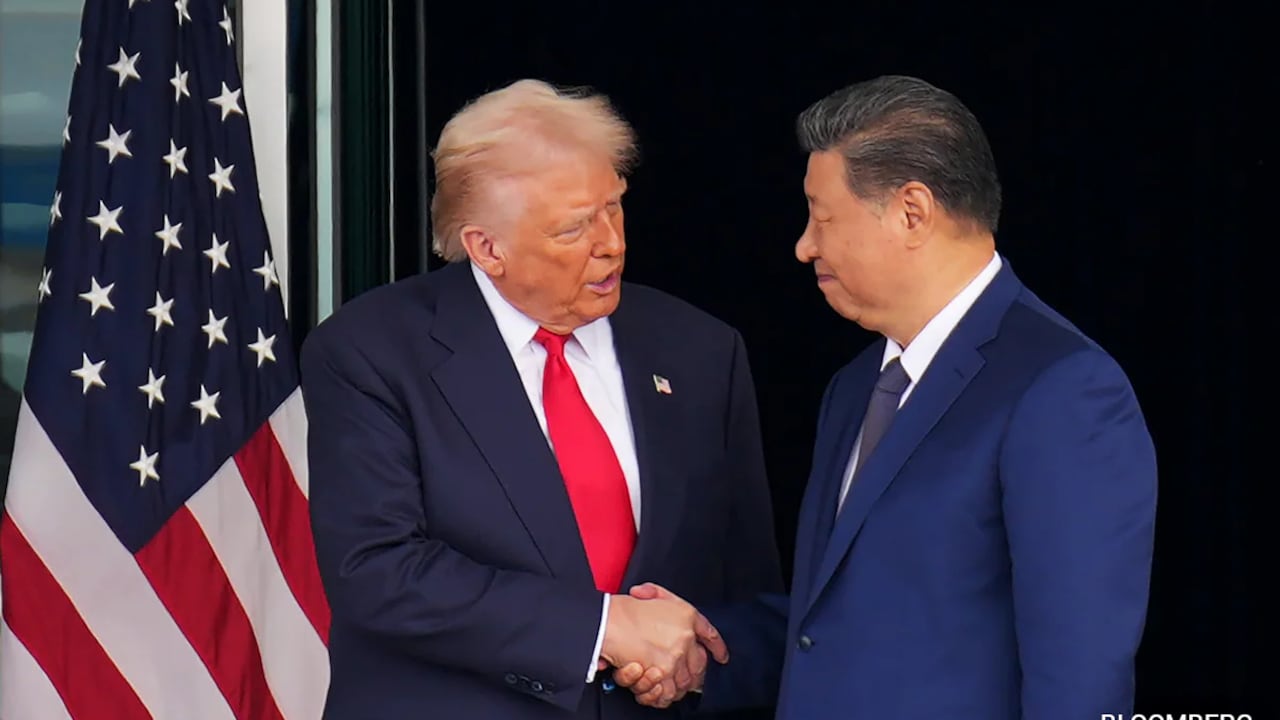
High-level diplomatic summits routinely rely on visual compliance. Ceremonial staging, calibrated handshakes, and carefully scripted communiques project structural alignment while concealing operational variance. The upcoming engagement between Donald Trump and Xi Jinping offers a textbook study in geopolitical theater masking structural divergence, specifically regarding the global distribution of advanced artificial intelligence capabilities.
Diplomatic optics prioritize trade balances, currency stability, and regional security corridors. Beneath this framework lies an unyielding technical contest over compute infrastructure, semiconductor fabrication supply chains, and algorithmic autonomy. The diplomatic friction is not a temporary policy disagreement; it is a structural rivalry over who dictates the foundational architecture of the twenty-first-century digital economy.
The Architecture Of Compute Sovereignty
The modern artificial intelligence race is fundamentally a constraint problem governed by physical limits, material inputs, and capital allocation. Unlike previous software revolutions, which scaled via commoditized hardware, contemporary large-scale machine learning relies on extreme semiconductor concentration.
The strategic chokepoint rests on Extreme Ultraviolet lithography systems, advanced packaging technologies, and high-bandwidth memory. Both superpowers understand that control over these nodes dictates systemic leverage.
The United States has implemented an export control regime designed to bottleneck foreign access to sub-7-nanometer logic devices and extreme-scale accelerator clusters. The objective of these controls is not merely commercial restriction; it is systemic deceleration. By choking access to leading-edge lithography, export policy attempts to widen the architectural gap between domestic model training efficiency and foreign alternatives.
Conversely, the state apparatus in Beijing has responded with forced domestic substitution. Capital allocation has shifted aggressively toward indigenous semiconductor foundries, packaging innovation, and architectural workarounds designed to extract maximum performance from older, non-restricted process nodes.
This creates a bifurcated technological ecosystem. One side operates on a frontier defined by hyper-dense silicon and massive power grids; the other operates on an iterative optimization path, turning hardware limitations into constraints that drive alternative algorithmic efficiencies.
The Economic Cost Function Of Algorithmic Decoupling
Decoupling critical technology supply chains introduces massive inefficiencies into the global economy. For decades, the semiconductor value chain operated on hyper-specialization. Design occurred in California, intellectual property in various allied nations, chemical production in Europe, fabrication in Taiwan, and final assembly in mainland China.
Splitting this integrated machine into discrete, sovereign domains forces redundancy, capital destruction, and duplicated research and development expenditures.
The cost function for this divergence involves three primary vectors:
- Capital Expenditure Inflation: Building redundant fabrication plants, sovereign data centers, and parallel research networks requires hundreds of billions of dollars in non-productive capital deployment. This capital expenditure diverts resources away from productivity-enhancing applications toward defensive technological posture.
- Talent Fragmentation: The restriction of cross-border technical mobility isolates research pools. When algorithmic breakthroughs cannot freely cross borders, duplicate paradigms emerge, slowing the aggregate velocity of fundamental scientific progress.
- Standardization Fractures: A splintered hardware and software ecosystem risks the emergence of incompatible protocols. If distinct geographic blocks develop proprietary architectures that cannot interoperate, global enterprise software loses the network effects that fueled the past three decades of growth.
The summit pageantry will frame this transition as a managed negotiation over market access. In practice, market access is secondary to systemic insulation. Both states are willing to absorb short-term economic friction to achieve long-term technological independence.
Strategic Asymmetries In Deployment And Scale
Beyond infrastructure, the two superpowers operate under radically different institutional incentives regarding the deployment and governance of artificial intelligence. These institutional divergences determine how intelligence models are trained, funded, and integrated into state and corporate apparatuses.
The Western model remains predominantly market-driven, relying on venture capital, public equities, and commercial monetization models to drive infrastructure buildout. This model favors rapid commercialization, open-source community iteration, and decentralized application development, though it faces emerging regulatory friction regarding data privacy, copyright, and safety guardrails.
The alternative model operating in Beijing integrates state capital directly with national champions. Strategic directives flow cleanly from central planning down to commercial entities, enabling massive, coordinated capital injections into specific national priorities like autonomous systems, smart manufacturing, and large-scale public surveillance grids. This top-down integration allows for rapid resource mobilization that bypasses traditional market hurdles, though it can suffer from allocative inefficiencies and reduced experimentation at the edge.
These institutional models create a permanent structural tension. It is a competition between the compounding velocity of decentralized market innovation and the focused mass of state-directed infrastructure concentration.
Navigating The Bifurcated Horizon
The convergence of high-level political posturing and deep technical rivalry means that standard diplomatic resolutions will likely fail to alter the trajectory of the artificial intelligence race. Treaties can cap conventional armaments or negotiate trade quotas, but they cannot easily govern decentralized algorithmic development or silicon supply chains without verifiable, highly intrusive verification mechanisms that neither power is willing to accept.
Strategic actors operating within this environment must abandon the assumption of a unified global technology market. Supply chain resilience, jurisdictional compliance, and architectural agility are no longer supplementary considerations; they are the primary determinants of competitive survival. Organizations must plan for a permanent state of technological partition, building multi-environment systems that can adapt to divergent regulatory and hardware realities across geographic divides.