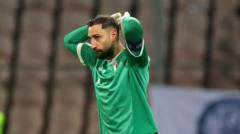
The failure of the Italian national football team to secure consecutive World Cup qualifications, followed by underwhelming performances in subsequent continental tournaments, represents more than a slump in form; it is a systemic collapse of elite performance standards. Gianluigi Donnarumma’s public commitment to "restoration" functions as a psychological signaling mechanism, yet his rhetoric masks the deep structural rot within the squad’s tactical and psychological frameworks. Restoration requires more than a vow; it demands a forensic audit of the three pillars of national team viability: technical succession, psychological resilience under high-variance conditions, and the evolution of the captaincy from a figurehead to an operational pivot.
The Triad of Italian Systemic Decay
The current state of the Azzurri is a byproduct of three specific points of failure that Donnarumma’s leadership must address if the team is to return to the global elite.
- The Experience Gap and Technical Atrophy: The transition from the veteran-heavy "BBC" defense (Barzagli, Bonucci, Chiellini) to the current iteration has been handled with insufficient speed. This creates a technical lag where the defensive unit lacks the intuitive positional awareness required for a high-line press.
- Scarcity of Goal-Scoring Efficiency: Italy's reliance on "False 9" configurations or inconsistent traditional strikers has created a bottleneck in the conversion of Expected Goals ($xG$) into actual goals. Without a clinical finisher, the burden of result-generation shifts disproportionately to the defense and goalkeeper, increasing the probability of "critical failure" events.
- The Identity Crisis of Post-Mancini Tactics: The shift from Roberto Mancini’s possession-heavy 4-3-3 to Luciano Spalletti’s more fluid, often experimental systems has left players in a state of cognitive dissonance during high-pressure phases.
The Donnarumma Paradox: Individual Performance vs. Collective Security
Donnarumma occupies a unique position in modern football: he is an elite shot-stopper whose individual statistics often deviate from the team’s defensive results. To analyze his capacity to lead a restoration, we must evaluate his impact through the lens of Goalkeeper-Centric Stability.
In modern tactical systems, a goalkeeper’s value is calculated through the formula of Post-Shot Expected Goals minus Goals Allowed ($PSxG - GA$). While Donnarumma consistently performs at a high percentile in $PSxG$, his leadership value is diluted by the defense’s inability to minimize high-value chances. For a "captain-restorer" to be effective, he must move beyond the goal line. His role now requires the management of the defensive block’s spatial orientation.
The primary friction point is the transition from a passive, deep-sitting defense to a proactive, aggressive press. Donnarumma’s "vow" implies a return to a specific Italian defensive archetype—Catenaccio updated for the 21st century—but the squad lacks the specialist profile to execute this. The current roster is comprised of versatile, "jack-of-all-trades" midfielders and wingbacks who excel in transition but struggle in static, high-density defensive scenarios.
The Psychological Infrastructure of a National Rebuild
Donnarumma’s emphasis on "heartbreak" highlights a significant psychological hurdle: The Scarcity Mindset. After missing World Cups in 2018 and 2022, the Italian squad suffers from a fear of negative outcomes that paralyzes tactical risk-taking. This is a classic case of loss aversion in an athletic context.
To mitigate this, the leadership must implement a "Reset Protocol" that focuses on three operational goals:
- Isolation of Past Data Points: Treat previous tournament failures as sunk costs. Performance metrics must be judged on a game-by-game basis to prevent the accumulation of "historical weight."
- Decentralized Leadership: While Donnarumma wears the armband, the on-pitch management must be decentralized. The captain cannot influence play 80 meters away in the final third. Restoration depends on identifying "sector captains"—midfield anchors and veteran attackers—who can maintain tactical discipline in real-time.
- The Emotional Buffer: Donnarumma must act as a lightning rod for criticism, shielding younger players from the immense pressure of the Italian media. This is an invisible but critical function of the modern captaincy.
The Tactical Cost Function of Inconsistency
Success in international football is determined by the ability to minimize variance. Unlike club football, where high-frequency matches allow for statistical normalization, international tournaments are low-sample-size environments. One defensive lapse or a missed penalty constitutes a catastrophic failure.
Italy’s current tactical model has a high Cost Function. The team expends significant energy in the middle third to maintain possession but lacks the "killer pass" or the verticality to exploit gaps. This results in "empty possession"—a high volume of passes with low threat value. For Donnarumma to lead a successful restoration, the technical staff must optimize the team’s Verticality Index.
The goal should not be to dominate the ball, but to dominate the spaces. This requires a shift from a 4-3-3 that prioritizes width to a more compact 3-5-2 or 3-4-2-1 that reinforces the central axis. This central reinforcement provides Donnarumma with a more predictable defensive shell, reducing the number of reactive, high-difficulty saves he is forced to make.
Institutional Limitations and the Youth Pipeline
A captain’s influence is limited by the quality of the raw material provided by the national infrastructure. The "heartbreak" Donnarumma references is a symptom of a deeper decline in Italian youth development.
- Foreign Player Saturation in Serie A: The high percentage of non-Italian players in the top-flight domestic league creates a glass ceiling for domestic talent. Young Italian players are often sent on loan to lower-tier clubs rather than gaining experience in Champions League environments.
- The Tactical Stagnation of Coverciano: The famed coaching school at Coverciano must evolve beyond traditional Italian tropes. The modern game requires high-intensity "Gegenpressing" and fluid positional rotation, skills that have been slow to integrate into the Italian DNA.
Donnarumma cannot fix the FIGC (Italian Football Federation), but he must navigate the resulting talent gaps. His role involves integrating "fringe" players—those who may not be superstars at their clubs but fit a specific tactical need for the national team.
Operationalizing the Restoration
For Italy to transition from a "heartbroken" squad to a competitive force, the following logic must be applied by the leadership:
- Standardize Defensive Drills: Implement a universal defensive language that remains consistent regardless of the tactical formation. This reduces cognitive load during transition phases.
- Phase Out Sentimental Selections: Leadership requires the courage to move past "heritage players" who no longer meet the physical demands of the international game.
- Leverage Home-Pitch Variance: Use Nations League and qualifying matches to build a "fortress mentality," utilizing the psychological edge of Italian stadia to rebuild the squad's confidence.
The path forward for Donnarumma and the Italian national team is not found in emotional appeals or vague promises of effort. It is found in the cold, methodical application of tactical discipline and the brutal honesty required to acknowledge that the "Italian identity" must be completely re-engineered. The restoration of a fallen giant is never a linear process; it is a series of incremental optimizations that, when compounded, result in a return to dominance.
The final strategic move for the Azzurri is the adoption of a Resilience-First Model. This entails prioritizing defensive solvency and transition speed over aesthetic possession. By reducing the complexity of their tactical demands, the team can minimize the probability of unforced errors, allowing their natural technical superiority in the midfield to eventually dictate the outcome of high-stakes matches. Donnarumma's success will not be measured by his saves, but by his ability to ensure that he doesn't have to make them.