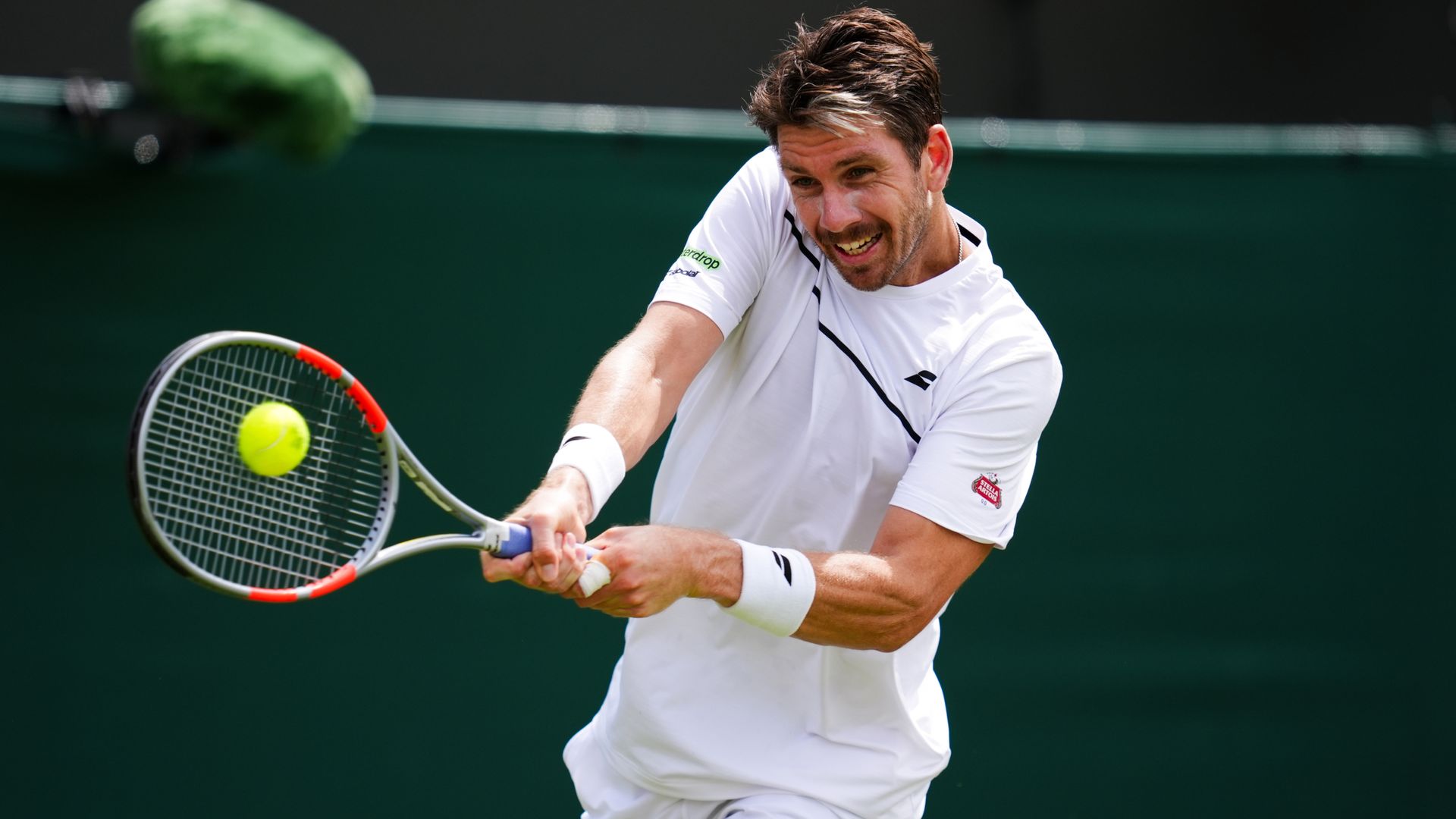
Cameron Norrie’s first-round exit at Wimbledon represents more than an isolated athletic upset; it is a case study in systemic performance decay when an elite athlete's core operational model fails to adapt to surface-specific demands. In professional tennis, longevity and success at the Grand Slam level depend on a compounding optimization cycle: physical output, tactical efficiency, and psychological resilience under variance. When any single pillar degrades, the structural integrity of the player’s entire competitive matrix collapses.
The standard media narrative attributes early-round Grand Slam exits to nebulous concepts like "bad luck" or "lack of confidence." A data-driven analysis reveals a far more predictable reality. Norrie’s baseline-centric, high-attrition style faces severe structural bottlenecks on grass courts—a surface that inherently penalizes extended rally lengths and rewards immediate linear velocity. To understand why a former British number one and Wimbledon semifinalist suffers a first-round exit, we must deconstruct the mechanics of his game through three specific analytical lenses: the surface-to-style mismatch, the breakdown of serve-return efficiency metrics, and the cumulative fatigue of an attrition-based physical model.
The Grass Court Tax: Style Incompatibility and Ball Mechanics
Every tennis surface operates under a distinct physical profile governed by coefficients of friction and restitution. Grass courts exhibit the lowest coefficient of friction on the ATP tour, meaning the ball retains a higher percentage of its horizontal velocity post-bounce compared to clay or hard courts. Concurrently, the low vertical bounce forces players to constantly strike the ball below their optimal strike zone, demanding exceptional knee flexion and shorter, more compact backswings.
Norrie’s technical architecture is built for high-bounce, high-friction surfaces like slow hard courts or clay. His western-grip forehand requires significant vertical acceleration to generate heavy topspin. On grass, this mechanic encounters two fatal flaws:
- The Preparation Bottleneck: The low, skidding bounce reduces the time window between the ball landing and entering the hitting zone. A looping backswing becomes a liability, forcing the player to hit late or contact the ball out of position.
- The Rotation Deficit: Topspin relies on the ball gripping the court surface to kick upward and disrupt the opponent's strike zone. On grass, the ball slides through the surface. Norrie’s heaviest shots lose their disruptive capability, sitting up at an ideal height for flat, aggressive counter-punchers.
This creates an asymmetric risk profile. A defensive baseline counter-puncher on grass must expend significantly more energy to neutralize aggressive baseline play because the court surface actively assists the attacker. By failing to shorten points or flatten out his groundstrokes, Norrie permits lower-ranked opponents to dictate the terms of engagement from the center of the court.
Deconstructing the Efficiency Metrics: Serve and Return Dynamics
In elite tennis, holding serve is the baseline requirement for survival, while return-game efficiency determines tournament progression. On fast grass courts, the margin for error shrinks exponentially. A single break of serve often decides an entire set, amplifying the pressure on a player’s service holds.
The Service Dominance Index Bottleneck
The Service Dominance Index (SDI)—calculated by adding the percentage of first-serve points won to the percentage of second-serve points won—serves as the primary indicator of a player's structural safety on court. Norrie’s serve has historically functioned as a tool for point initiation rather than a direct weapon. He relies on placement and heavy slider trajectories to prevent clean returns, setting up a grueling baseline sequence.
On grass, this approach yields diminishing returns. If the first-serve percentage drops below a critical threshold (typically 65%), the opponent gains immediate leverage. Norrie’s second serve lacks the raw velocity or extreme kick required to push returners behind the baseline. This allows opponents to step inside the court, take the ball on the rise, and immediately seize control of the rally, effectively turning Norrie's service games into defensive scrambles.
Return Point Conversion Failure
Conversely, Norrie’s primary competitive advantage has long been his elite return game. His ability to absorb pace and extend rallies allows him to break opponents through sheer physical accumulation.
Grass courts neutralize this advantage by minimizing the number of break point opportunities generated per set. The data shows that against big-serving opponents on grass, return win percentages drop across the board. When break opportunities do arise, they must be converted with high efficiency. A failure to capitalize on a single 30-40 window shifts the psychological and physical momentum entirely back to the server. Norrie's recent performance profiles indicate a sharp decline in break point conversion rates, driven by a passive return positioning that allows servers to hit unreturnable spot-serves without fear of aggressive counter-measures.
The Attrition Model and Physical Depreciation
Every professional athlete operates under a finite physical budget. Norrie’s rise to the top 10 of the ATP rankings was heavily subsidized by an elite aerobic capacity, allowing him to win what sport scientists classify as "high-intensity attrition matches"—consecutive three-to-four-hour contests where the primary objective is to outlast the opponent physically.
This operational model possesses a hidden cost function: linear physical depreciation. As an athlete progresses through their late twenties, the recovery window required between high-intensity matches expands.
[High-Attrition Style] -> [Extended Match Durations] -> [Incomplete Systemic Recovery] -> [Micro-Step De-acceleration] -> [Defensive Vulnerability]
This structural decay manifests in micro-step delays. In tennis, a deficit of just five centimeters in positioning changes a clean, offensive groundstroke into a reaching, defensive slice. When a physical attrition model experiences even a 2.5% reduction in lateral foot speed, the player can no longer recover the court effectively after an opponent’s opening strike.
At Wimbledon, this deficit is fatal. Because the footing on grass is inherently unstable compared to hard courts, players cannot slide into shots with the same predictability. A player who relies on supreme physical coverage suddenly finds themselves exposed, forced to hit on the dead-run without a stable base, leading directly to unforced errors or short balls that opponents easily dispatch.
Strategic Realignment: The Necessary Technical Pivot
To arrest this performance decline and extend his competitive window at the Grand Slam level, Norrie must execute a fundamental pivot in his tactical framework. Relying on baseline volume and physical endurance is no longer a viable strategy against a younger, more explosive field on fast surfaces.
The first priority is the immediate shortening of point duration. Norrie must implement a hard ceiling on rally length during fast-court swings, targetting an average of four shots or fewer per point. This requires an intentional increase in first-serve velocity, even at the expense of a minor reduction in first-serve percentage, to earn free points and weak returns.
The second priority demands a structural shift in court positioning. He must consciously abandon his deep baseline defensive position and commit to holding a line within 0.5 meters of the baseline. This position shortens the opponent's recovery time and allows Norrie to take the ball earlier, neutralizing the low skid of the grass bounce. Furthermore, he must increase his net-approach frequency by a minimum of 15% per match, deploying the serve-and-volley or mid-court transition play as a functional tool to disrupt the rhythm of aggressive baseline opponents. Without these systemic technical modifications, early-round exits at major tournaments will transition from an anomaly into the baseline expectation.