The collapse of Cuban food security is not a localized agricultural failure but a systemic breakdown of a supply chain dependent on imported petroleum and chemical inputs. When external trade restrictions—specifically the United States embargo—tighten, they act as a kinetic force against the three pillars of modern industrial farming: mechanical energy, nitrogenous fertilization, and cold-chain logistics. The current crisis illustrates how a nation’s caloric output is tethered directly to its ability to manage foreign exchange and energy flow.
The Energy Calorie Mismatch
The fundamental unit of agricultural output is no longer the acre; it is the joule. Modern industrial farming requires an energy subsidy to produce a caloric surplus. In the Cuban context, this subsidy is provided by imported diesel and electricity. The restriction of these inputs creates a cascading failure across the production cycle.
- Soil Preparation Bottlenecks: Without fuel for tractors, the window for tilling and planting shifts from days to weeks. This delay forces farmers to miss optimal climatic windows, reducing the potential yield per hectare before a single seed is even planted.
- The Irrigation Deficit: Cuban agriculture relies heavily on electric and diesel-powered pumps to move water. A 50% reduction in fuel availability does not result in a 50% reduction in crop health; it leads to total crop failure in arid zones where the ground becomes too desiccated to support root systems.
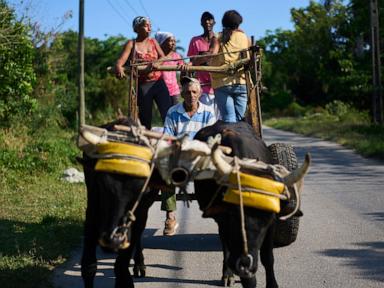
- The Labor Inefficiency Loop: To compensate for mechanical failure, the state often reverts to animal traction (oxen). While culturally resilient, animal labor is orders of magnitude less efficient than mechanized labor. An ox-drawn plow covers a fraction of the area a tractor covers in an hour, while requiring its own caloric intake and maintenance, effectively siphoning resources away from human food production.
Chemical Scarcity and the Nitrogen Trap
Cuban soil, like much of the Caribbean, requires supplemental nitrogen, phosphorus, and potassium (NPK) to maintain the yields necessary to feed an urbanized population. The blockade disrupts the procurement of these chemicals by increasing the "risk premium" on shipping and finance.
The lack of synthetic fertilizer creates a "nutrient mining" effect. Farmers continue to plant, but the soil lacks the replenishment necessary for growth. This results in stunted crops and increased vulnerability to pests. Because the embargo limits access to modern pesticides, these weakened crops are frequently decimated by infestations that would otherwise be manageable. This is not a failure of farming technique but a failure of chemical logistics.
The secondary effect of fertilizer scarcity is the degradation of seed quality. When plants are grown in nutrient-deficient soil, the seeds they produce for the next cycle are less vigorous. This creates a downward spiral of diminishing returns where each successive harvest is smaller than the last, regardless of the labor hours invested.
The Logistics of Spoilage and Value Chain Rupture
A harvest only matters if it reaches the consumer. In Cuba, the gap between "farm gate" and "dinner plate" is a gauntlet of failing infrastructure. The inability to source spare parts for transport trucks—many of which are decades-old Soviet or American models—means that a significant percentage of the harvest rots in the fields.
The Cold-Chain Failure Function
Perishable goods require a continuous temperature-controlled environment. The Cuban grid, plagued by fuel shortages and the inability to import components for power plant maintenance, suffers from frequent blackouts. This disrupts refrigeration at every node:
- On-farm storage: Rapid cooling is required to stop enzymatic degradation.
- Processing centers: Milk and meat processing require constant power to ensure food safety.
- Retail distribution: Without reliable power, vendors cannot hold inventory, leading to "panic selling" or total waste.
This creates a high-velocity waste environment where the actual food reaching the market is often a fraction of what was harvested. The economic cost is doubled: the farmer loses the investment of the season, and the state must spend precious hard currency to import finished food products to fill the gap.
The Monetary Constraint and Market Distortion
The US blockade functions primarily as a financial blockade. By restricting Cuba’s access to the international banking system, it forces the state to use complex, expensive workarounds to buy necessities.
The resulting "liquidity trap" prevents the Cuban government from investing in the very technologies that would mitigate the blockade’s impact. For example, a shift to solar-powered irrigation would reduce diesel dependency, but the initial capital expenditure (CAPEX) requires hard currency that is currently diverted to emergency food imports.
This creates a perverse economic cycle. The state cannot afford the technology to grow food because it is spending all its money buying food. This exhaustion of reserves leads to currency devaluation, which in turn makes the cost of imported inputs even more prohibitive. For the individual farmer, this means the price of a bag of fertilizer or a tractor tire may exceed the total revenue of their previous harvest.
Decentralization and the Resilience Paradox
In response to these pressures, there is a push toward "agro-ecology" and decentralized, urban farming. While these methods are highly resilient to fuel shocks, they are fundamentally incapable of achieving the caloric density required to support a modern nation of 11 million people.
Small-scale organic farming is an excellent supplement but a poor foundation for a national food strategy. The caloric requirements of a population are met by high-yield grains and tubers, which require the very industrial inputs—fertilizers, large-scale irrigation, and mechanized harvesters—that the blockade targets.
The resilience of the Cuban farmer is a testament to human ingenuity, but it is being used to bridge a gap that is structural. Relying on "innovation" to solve a lack of basic energy is a strategy with a hard ceiling.
Strategic Realignment and the Shift to Distributed Energy
The path forward requires a brutal prioritization of resources toward the decoupling of agriculture from centralized fuel imports. This is not an environmental choice but a national security imperative.
- Decentralized Power Generation: Moving irrigation systems to independent solar and wind micro-grids to bypass the failing national electricity infrastructure.
- Localized Bio-fertilizer Production: Scaling the production of organic fertilizers to mitigate the NPK deficit, acknowledging that while yields may be lower than synthetic levels, they will be more stable.
- Strategic Crop Substitution: Transitioning acreage from high-input, high-risk crops to resilient varieties that require less water and chemical intervention, even if these crops have lower market value.
The objective is to shorten the supply chain until it fits within the nation's actual, sustainable energy budget. This means abandoning the hope for a return to industrial-era abundance as long as the financial restrictions remain in place. The strategy must move from "surviving the crisis" to "optimizing for permanent scarcity." By focusing on modular, low-energy agricultural units, the system can reduce its exposure to external shocks and begin the slow process of caloric stabilization. This shift requires a massive reallocation of state credit away from the tourism sector and directly into the micro-mechanization of the rural workforce. Only by treating the caloric deficit as a technical engineering problem rather than a political one can the cycle of starvation be broken.