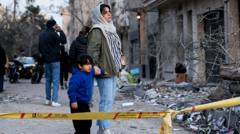
The sirens in Haifa do not sound like a warning anymore. They sound like a persistent, mechanical heartbeat, a rhythmic reminder that the sky is no longer a canopy but a ceiling that might collapse at any moment. Below that ceiling, the calculus of survival has shifted. It is no longer about whether a strike will happen, but how long the man at the helm needs the fire to keep burning to ensure his own shadow remains long enough to cover his tracks.
Benjamin Netanyahu sits in a fortified room, surrounded by maps that glow with the heat of fresh impact points across Southern Lebanon and Beirut. To the world, these are tactical coordinates in a campaign against Hezbollah. To the families huddled in basement shelters from Kiryat Shmona to Tyre, these are the coordinates of their erasure. But to the Prime Minister, these maps are a stay of execution.
Political survival is a hungry beast. It requires constant feeding, and right now, the only currency it accepts is the smoke rising from the Bekaa Valley.
The Weight of the Gavel
Consider a man standing on a narrowing ledge. Behind him is a courtroom where years of corruption charges—bribery, fraud, breach of trust—wait like a cold cell. Beneath him is a public that, months ago, was screaming for his resignation, furious over the intelligence failures of October 7. In front of him is a war.
As long as the jets are in the air, the ledge stays wide. The moment the engines go quiet, the ledge crumbles.
This isn't a metaphor for the complexity of Middle Eastern geopolitics. It is a literal description of a legal calendar. In Israel, a sitting Prime Minister is rarely ousted during the height of a multi-front existential conflict. By expanding the theater of operations into Lebanon, Netanyahu isn't just targeting rocket launchers. He is targeting the clock. He is stretching the minutes into months, ensuring that the "state of emergency" becomes the permanent state of being.
He needs the noise of the bombs to drown out the sound of the judge’s gavel.
The Ghost of a Border
Imagine a woman named Adara. She lives in a small village in Southern Lebanon, a place where the scent of wild thyme used to define the morning air. Now, the air smells of pulverized concrete and the sharp, metallic tang of cordite. She is not a combatant. She is a grandmother who has seen three wars and knows the specific whistle of an F-15 before the earth heaves.
When the Israeli Defense Forces (IDF) issued evacuation orders for dozens of Lebanese villages, they framed it as a humanitarian necessity. But to Adara, and thousands like her, it feels like the beginning of a permanent absence. History in this region is a series of "temporary" displacements that turn into decades of exile.
The strategy of "de-escalation through escalation" is a phrase born in air-conditioned briefing rooms. On the ground, it looks like a mother carrying a sleeping child through a sea of stalled traffic on the highway to Beirut, watching her life’s work vanish in a rearview mirror.
Netanyahu claims this campaign is necessary to return the 60,000 displaced Israelis to their homes in the north. It is a powerful, righteous-sounding goal. Yet, every bomb dropped on a residential block in Beirut makes the northern border more volatile, not less. It invites a cycle of retaliation that ensures those 60,000 people will be living in hotels and temporary apartments for the foreseeable future.
The goal isn't the return. The goal is the pursuit.
The Invisible Stakes of the Cabinet Room
Within the Israeli government, the air is thick with a different kind of tension. Netanyahu’s coalition is a fragile mosaic of far-right extremists who view the Lebanon front not as a burden, but as an opportunity. Men like Itamar Ben-Gvir and Bezalel Smotrich do not want a ceasefire. They want a total reconfiguration of the region.
Netanyahu is a captive of his own allies. If he reaches for a diplomatic solution—a path the United States and France have been desperately trying to pave—his government collapses. The moment the religious nationalists walk out, a general election is triggered.
In that election, Netanyahu would face a public that hasn't forgotten the failures that allowed the border to be breached in the first place. He would face a military leadership that is increasingly vocal about the lack of a "day after" plan.
So, he chooses the third option: the forever war.
It is a masterful, if horrific, piece of political engineering. By keeping the country in a state of high-intensity combat, he renders any talk of an election "irresponsible." He transforms his political opponents into "distractions" from the national effort. He turns the bloodbath in Lebanon into a shield for his own career.
The Human Cost of Delay
We often speak of "collateral damage" as if it were an accidental byproduct of war. In this theater, the damage is the point. The intensity of the strikes on Lebanon—the thousands of casualties in a matter of days, the leveling of entire neighborhoods—is designed to project a level of force that demands a long, drawn-out response.
Peace is fast. War is slow. Netanyahu needs the slow.
Think of the Israeli reservist, called up for the third time in a year, leaving behind a struggling business and a terrified spouse. He is told he is fighting for the security of the Galilee. But in the quiet moments in the barracks, he wonders if he is actually fighting to prevent a testimony in a Jerusalem courtroom.
Think of the doctor in a Beirut hospital, working by flashlight because the power grid is shattered, trying to patch together a teenager who was just walking to the store. The doctor doesn't care about Netanyahu’s legal troubles or Hezbollah’s command structure. He only sees the physical reality of a political strategy: shredded muscle and shattered bone.
The Myth of the Surgical Strike
There is a persistent lie told by modern militaries: the idea of the "surgical strike." It suggests a war can be fought with the precision of a scalpel, removing "terrorist infrastructure" while leaving the surrounding tissue healthy.
Lebanon is currently being subjected to a "surgery" that involves 2,000-pound bombs.
When a building in a crowded district of Beirut is toppled to kill one commander, the hundreds of people living in the surrounding radius are not "collateral." They are the victims of a deliberate choice. That choice is made by a leader who knows that a quiet border is a boring border, and a boring border leads to questions about domestic policy, housing prices, and criminal indictments.
The bloodbath isn't a failure of diplomacy. It is a rejection of it. Every time a ceasefire proposal is floated, Netanyahu adds a new condition, or launches a new, high-profile assassination. It is the "Lucy and the Football" of international relations. The world reaches for peace, and he pulls it away at the last second, citing a "new intelligence development."
The Echo Chamber
Power has a way of thinning the air around a leader until they can only hear their own pulse. Netanyahu has spent decades convincing himself that he is the only person capable of protecting the Jewish state. It is a messiah complex fueled by a very real fear of a prison cell.
This conviction allows him to look at the mounting body count in Lebanon and see not lives lost, but "strategic depth." It allows him to look at the grieving families in Israel and see "the price of victory."
But there is no victory at the end of this road. There is only a pause before the next eruption. By destroying the social and physical fabric of Lebanon to save his own skin, Netanyahu is sowing the seeds of a resentment that will bloom for the next fifty years. He is ensuring that the children of today’s "collateral damage" will be the combatants of tomorrow.
And perhaps that is exactly what he wants.
A peaceful neighbor is a threat to a man whose entire brand is "Mr. Security." If there is no monster under the bed, the protector is no longer needed. So, he pokes the monster. He burns the bed. He tells the people that only he can keep the fire contained, all while he holds the matches behind his back.
The night in the Middle East is long, and the sun is being held back by a man who is afraid of what he will see in the light. He will keep the world in the dark as long as the darkness keeps him in power.
The tragedy is not just that he is willing to spill blood to save himself. The tragedy is that we have mistaken his self-preservation for a strategy, and his survival for a victory.
The sirens will keep screaming. The maps will keep glowing. The man in the bunker will keep counting the days he has bought with the lives of others, while the thyme in the south burns to ash.