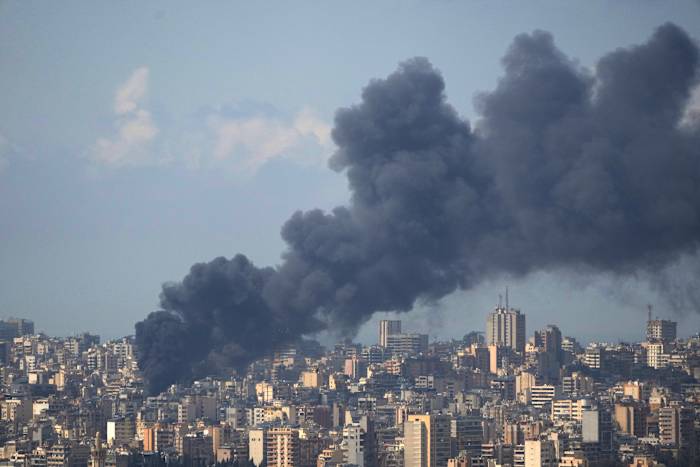
The recent kinetic escalation in central Beirut, resulting in over 100 casualties, represents a calculated breakdown in the normative frameworks of modern ceasefire negotiations. While diplomatic efforts often prioritize the cessation of hostilities within specific geographic borders, the Israeli military strategy operates on a logic of Strategic Extraterritoriality. This doctrine posits that a ceasefire with a state actor (Lebanon) or a localized paramilitary force (Hezbollah) does not extend to the ideological or logistical nodes of an external third party (Iran) operating within that same space. By striking high-density urban centers in Beirut under the premise that a potential Iran-Israel truce is "non-applicable" to Lebanese soil, Israel is effectively decoupling the geography of the conflict from the identity of the combatant.
The Mechanics of Kinetic Decoupling
The traditional understanding of a "front line" is obsolete in this context. The Israeli Defense Forces (IDF) are employing a Dual-Track Attrition Model. Under this framework, military actions are partitioned into two distinct categories:
- Borderline Suppression: Tactical engagements aimed at clearing the immediate frontier to allow the return of displaced civilians.
- Node Eradication: High-precision strikes against command, control, and logistical infrastructure belonging to the Iranian "Axis of Resistance," regardless of their proximity to civilian populations or their location within the capital city.
The strike in central Beirut signifies a shift from the former to the latter. It serves as an operational proof of concept that Israel will not permit a "safe harbor" status for Iranian assets within Lebanese borders, even if a formal ceasefire with the Lebanese government is under discussion. This creates a Diplomatic Friction Point: Lebanon cannot guarantee the security of Iranian assets, yet Israel will not cease fire as long as those assets remain.
The Human Cost as a Variable of Strategic Calculus
The casualty count exceeding 100 individuals is not merely a byproduct of inaccuracy; it is a function of Structural Urban Density. Central Beirut’s layout creates a high Collateral Damage Coefficient. When high-yield munitions are deployed against embedded targets—such as subterranean command bunkers or weapon caches integrated into residential blocks—the blast radius naturally encompasses non-combatants.
From an analytical standpoint, the IDF appears to have recalibrated its Proportionality Threshold. This threshold is the internal military metric used to determine if the strategic value of a target justifies the predicted civilian loss. By targeting central Beirut, the IDF is signaling that the elimination of specific high-value targets (HVTs) or the disruption of Iranian supply lines outweighs the significant political and humanitarian fallout of mass casualties. This creates a state of Psychological Attrition, where the civilian population is forced to recognize that proximity to Iranian-linked infrastructure is a lethal liability.
The Iran-Lebanon Linkage Paradox
The core of the current escalation lies in the rejection of a "Global Truce" in favor of "Local Specificity." Israel’s insistence that an Iranian truce does not apply to Beirut is a strategic move to prevent Iran from using the Lebanese theater as a low-cost proxy zone while protecting its own sovereign territory from direct retaliation.
The Three Pillars of Proxy Vulnerability
- Logistical Insulation: Iran utilizes Lebanese infrastructure to move hardware without risking its own domestic soil. Israel’s strikes are designed to strip away this insulation, making the cost of proxy warfare unsustainable for the host nation.
- Command Ambiguity: By blending IRGC (Islamic Revolutionary Guard Corps) personnel with Hezbollah commanders, the "target profile" becomes blurred. Israel exploits this ambiguity to strike Iranian personnel under the umbrella of Lebanese military operations.
- The Sovereignty Gap: The Lebanese state lacks the kinetic capability to expel foreign military influence. Israel fills this vacuum with airpower, asserting that if the Lebanese state cannot maintain its neutrality, it loses its claim to territorial inviolability.
Logical Failures in Modern Ceasefire Models
Current diplomatic frameworks are failing because they rely on Linear Escalation Theory—the idea that more violence leads to more pressure, which eventually leads to a signature on a page. However, the Beirut strikes demonstrate that we are in a state of Non-Linear Escalation.
In this environment, a strike that kills 100 people does not necessarily bring the parties closer to a deal. Instead, it alters the Incentive Structure of the adversaries. For Hezbollah and Iran, retreating after such a strike is viewed as a total capitulation, which threatens their domestic legitimacy. For Israel, the "Success Metric" is shifted from a signed peace treaty to the physical degradation of the enemy’s capability to fire a missile. If the hardware is destroyed, the treaty is secondary.
The Economic and Civil Deterioration Factor
Beyond the immediate loss of life, the strikes accelerate the State-Level Entropy of Lebanon. The destruction of central Beirut’s infrastructure creates an immediate surge in the Cost of Governance.
- Emergency Response Saturation: The medical and rescue infrastructure in Beirut is currently operating beyond its Elasticity Limit. Every strike of this magnitude requires a redirection of national resources that Lebanon’s fragile economy cannot sustain.
- Investment Flight: No capital remains in a theater where "safe zones" do not exist. By striking the heart of the capital, Israel is effectively imposing a Sovereignty Tax on Lebanon—a cost so high that the state must eventually choose between total collapse or a forced removal of Iranian influence.
Identifying the Strategic Bottleneck
The primary bottleneck in resolving this conflict is the Verification Gap. Even if a ceasefire is reached, Israel demands the right to kinetic intervention if Iranian weapons are detected entering the theater. This is a "Non-Starter" for Lebanese sovereignty but a "Non-Negotiable" for Israeli security.
This creates a Permanent Conflict Loop:
- A ceasefire is proposed.
- Israel demands "Enforcement Rights" (extraterritorial strikes).
- Lebanon/Hezbollah rejects the loss of sovereignty.
- Israel continues node eradication to achieve through force what the treaty cannot provide.
Kinetic Dominance as the Final Arbiter
The strike on central Beirut is a declaration that the era of "Managed Conflict" is over. Israel is no longer seeking a return to the status quo ante; it is seeking a Structural Reconfiguration of the northern front. This involves the systematic dismantling of the "Ring of Fire" strategy employed by Tehran.
The path forward is defined by the Persistence of Air Superiority. As long as Israel maintains the ability to strike the heart of Beirut with impunity, the diplomatic process is merely a secondary track to the primary objective: the physical removal of Iranian strategic depth in the Levant. The casualties, while devastating, are categorized within this logic as the inevitable friction of a high-stakes geopolitical realignment.
The immediate requirement for Lebanese stakeholders is the establishment of a Security Decoupling Zone—a physical or administrative separation between Iranian military assets and Lebanese civilian infrastructure. Failure to achieve this internal separation ensures that the "Iran Truce Exclusion" remains the governing logic of the conflict, leaving central Beirut as a perennial target for high-yield kinetic intervention.



