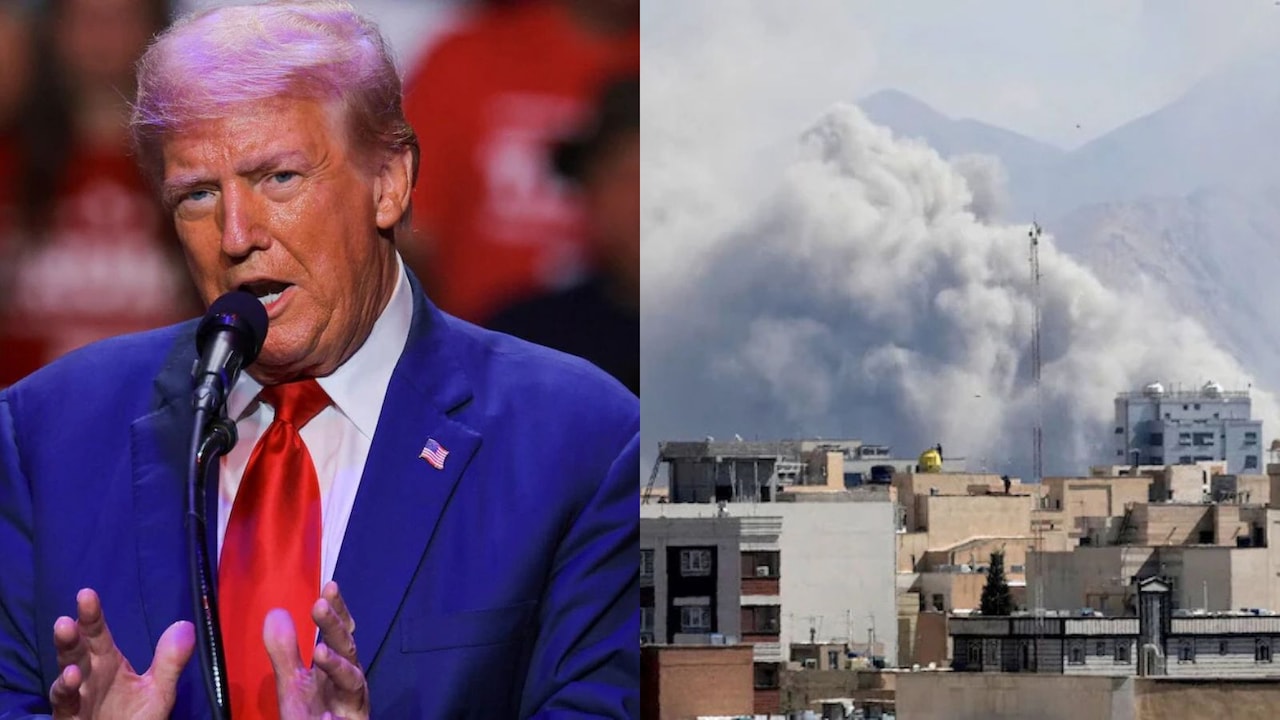
Static.
That is the sound that precedes the end of certainty, a low, granular hiss in a quiet room thousands of miles away from where the steel actually falls. When a president steps up to a bank of microphones and announces that American forces have struck an Iranian anti-aircraft facility, the language used to describe the event often feels strangely domestic, almost polite. "Hit their anti-aircraft facility nicely," Donald Trump said, confirming the U.S. military strike on Iran in a phrasing that sounded less like the language of war and more like a golf swing or a well-placed billiard shot.
Words like "nicely" do a specific kind of work in modern statecraft. They sand down the jagged edges of violence until it looks like precision, hygiene, and restraint. If you read the standard breaking news wire, you get the clean geometry of the event: the target, the confirmation, the geopolitical tit-for-tat, the immediate reactions from Washington and Tehran. You get the map coordinates and the diplomatic cable summaries. What you do not get is the smell of cordite mixing with desert dust, or the sudden, breathless silence in a kitchen in Isfahan when the windows rattle in their frames.
To understand what a "nice" strike actually means, you have to step out of the briefing room and look at the invisible architecture holding the Persian Gulf together—and how little weight it takes to make the whole structure groan.
The Architecture of a Measured Blow
Military planners have a specific vocabulary for strikes designed to punish without provoking an all-out regional conflagration. They call it proportional response, calibrated escalation, or signaling. Think of it like two heavyweights standing in a crowded glass shop; neither wants to throw a haymaker because the resulting crash will ruin them both, so instead, one steps forward and snaps a single, sharp jab against the other’s shoulder to prove he still owns the center of the floor.
An anti-aircraft facility is the textbook target for this kind of signaling. Unlike a crowded barracks, a major oil refinery, or a political headquarters, an air defense battery sits on the perimeter of a nation’s military nervous system. It is a blindfold rather than a heart wound. By taking out radar arrays and surface-to-air missile launchers, the attacking force sends an unmistakable message: We can see you, we can reach you, and your sky belongs to us whenever we choose to enter it.
Yet that clinical logic only holds if everyone in the room agrees on the rules of the game.
Consider a hypothetical scenario to see where the math breaks down. Imagine a twenty-two-year-old conscript named Reza sitting inside a mobile radar van on the outskirts of an Iranian air defense perimeter at two in the morning. To the Pentagon’s targeting software, Reza’s post is a glowing red polygon representing an S-300 or Bavar-373 radar signature—a piece of hardware that threatens American pilots and reconnaissance drones. To Reza, it is a cramped, humming box that smells of stale tea and warm electronics, where he is counting down the weeks until his mandatory military service ends so he can go back to studying civil engineering.
When the cruise missile or precision-guided munition arrives—delivered "nicely," with minimal collateral blast radius—Reza does not experience a diplomatic signal. He experiences a flash of white light, a pressure wave that flattens the scrub brush for a hundred yards, and the sudden disappearance of the world he knew five seconds earlier. Even if the strike is timed or angled to spare personnel, the shockwave ripples outward into every home within twenty miles. Mothers wake up clutching their chests. Fathers stand in doorways staring at the orange glow on the horizon, wondering whether to pack their children into the car before dawn.
I have spent years watching how foreign policy decisions made in climate-controlled rooms translate on the ground, and the most jarring disconnect is never the malice of the decision-makers—it is their distance. In Washington, an air defense strike is a line item on an evening news ticker, debated over morning coffee by pundits who treat sovereign nations like chess pieces. On the ground, there is no such thing as a surgical strike. There is only the before and the after.
Why Air Defenses Are Never Just Defensive
To understand why the United States would specifically target an Iranian anti-aircraft facility—and why Trump’s confirmation carries so much weight—you have to look at the silent war that has been waged in the skies over the Middle East for years.
People often hear the term "anti-aircraft" and assume the hardware is purely protective, like a shield raised to block an incoming sword. In modern warfare, that distinction evaporated decades ago. Integrated air defense systems are the foundation of what strategists call anti-access/area denial. If you can build an impenetrable dome of radar and surface-to-air missiles over a stretch of coastline or a strait, you do not need to fire a single offensive shot to control the region. You simply make the cost of entering your airspace too high for anyone else to bear.
For Iran, whose conventional air force still relies heavily on aging Cold War-era jets patched together with domestic engineering, surface-to-air missiles are the great equalizer. They are the primary shield protecting nuclear research sites, ballistic missile depots, and command centers from Israeli or American airpower. When Washington confirms a strike against one of those batteries, it is doing far more than retaliating for a provocation, a downed drone, or a proxy attack on regional bases. It is punching a hole in the umbrella.
And once a hole is punched in an umbrella, the person holding it knows the rain is coming.
Let us be honest about the anxiety this creates, because pretending the picture is simple would be dishonest. Nobody outside a tiny circle of classified intelligence briefings knows with absolute certainty where the exact red lines sit at any given hour. History shows us that great powers stumble into major wars far more often through misread signals than through grand design. In 1914, European leaders believed a localized punitive strike in the Balkans could be contained within neat diplomatic borders. In 1962, during the Cuban Missile Crisis, a single Soviet submarine commander nearly launched a nuclear torpedo because depth charges cut off his communication with Moscow, leaving him convinced World War III had already begun above the waves.
When a leader says we hit a facility "nicely," the implicit promise is control. We struck hard enough to hurt, softly enough to stop. The terrifying truth of the Persian Gulf is that control is an illusion shared by both sides until the exact second it vanishes.
The Invisible Ledger of Escalation
Look closely at what happens in the forty-eight hours after a strike is confirmed. The real action rarely happens on the battlefield; it happens in the invisible ledger of domestic politics and regional pride.
In Tehran, the leadership faces an acute dilemma every time American ordnance lands on Iranian soil. If the regime absorbs the blow silently, it risks looking weak to its hardline domestic base and its regional network of allied militias across Iraq, Syria, Lebanon, and Yemen. Strength is the primary currency of survival in the Islamic Republic; admitting that an American strike destroyed an air defense site without consequence invites the next strike, and the one after that. Yet if Tehran retaliates directly against American troops or ships, it invites the full, unrestrained weight of the U.S. military—a fight Iran’s economy and infrastructure could not survive intact.
So Tehran plays the shadow game. It denies, minimizes, or reframes the damage in state media, claiming its defenses intercepted the incoming threat or that the damage was superficial, while quietly calibrating a response through indirect channels—a cyber intrusion, a maritime harassment in the Strait of Hormuz, or a rocket barrage fired by a proxy group hundreds of miles away.
Meanwhile, in Washington, the political math runs on an entirely different clock. A president confirming a strike in casual, confident language is speaking primarily to an American audience exhausted by decades of endless Middle Eastern entanglements. The message is tailored to project strength without triggering the public’s fear of another ground invasion. We handled it. Clean. Fast. Over.
Consider a second hypothetical character, this time on the other side of the ocean: a Navy technician named Sarah aboard a guided-missile destroyer patrolling the warm, shallow waters of the Arabian Sea. When Sarah hears the news of the strike confirmed from Washington, she does not feel the satisfaction of a clean political point scored. Her shift immediately stretches from twelve hours to sixteen. The ship goes to heightened readiness. Every small fishing dhow on the radar screen suddenly becomes a potential swarm boat packed with explosives; every high-altitude commercial flight path has to be double-checked against ballistic missile trajectories. For Sarah, "nicely" means sleeping in her boots with a life vest within arm’s reach for the next three weeks.
The Cost Measured in Quiet Rooms
We have grown dangerously comfortable with the sanitization of military force. Over the past thirty years, high-definition targeting pod footage and precise terminology have trained the public to view airstrikes as a form of long-distance surgery—bloodless, technical, and reversible.
They are none of those things. Even when a strike kills zero civilians and flattens nothing more than a concrete radar pad and a cluster of mobile launchers, it alters the psychological gravity of an entire region. Shipping insurance rates in the Persian Gulf twitch upward within minutes, adding fractions of a cent to the cost of every barrel of oil and every container of grain moving through those waters. Families in Tehran watch the value of the rial dip another notch against the dollar, silently calculating how much more expensive bread, medicine, and fuel will be by Friday. Diplomats in Oman, Qatar, and Switzerland cancel their weekend plans and open back-channel phone lines that never appear in official press releases.
The real danger of describing a military strike as "nice" is not that the word is cruel, though to anyone standing near the blast radius it certainly is. The danger is that the word makes war feel manageable. It convinces the spectators that force can be dialed up and down like a thermostat in a living room, ignoring the fact that the house is built of dry timber and someone is holding a match.
Every radar dish bent into twisted scrap metal on an Iranian hillside is a reminder of how thin the membrane between deterrence and disaster truly is. Deterrence works right up until the afternoon it fails, and nobody ever hears the alarm bell until the smoke is already rising.
Out in the desert beyond the perimeter fence, long after the press conferences in Washington have wrapped up and the cable news panels have moved on to the next domestic scandal, the dust settles back over the scorched earth. A local shepherd walks his flock along the ridge at dawn, pausing for a moment to look down at the blackened crater where a humming metal tower used to stand against the sky, before turning his back to the wind and walking on.