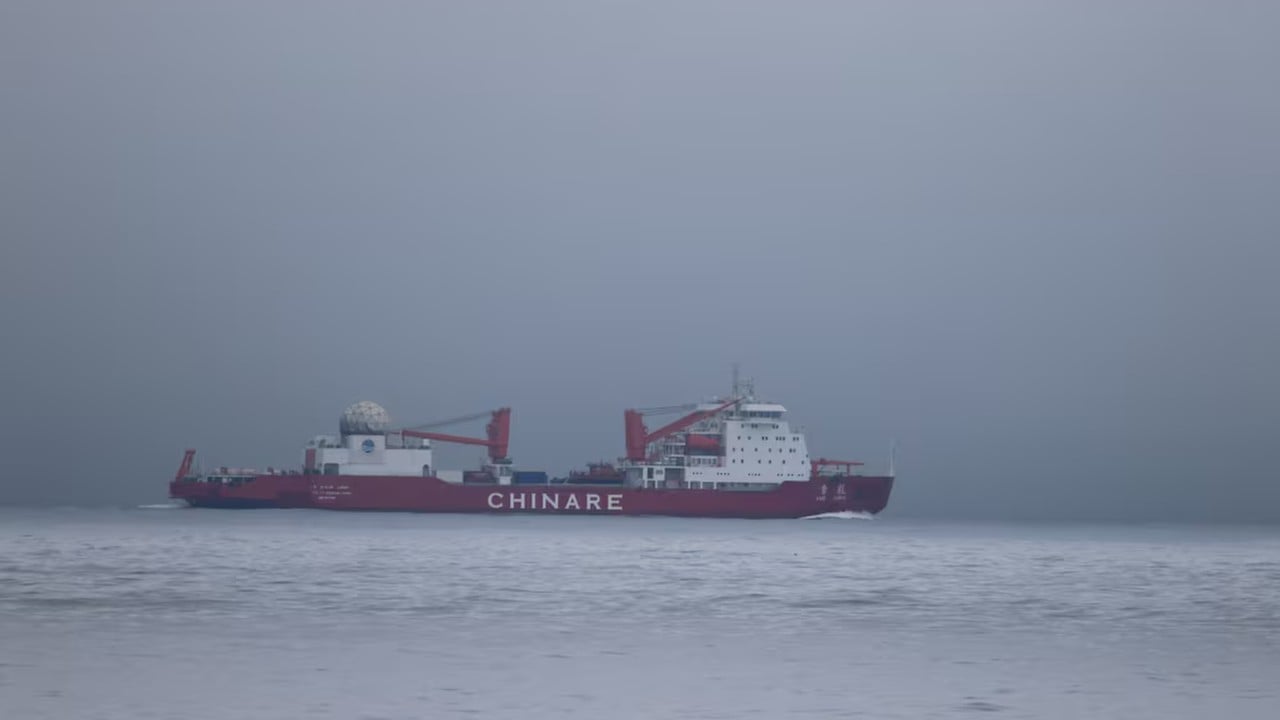
Every maritime analyst with a LinkedIn account is writing the exact same obituary this month. They look at the sudden October freeze-ups along the Northern Sea Route, tally up the eye-watering insurance premiums, point to the 2024 traffic spike followed by seasonal bottlenecks, and declare China’s "Polar Silk Road" dead on arrival.
They are looking at the water. Beijing is looking at the map.
If you judge China’s Arctic shipping ambitions by standard commercial container-shipping metrics—spot rates, transit reliability, fuel burn per twenty-foot equivalent unit—then yes, the venture looks like an expensive disaster. Sudden multi-year drift ice doesn't care about a 14-day schedule guarantee. Hull damage in the East Siberian Sea destroys quarterly margins. Western shipping giants like Maersk and MSC walked away from the route years ago because, on a spreadsheet, it makes zero financial sense.
Here is what the spreadsheet crowd misses: China isn't running a commercial logistics startup. It is buying geopolitical insurance.
When you stop evaluating the Northern Sea Route (NSR) through the lens of a Maersk executive and start looking at it through the eyes of a strategist in Beijing, the high costs and sudden ice stop being fatal flaws. They become the exact price of admission China is happily paying to break a maritime stranglehold that has kept the Chinese Communist Party awake at night for three decades.
The Malacca Trap Nobody Wants to Price In
To understand why COSCO and Chinese state-backed carriers keep pushing ice-class vessels into sub-zero waters despite brutal operating costs, you have to look 4,000 miles south to a narrow strip of water between Malaysia and Indonesia.
The Strait of Malacca.
Roughly 80% of China’s imported energy and a massive share of its raw materials pass through that 1.7-mile-wide chokepoint at the Phillips Channel. Former Chinese President Hu Jintao famously called this the "Malacca Dilemma" back in 2003. Twenty-three years later, the dilemma hasn't shrunk. It has metastasized.
In any severe geopolitical crisis—whether a blockade over Taiwan, a naval standoff in the South China Sea, or sanctions triggered by a global conflict—the Strait of Malacca and the alternative Sunda and Lombok straits can be sealed shut by a handful of destroyers, submarines, or naval mines.
Now ask yourself: what is the true cost per container if your primary trade artery is severed overnight?
Infinite.
The lazy consensus in Western maritime journalism assumes that global trade operates in a permanent state of frictionless peace where the cheapest route always wins. I have watched billion-dollar supply chain operators get blindsided by this exact blind spot time and again—most recently during the Red Sea Houthi crisis, when executives who optimized every penny around the Suez Canal suddenly found themselves burning millions of dollars rerouting around the Cape of Good Hope.
Beijing learned that lesson before the ships even turned around. By subsidizing Arctic transits today, China is paying a steep, predictable premium in peacetime to build the operational muscle memory, ice-navigation data, and hull capacity needed to survive a maritime blockade in wartime.
Why "Sudden Ice" Is Actually an Operational Filter
Let’s dismantle the weather argument. Critics love to highlight how unpredictable Arctic sea ice remains, even in a warming climate. While total summer ice extent has trended downward over the past forty years, thinning ice actually breaks up faster and drifts more erratically. High winds can shove thick ridges of multi-year ice directly into shipping lanes in the Vilkitsky Strait or the Laptev Sea within hours.
A traditional liner company sees this and quits. You cannot run a just-in-time retail supply chain for Zara or Walmart when a 40,000-ton bulk carrier gets pinned in pack ice for two weeks waiting on a Russian nuclear icebreaker.
China’s Arctic fleet isn't hauling cheap plastic toys.
Look at the actual manifests of the vessels driving the recent traffic surges along the Northern Sea Route. They aren't competing with the Rotterdam-to-Shanghai mega-container loops. They are hauling:
- Liquefied Natural Gas (LNG) from Russia’s Yamal and Gydan peninsulas.
- Crude oil from Novy Port and Varandey.
- Iron ore, coal, timber, and metallurgical concentrates.
- Heavy industrial modules for Russian energy projects cut off from Western contractors.
Bulk commodities and energy don't expire if a storm delays a vessel by six days. When you are moving 150,000 tons of crude or LNG directly from the Russian Arctic to northern Chinese ports like Tianjin or Dalian, a one-week weather delay is an accounting footnote, not a supply chain collapse.
Even better for Beijing, the brutal ice conditions act as a natural moat. Because Western insurers, classification societies, and commercial carriers refuse to touch the route due to environmental liability and Polar Code compliance costs, China and Russia get to write the operational standards, map the bathymetry, and dominate the infrastructure with zero Western competition.
The Myth of "Prohibitive Costs" in State-Directed Logistics
Whenever a Western analyst writes about the high cost of Arctic shipping, they cite three numbers:
- Capital Expenditure: Building an Arc7 ice-class carrier costs roughly 30% to 50% more than a standard open-water hull of the same capacity.
- Icebreaker Escort Fees: Russia’s Rosatomflot charges steep tariffs for nuclear icebreaker assistance through the hardest sectors.
- Insurance and Fuel: Higher hull-and-machinery premiums combined with heavy fuel burn when punching through slush and broken ice.
These numbers are completely accurate. They are also completely irrelevant to how Beijing allocates capital.
In the West, shipping lines live and die by return on invested capital (ROIC). If a route loses money for eight quarters, shareholders revolt and the route dies. In China, state-owned enterprises like COSCO Shipping and China Merchants Group operate under a dual mandate. They are expected to turn a profit over the long run, sure, but their primary directive is strategic utility to the state.
Think of the Arctic route the exact same way Beijing thinks about its high-speed rail network into Xinjiang and Tibet, or its early investments in domestic lithium refining. On day one, the unit economics look terrible. Western economists laugh at the debt load and low utilization rates. Ten years later, Beijing controls the physical infrastructure, owns the supply chain chokepoints, and sets the global price while Western competitors are still arguing in committee about feasibility studies.
Furthermore, the cost equation shifts dramatically when you factor in Russian desperation. Since 2022, Moscow has lost its primary European buyers for pipeline gas and seaborne crude. Russia desperately needs Asian buyers, and it needs ships capable of moving that energy out of Arctic terminals. That desperation gives Beijing massive leverage to negotiate discounted icebreaker tariffs, joint port ownership stakes, and long-term commodity supply contracts priced well below global benchmarks.
The Heavy Hitters Playing the Long Game
Don't take my word for it. Watch where the concrete is being poured and the steel is being cut.
- COSCO Shipping Specialized Carriers: While European lines retreated, COSCO steadily expanded its polar transit operations, sending multipurpose heavy-lift vessels and pulp carriers through the Northeast Passage every summer and autumn window to train crews in high-latitude navigation.
- NewNew Shipping Line: A lesser-known Chinese operator that aggressively stepped into the container gap left by Western lines, launching regular seasonal liner services linking ports like Taicang and Rizhao with Arkhangelsk and St. Petersburg—using ice-class hulls even late into the autumn freeze-up.
- China National Petroleum Corporation (CNPC) and Silk Road Fund: These aren't dabbling tourists; they hold major equity stakes in Novatek’s Yamal LNG and Arctic LNG 2 projects, tying Chinese capital directly to the physical extraction and seaborne export of Russian polar energy.
- Chinese Shipyards: Yards like Guangzhou Shipyard International and Hudong-Zhonghua have quietly mastered the construction of complex polar-class tankers and heavy-lift modules, capturing high-margin shipbuilding expertise that used to belong exclusively to Finnish and South Korean yards.
These organizations aren't pouring billions into polar metallurgy and Arctic port logistics because they failed to read a weather report. They are building a parallel maritime ecosystem outside the reach of the US Navy and Western financial clearinghouses.
People Also Ask (And Why the Questions Are Rigged)
If you search for China’s Arctic ambitions right now, you will run into the same three questions dominating industry panels. Every single one of them is framed around the wrong assumptions.
"Can the Northern Sea Route ever replace the Suez Canal?"
No. Stop asking this. Nobody in Beijing, Moscow, or Rotterdam believes the Arctic will replace the Suez Canal.
The Suez Canal handles over 12% of global trade and sits in a warm-water corridor connecting massive population centers in South Asia, the Middle East, and the Mediterranean. The Arctic has almost zero intermediate ports where a ship can drop off cargo in Singapore, pick up containers in Jebel Ali, and unload in Piraeus. It is a point-to-point expressway between Northeast Asia and Northern Europe or the Russian Arctic. Framing the NSR as a "Suez replacement" is a straw man invented by headline writers so they can knock it down every winter. It doesn't need to replace Suez; it only needs to carry 3% to 5% of strategic bulk, energy, and high-priority bilateral cargo to fundamentally alter Eurasian trade resilience.
"Isn't Arctic shipping an environmental disaster waiting to happen?"
Yes—and that is precisely why Western companies can't touch it while Chinese state carriers can.
Let’s be brutally honest here. A heavy fuel oil spill under multi-year pack ice would be nearly impossible to clean up with current skimming and dispersant technology. Black carbon emissions from ships operating near snow and ice accelerate local melting by reducing surface albedo. Publicly traded European shipping giants face intense ESG scrutiny from institutional investors, regulators, and consumers; one oil slick in the Kara Sea would trigger a catastrophic brand and legal crisis. Chinese state-owned operators face zero shareholder activism and negligible domestic NGO pressure. The environmental risk is very real, which creates an asymmetric advantage for state-backed players willing to absorb reputational blowback that would bankrupt a Western board of directors.
"Will climate change make the Arctic ice-free year-round soon?"
Not for commercial shipping. Even under aggressive warming scenarios, the Arctic Ocean will remain dark, freezing, and choked with seasonal sea ice every winter for the rest of this century.
"Ice-free Arctic" in climate science usually refers to sea ice extent dropping below 1 million square kilometers for a few weeks in September. That still leaves treacherous, shifting ice floes in narrow straits and a brutal polar winter from November through May. Anyone betting on cheap, unescorted, non-ice-strengthened ships cruising past Siberia in February is hallucinating. Year-round transit will always require reinforced hulls, nuclear or heavy-duty icebreakers, and specialized crews.
The Real Blind Spot in Beijing’s Polar Play
If I’m going to tear apart the Western consensus, I have to be equally ruthless about the flaws in China’s own strategy. Beijing’s Arctic push isn't bulletproof. In fact, it carries three massive vulnerabilities that rarely make the news.
- Total Dependence on Russian Sovereignty: China has zero Arctic coastline. To use the Northern Sea Route, Chinese ships must pass through waters Russia claims as internal or territorial seas, rely on Russian nuclear icebreakers, and use Russian search-and-rescue infrastructure. Right now, Moscow is Beijing’s junior partner. But Russia is deeply paranoid about Chinese encroachment in Siberia and the Far East. If Moscow’s geopolitical position ever stabilizes, the Kremlin could hike transit fees overnight or restrict Chinese military-civil fusion research vessels in the region.
- Sub-Surface and Bathymetric Blindness: Large swaths of the Arctic seabed remain poorly charted compared to the North Atlantic or South China Sea. Shifting underwater shoals and incomplete hydrographic data create constant grounding risks for deep-draft vessels—a reality underscored when ice-class ships are forced to deviate from established deep-water channels to dodge sudden ice ridges.
- Secondary Sanctions Chokepoints: Even if a ship avoids the US Navy by sailing north of Siberia, global maritime trade still runs on Western finance, P&I insurance clubs, and satellite communications. Washington has already demonstrated with its sanctions on Russia’s Arctic LNG 2 tankers that it doesn't need to blockade a strait to stop a ship; it just needs to blacklist the hull, the shipyard, and the port terminal, turning a $300 million vessel into a floating paperweight that no international port will touch.
What Smart Operators Should Actually Do
If you are in global logistics, commodities trading, or maritime risk analysis, stop reading seasonal clickbait about whether the Arctic is "booming" or "busting." Adjust your playbook to reality:
- Track hull registries, not press releases. Ignore diplomatic white papers about the "Polar Silk Road." Watch the order books for Arc4 through Arc7 ice-class vessels and monitor AIS transponder traffic through the Bering Strait between July and November. That tells you the real capital commitment.
- Price in bilateral decoupling. Treat the Northern Sea Route not as a global trade lane, but as a dedicated Sino-Russian industrial pipeline. If you trade pulp, fertilizers, LNG, or metals, factor in the reality that Russian supply is permanently locking into Asian buyers via northern ports, tightening supply in Atlantic basins.
- Audit your chokepoint exposure. Ask your supply chain team the same question Beijing asked itself twenty years ago: what happens to our margins if one narrow strait closes for ninety days? If your entire contingency plan is "pay spot rates and hope for the best," you are already behind.
Western analysts keep waiting for China to abandon the Arctic because the quarterly profit-and-loss statement looks ugly. They are measuring a fortress by its rental yield. Beijing isn't trying to beat Maersk on cost per container—it is building an escape hatch for an empire, and it doesn't care how much ice it has to break to keep the door unlocked.


