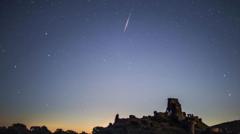
Every single August, media outlets roll out the exact same tired script. They tell you to pack a lawn chair, drive three hours away from light pollution, and stare blindly at the night sky to catch the Perseid meteor shower. They promise a celestial fireworks show. They tell you to look for streaks of light and make a wish.
It is mass delusion packaged as family-friendly entertainment.
I have spent decades dragging heavy optics into freezing desert nights and pitch-black mountain passes. I have watched more amateur astronomers freeze their toes off for a glimpse of space dust than I care to admit. And do you know what the dirty little secret of the Perseids is?
You are being sold a romanticized fantasy that bears almost no resemblance to optical reality.
The lazy consensus is that mid-August offers an effortless, high-yield cosmic spectacle if you just escape the city lights. The truth is much more cynical. The Perseids are bloated by media hype, plagued by terrible viewing logistics for most of the northern hemisphere, and systematically misunderstood by everyone who writes about them.
Let us tear down the mythology, look at the cold orbital mechanics, and figure out how to stop wasting your summer nights on bad astronomy.
The Myth of the Midnight Peak
If you read standard guides, they tell you to go outside around midnight, look toward the constellation Perseus, and wait for the show to start. This advice reveals a fundamental ignorance of how Earth moves through space.
Earth orbits the Sun at roughly thirty kilometers per second. As our planet plows along its path, the side facing forward into the orbital motion takes the brunt of any interplanetary debris. That leading edge of Earth is dawn.
Because of this, the radiant point of the Perseids—the constellation Perseus from which the meteors appear to originate—is low on the horizon in the early evening hours. The shower doesn't even begin to ramp up in earnest until the local sky rotates into the direction of Earth's orbital vector. That usually happens around two or three in the morning.
If you are standing outside at ten o'clock at night eating s'mores and complaining that you only saw two faint streaks of light, you aren't experiencing bad luck. You are experiencing basic orbital physics that your favorite lifestyle blog failed to mention.
The peak hours are between two in the morning and dawn. If you aren't losing sleep, you aren't seeing the shower. Full stop.
The Zenith Hourly Rate Lie
Let us talk about numbers, because astronomy journalism loves to throw around inflated statistics. You will read headlines screaming about one hundred meteors per hour.
That metric is called the Zenith Hourly Rate, or ZHR. It is a completely theoretical construct designed for professional cataloging, not for human beings standing in a damp field.
ZHR assumes a completely dark sky, zero atmospheric extinction, and—most importantly—that the radiant point of the shower is directly overhead at your zenith. None of those conditions ever apply to you.
When Perseus is sitting at a forty-five-degree angle instead of straight up, your actual visible meteor count gets slashed dramatically. Atmosphere blocks light. Low angles mean you are looking through a thicker slice of air, turning faint meteors into invisible smudges.
In reality, even under genuinely dark skies during a peak hour, a seasoned observer lucky to count forty actual meteors per hour is having a good night. For the average suburban backyard watcher fighting orange sodium vapor lights and a neighbor's security flood, that number drops to five or ten.
One meteor every six minutes is not a fireworks display. It is a test of patience that most people fail within forty-five minutes.
The Moon is Your Worst Enemy
Every year, amateur stargazers check the date of the peak—usually around August twelfth—and plan their lives around it. This is completely backwards.
In astronomy, the Moon dictates your schedule, not the calendar.
A bright waxing gibbous or a full moon will completely wash out eighty percent of the Perseids. Meteor streaks are faint, transient ionization trails left by dust grains burning up in the upper mesosphere at fifty miles up. They do not compete with moonlight.
If the peak of the Perseids coincides with a bright lunar phase, you might as well stay inside and watch television. The media articles never emphasize this because they operate on rigid calendar cycles, not lunar ones. They need an article on August tenth, so they publish it, regardless of whether the moon is turning the night sky into a glowing milk bowl.
Before you pack your car, check the lunar calendar. If the moon is up during the prime morning hours, the Perseids are officially canceled.
What Swift-Tuttle Actually Is
Let us look at the source of this debris field: Comet 109P/Swift-Tuttle.
Discovered independently by Lewis Swift and Horace Parnell Tuttle in 1862, this periodic comet has a nucleus about twenty-six kilometers across. To put that in perspective, it is roughly the same size as the asteroid that allegedly wiped out the dinosaurs.
Swift-Tuttle is classified as a potentially hazardous object. Its orbit crosses Earth's orbit cleanly, and it makes a pass every one hundred and thirty-three years. It last swung past us in 1992, and it won't be back until 2126.
Every time it passes the inner solar system, solar heating bakes volatile ices off its surface, leaving behind billions of tiny dust particles—meteoroids—strung out along its orbital track like a cosmic breadcrumb trail. When Earth crosses that path every August, those particles hit our atmosphere at roughly fifty-nine kilometers per second.
That is kinetic energy converted instantly into heat, light, and ionized gas. You are literally watching the shattered remnants of an icy behemoth vaporize sixty miles above your head.
That part is genuinely cool. But understanding the physics doesn't make the viewing experience any less overhyped.
How to Actually Watch Without Hating Yourself
If you are stubborn enough to go out anyway, stop following the terrible advice found on generic lifestyle sites. Do not use binoculars or telescopes.
This is the number one rookie mistake. Telescopes have narrow fields of view. You are trying to spot a random, lightning-fast flash across a massive canvas of sky. Pointing a telescope at a meteor shower is like trying to watch a football game through a straw.
You need your naked eyes. And more importantly, you need your dark adaptation.
Your eyes contain two types of photoreceptors: cones for color and daytime vision, and rods for low-light sensitivity. Rod cells rely on a pigment called rhodopsin, which takes up to forty-five minutes to fully regenerate in absolute darkness.
Every time you look down at your glowing smartphone to check social media or see what time it is, you instantly bleach the rhodopsin in your retinas. You reset your night vision to zero. You spend forty-five minutes blinding yourself over and over again while wondering why you can't see anything.
Leave the phone in the car. Cover your flashlight in red cellophane if you must use one. Give your eyes forty-five minutes of uninterrupted darkness before you judge the sky.
The Superior Strategy: Shift Your Window
If you want to experience the best of what the Perseids offer without freezing or falling asleep at your desk the next day, forget the midnight-to-dawn slog.
Instead, look up during the evening twilight in the days leading up to the peak.
While most meteors happen in the pre-dawn hours, the early evening brings a specific phenomenon called "earthgrazers." Because the radiant point is low on the horizon, any meteor that hits the atmosphere at that hour comes in at a shallow, skimming angle.
Earthgrazers are rare, but when they happen, they are spectacular. They travel horizontally across a massive swath of the sky, burning slowly, often leaving persistent trains of glowing smoke that linger for several seconds.
You won't get volume in the evening. You won't get fifty meteors an hour. But you might catch one slow, brilliant, jaw-dropping earthgrazer while you are still eating dinner on the back patio, without destroying your sleep schedule or driving an hour into the wilderness.
Stop Waiting for the Sky to Save Your Weekend
We live in a culture that desperately wants to outsource awe. We want a date on a calendar, a pre-packaged event, and a guarantee that if we follow three simple steps, the universe will provide a cinematic experience.
Nature doesn't work that way. The cosmos is indifferent, chaotic, and governed by cold mechanics.
The Perseid meteor shower is not a magical event waiting to heal your soul or give you a postcard-worthy Instagram story. It is a predictable orbital intersection with the dirty wake of a periodic comet.
If you want to go out at three in the morning into the freezing dark, respect the physics, ditch the phone, check the moon phase, and temper your expectations. Otherwise, stay inside, sleep in your own bed, and let the space dust burn up without you.