The old economic rulebook is dead. If you are sitting around waiting for interest rates to drop back to zero, supply chains to become perfectly predictable, and geopolitical tensions to magically vanish, you are setting yourself up for financial ruin. It is not going to happen.
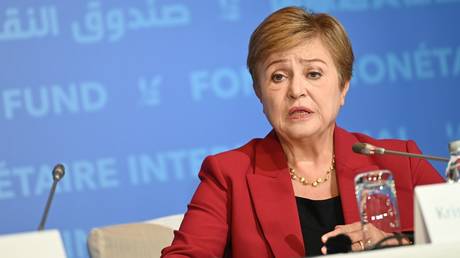
International Monetary Fund (IMF) Managing Director Kristalina Georgieva dropped a heavy dose of reality during her appearance on Bloomberg’s Leaders with Francine Lacqua podcast. Her message was blunt. The constant sequence of global crises we are living through isn't a temporary rough patch. It is the new permanent reality. If you enjoyed this post, you should look at: this related article.
"I am worried that we are not completely internalizing yet that this is how the world is going to be," Georgieva warned. "We are not going to get to a place where shocks are gone."
Since taking the wheel at the IMF in 2019, Georgieva has managed a chaotic timeline: a global pandemic, the war in Ukraine, massive trade tariff wars, and the explosive conflict in the Middle East that recently pushed the IMF to downgrade its 2026 global growth forecast to 3.1%. The institution, which commands a $1 trillion lending capacity across 191 member nations, is essentially screaming from the rooftops that crisis-mode is now the default setting. For another perspective on this development, check out the latest coverage from Business Insider.
If you are running a business or managing investments, you need to understand exactly what this shift means. The real danger isn't just the next crisis. It is the fact that our institutions are about to fumble the incoming wave of technological disruption exactly like they fumbled globalization thirty years ago.
The Brutal Admission of the Globalization Fumble
To understand why the IMF is so spooked about the near future, you have to look at what they finally admitted about the past. For decades, elite economists treated globalization like an absolute win. They looked at big-picture metrics. Global GDP went up. Cheap goods flooded western markets. Hundreds of millions of people lifted themselves out of extreme poverty in emerging economies.
On paper, the math worked. In reality, it created an angry, fractured world.
Georgieva admitted that organizations like the IMF completely failed to see the human collateral damage. "We collectively, including the fund, did not appreciate the backlash against globalization," she said.
While billionaires celebrated corporate efficiencies, actual communities were hollowed out. Manufacturing towns lost their factories. Stable jobs vanished overnight. Local economies dried up, and nobody in power bothered to offer a safety net or a real transition plan. The resulting economic pain fueled the populist political revolts, trade wars, and deep social divides that define our current decade.
The IMF focused entirely on the global average while ignoring the local wreckage. Now, they see history preparing to repeat itself on a much faster timeline.
Why AI is the Next Massive Economic Shock
The next systemic shock isn't originating in a central bank or on a battlefield. It is coming from Silicon Valley. The IMF is directly tying its warnings about future instability to the rapid rollout of artificial intelligence.
The economic data behind this anxiety is staggering. The IMF estimates that nearly 40% of global employment is exposed to AI disruption. In advanced economies, that number skyrockets to 60%.
| Economy Type | Job Exposure to AI Disruption |
|---|---|
| Advanced Economies | 60% |
| Emerging Markets | 40% |
| Low-Income Countries | 26% |
Look closely at those numbers. The shockwaves will hit wealthy countries first and hardest. The IMF expects about half of those exposed jobs in advanced nations to get a productivity boost from AI integration. The other half? Those workers face lower labor demand, suppressed wages, or outright job elimination.
The core issue isn't whether AI makes corporations more profitable or productive. It will. The issue is that the speed of job destruction will vastly outpace the creation of new roles.
Think back to the globalization era. When a factory closed, it took a decade for the town to slowly decay. With AI, a company can automate entry-level white-collar roles—like legal research, coding, copywriting, and customer support—in an afternoon. The benefits will instantly concentrate in the hands of tech founders and capital owners, while the economic disruption hits the middle class at lightning speed.
Georgieva is terrified of this exact scenario. "I’ll tell you what I’m very keen not to see repeated is the same with artificial intelligence," she emphasized. But wishing won't stop it. The structural incentives for businesses to slash labor costs using automation are too powerful to ignore.
Systemic Fragility from Energy to Cyber Risks
If AI isn't enough to worry about, the broader economic foundation is showing deep cracks. The IMF's recent economic downgrades stem from the escalating conflict in the Middle East, which has spiked oil prices and choked off vital transit paths like the Strait of Hormuz.
Europe is still reeling from the lingering effects of the Ukraine conflict. Despite political promises to completely sever ties with Russian fossil fuels by 2027, the reality of high energy costs is forcing a quiet, desperate debate behind closed doors in Brussels about whether to restore energy relationships just to keep domestic industries alive.
At the same time, the IMF's financial stability teams are quietly raising alarms about a different kind of vulnerability. The rise of advanced frontier AI models has created unprecedented cybersecurity risks. In recent technical briefings, analysts warned that advanced models could autonomously discover and exploit vulnerabilities across major operating systems and web browsers.
We are no longer just dealing with individual bad actors hacking a local network. We are looking at the potential for highly sophisticated, automated cyber attacks that could trigger correlated failures across global banking systems and payment networks simultaneously. When everything is interconnected, a single glitch or targeted strike can cascade through the entire system in minutes.
How to Build a Friction Resistant Strategy
So, what do you actually do with this information? If stability is gone, trying to predict the exact timing of the next black swan event is a fool's errand. You don't need a better crystal ball. You need a strategy built for impact.
Stop Optimizing for Zero Friction
For years, the goal of every business was maximum efficiency. Just-in-time supply chains. Razor-thin inventory margins. Total reliance on single, cheap overseas suppliers.
That model is a liability now. You need to introduce deliberate redundancy into your operations. Hold more cash on hand, even if inflation nibbles at it. Diversify your supply chain across multiple geographical regions, even if it costs more upfront. Localize what you can. Fragile systems break under pressure; resilient systems survive.
Treat Cash Flow as Your Ultimate Defense
When shocks hit, credit markets freeze up instantly. We saw it in 2020, and we are seeing the ripples again. Do not rely on easy access to debt to bail you out of a sudden downturn. Prioritize positive, predictable cash flow over vanity growth metrics. If your business cannot survive a 20% drop in revenue for six consecutive months without needing an emergency loan, you are overexposed.
Build Personal Technical Aggression
If you are an individual worker or manager, clinging to routine tasks is professional suicide. Entry-level, repetitive, and purely analytical roles are being eaten by automation. The only way to survive the AI labor transition is to become the person who directs the technology, rather than the person replaced by it. Lean heavily into roles that demand complex human judgment, deep relationship building, and cross-disciplinary problem solving.
The IMF is right to worry about the future, because large bureaucratic governments move too slowly to protect you from these overlapping waves of disruption. The objective analysis is clear. Stop waiting for the storm to pass. Learn how to operate in the rain.