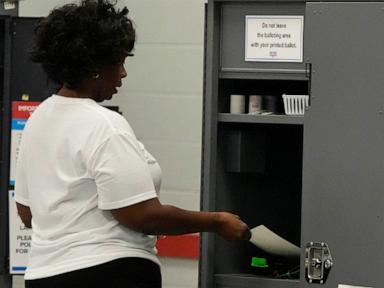
The media is currently hyperventilating over Georgia’s latest legislative game of chicken. Lawmakers recently punted the state's self-imposed July 1 deadline to ban QR codes on paper ballots, pushing the timeline out to 2028. The predictable chorus of mainstream journalists and partisan activists is out in full force, treating this delay like a catastrophic failure of democracy that leaves the upcoming midterm elections teetering on the edge of a tech-fueled abyss.
They are asking the entirely wrong question.
The lazy consensus across the political spectrum is that QR codes are an existential threat to election integrity because humans cannot read pixels, and therefore we must immediately dismantle the electronic infrastructure in favor of hand-marked paper ballots. This narrative is not just wrong; it is a regression masquerading as reform. I have watched organizations blow millions of dollars overhauling high-security tech stacks based on pure vibes and public relations panics, only to end up with systems that are slower, more expensive, and vastly more vulnerable to human error. Georgia’s legislative gridlock is not a crisis. It is an accidental victory for mathematical reality over political theater.
The Myth of the Unverifiable Ballot
The primary argument peddled by critics is simple: because a voter cannot read the black-and-white matrix of a QR code with the naked eye, the voting machine could theoretically print a human-readable summary that says "Candidate A" while encoding "Candidate B" into the barcode scanned by the tabulator.
It sounds terrifying. It is also an incredibly weak threat model.
Georgia’s current ballot-marking devices do not just spit out a barcode into a black box. They produce a physical, standardized paper ballot that prints every single one of your choices in plain English. That paper ballot is the absolute anchor of the entire system.
If a malicious actor or a rogue software update attempted to alter votes via the QR code, the deception would instantly collapse during the mandatory post-election audits. Georgia law requires statistical audits where physical paper ballots are pulled and verified. If the human-readable text on those ballots did not match the digital machine count generated by the QR codes, the discrepancy would flash like a neon sign.
The downside to our current setup is not a lack of security; it is a lack of imagination. Instead of panicking over the barcode, the state could simply mandate a dual-tabulation check at the county level using Optical Character Recognition software to read the text strings simultaneously on election night. In fact, when the Secretary of State's office issued preliminary guidance for recent special elections, they outlined exactly this: using software to double-check the text against the barcode images before certification. The tech to verify exists without burning the whole house down.
The Brutal Math of Human Error
Activists pushing for an immediate, mandatory shift to hand-marked paper ballots operate under the romantic delusion that humans are flawless data processors. They want voters to fill out bubbles with pens, drop them in boxes, and let human hands do the counting or sorting.
Let us look at actual audit data from Georgia’s recent primary elections instead of relying on theoretical hand-waving. Secretary of State Brad Raffensperger recently dropped the cold, hard numbers from the state's post-election reviews, and they are devastating to the anti-machine crowd.
Out of more than 2 million ballots cast, a microscopic 159 errors were identified across the entire state. That is an accuracy rate well north of 99.99%. But here is the kicker: 143 of those 159 errors occurred on hand-marked paper ballots.
When humans mark paper by hand, they do not behave like machines. They make stray marks. They hesitate and leave faint smudges. They use the wrong color ink. They check two boxes and cross one out, leaving election workers to guess at voter intent. Imagine a high-stakes midterm election where hundreds of thousands of ballots contain ambiguous ink bleeding, and partisan lawyers are fighting over whether an "X" over a bubble constitutes a vote or a cancellation.
We have lived through this before. We spent years watching highly paid election attorneys argue over hanging chads and incomplete circles. Shifting entirely to hand-marked ballots does not eliminate risk; it replaces a highly auditable cryptographic problem with an un-auditable human compliance problem. It trades a secure, standardized system for an administrative nightmare where the integrity of your vote relies entirely on the physical security of paper piles and the subjective interpretation of local volunteers.
How to Actually Secure the Vote
If Georgia lawmakers genuinely want to build trust without crashing the logistics of the midterms, they need to stop trying to "fix" the voting machines by dragging the state back to the 19th century. Instead, they must lean heavily into hard verification protocols that bridge the gap between machine efficiency and public trust.
- Mandate Risk-Limiting Audits (RLAs) with Teeth: Instead of auditing a token sample, tie the audit sample size directly to the margin of victory. A razor-thin race triggers a massive, hand-counted audit of the plain-text names on the paper. If the machine count and the hand count align, the QR code debate becomes completely irrelevant.
- Open-Source the Tabulation Verification: If the public is terrified of proprietary code inside Dominion scanners, the state should use standard commercial scanners to create high-resolution digital images of every ballot, publish them securely online, and allow independent public entities to run open-source text-recognition software across the images. Transparency kills conspiracy.
- Stop Changing the Rules in Election Years: Implementing an entirely new hardware infrastructure or reprogramming thousands of machines months before a major election is operational suicide. Election directors need predictability, not continuous legislative pivots designed to score cable news talking points.
The obsession with eliminating QR codes is a classic tech-panic distraction. The paper trail is already sitting in the precincts, waiting to be read, counted, and verified by human eyes whenever doubt arises. Stop running away from the barcodes, and start enforcing the math that proves they are right.

