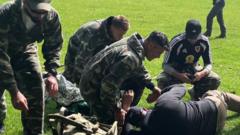
Football coaches love pretending they are generals preparing young men for battle. They buy into the cinematic obsession with boot camps, simulated ambushes, drill sergeants screaming in mud, and the romantic delusion that high-intensity military trauma translates to winning three points on a Saturday afternoon.
It is absolute theater. And it is actively failing modern athletes.
Every few years, a profile emerges highlighting some manager who took his team into the wilderness to trek with royal marines, sleep in ditches, or dodge simulated explosions. The media laps it up. Fans swoon over the performative grit. The narrative writes itself: if you can survive a simulated ambush, you can handle a high press at Anfield.
That logic is totally flawed.
Translating military doctrine directly onto a football pitch reveals a total misunderstanding of both warfare and modern tactical systems. War is an exercise in strict risk mitigation, top-down hierarchy, and rigid adherence to protocol designed to keep people alive in absolute worst-case scenarios. Football is a dynamic game of rapid self-organization, controlled risk-taking, and elite spatial awareness.
When you treat elite athletes like soldiers, you do not build resilient thinkers. You build obedient, risk-averse executioners who freeze the moment a match plan breaks down.
The Boot Camp Myth and the Illusion of Cohesion
Coaches drag squads to military bases for one primary reason: they want an instant shortcut to team bonding. They want to manufacture shared suffering because true culture takes months of consistent, boring, daily work to build.
It is easy to throw twenty millionaires into a muddy trench, strip them of their comfort zones, and claim they emerged as brothers. Shared discomfort creates an immediate spike in cortisol and adrenaline. It forces temporary compliance. But compliance is not cohesion.
The Trauma Bonding Fallacy
I have watched club executives drop hundreds of thousands of dollars on extreme survival retreats only to see the exact same dressing room fractures reappear by mid-November. Why? Because surviving an artificial crisis does not solve tactical friction or ego clashes on the pitch.
- Artificial Stress vs. Performance Stress: Carrying a telephone pole up a hill alongside a teammate requires simple physical endurance and joint compliance. Passing through a compact mid-block under suffocating pressure requires cognitive clarity, situational awareness, and trust in a shared tactical picture.
- The Obedience Trap: Military drills rely heavily on instant obedience to authority. Modern football demands decentralized decision-making. If your players are conditioned to wait for orders from a dictator on the sideline, they lose the precise split-second initiative that separates elite performers from middle-of-the-pack squads.
- The Fatigue Fallacy: Driving athletes to complete physiological exhaustion under the guise of "building mental toughness" usually just degrades their motor skills, disrupts recovery cycles, and spikes injury rates right before the competitive season starts.
When you strip away the camouflage paint and military cosplay, these retreats are rarely about the players. They are about the manager’s own deep-seated insecurity and desire for control.
Why Command-and-Control Leadership Kills Modern Tactics
The traditional army model relies on a strict command structure. Information flows down from the general; execution flows up from the grunt. In the mid-20th century, when football was played in rigid 4-4-2 blocks with fixed positional responsibilities, that autocratic approach could produce baseline results.
That era is completely dead.
Modern football relies on fluidity, positional rotation, and immediate counter-pressing triggers. The pitch moves too fast for a manager to micromanage every phase of play from the technical area.
TRADITIONAL MILITARY MODEL        MODERN ELITE FOOTBALL MODEL
[ Headquarters / General ]        [ Shared Tactical Blueprint ]
            │                                  │
            ▼                                  ▼
[ Rigid Command Chain ]           [ Autonomous Pitch Units ]
            │                                  │
            ▼                                  ▼
[ Blind Execution of Order ]      [ Rapid Real-Time Adaptation ]
When a coach applies military-style command-and-control, three destructive mechanics occur:
- Psychological Paralysis: Players become terrified of making mistakes. When error is framed as a breach of duty or a personal failure of "grit," athletes choose the safe, sideways pass over the line-breaking risk.
- Cognitive Overload: A player whose nervous system is hyper-sensitized by drill-sergeant screaming cannot process visual information efficiently. High anxiety narrows perceptual vision, turning wide-angle playmakers into tunnel-visioned panic passers.
- Loss of Player Agency: Tactical systems like positional play rely on athletes reading the opponent's body language and adjusting their spacing dynamically. If a player is trained merely to obey orders, they lose the capacity to improvise when the opposition presents an unexpected structure.
Imagine a scenario where a center-back identifies a clear opening to drive into the midfield because the opponent's press shifted prematurely. An athlete raised in a rigid command environment stays back because "that wasn't the pre-match briefing." An athlete built in a high-trust, autonomous system takes the space immediately and breaks the game open.
What Military Philosophy Actually Gets Right (And What Football Misses)
The irony of this entire obsession with army coaching is that football managers cherry-pick the most outdated, caricature-driven elements of military training while completely ignoring the real tactical innovations of modern military doctrine.
If football directors actually studied modern military operations—specifically concepts refined over the last thirty years—they would fire the shouting drill instructors immediately.
Mission Command (Auftragstaktik)
The Prussian military developed Auftragstaktik (Mission Command) in the 19th century after realizing that central command breaks down the moment gunsmoke hits the field. The core principle is simple: commanders define the ultimate objective and the boundaries of the operation, but give full operational autonomy to lower-level leaders on the ground to decide how to achieve that objective based on immediate reality.
Elite football managers like Pep Guardiola and Roberto De Zerbi do not use military drill discipline; they use Auftragstaktik.
They do not tell a winger exactly where to stand at every second. They give the squad a strict set of spatial principles, create numerical overloads in specific zones, and give the players absolute freedom to solve the puzzle themselves in the final third.
+-----------------------------------------------------------------------+
|                       MISSION COMMAND ON THE PITCH                    |
+-----------------------------------------------------------------------+
| PRINCIPLE: Create an overload on the left flank to isolate the right  |
| winger 1v1.                                                           |
|                                                                       |
| EXECUTED BY PLAYERS: Left-back overlaps, central midfielder drops     |
| deep, winger stays wide. The choice to pass, dribble, or switch play  |
| is made 100% autonomously in the moment.                              |
+-----------------------------------------------------------------------+
Debriefing Without Rank
Special operations forces do not survive because they blindly follow orders; they survive because they conduct brutal, rank-free post-action reviews. In a military debrief, a junior officer can openly correct a senior commander if the commander made a tactical error in the field.
In football, the autocrat manager dominates the video room. They use film review as a weapon to punish, humiliate, and assign blame.
If clubs actually wanted to borrow from elite military units, they would start by creating psychological safety in analysis sessions, letting twenty-year-old midfielders point out where the head coach’s press setup failed, without fear of being dropped for the next match.
The Danger of Confusing Physical Discomfort with Tactical Preparedness
There is an addictive quality to physical suffering. It feels productive. When a team finishes a grueling pre-season camp climbing mountains with heavy packs, the staff feels a sense of accomplishment.
It is a complete psychological trap.
Fitness in elite sport is hyper-specific. High-intensity sprinting, deceleration, change of direction, and tactical awareness under heart-rate spikes bear zero metabolic or neurological relation to carrying sandbags across a riverbank.
"When you overload an athlete with non-specific, high-fatigue tasks, you do not build a warrior. You build an exhausted, slow athlete whose central nervous system is too fried to process complex spatial tactical cues."
Let us look at the reality of modern physical preparation versus military-style conditioning:
| Attribute | Army-Style Boot Camps | Modern High-Performance Football |
|---|---|---|
| Energy System | Aerobic Grind & Chronic Exhaustion | Alactic/Aerobic Repeat Sprint Ability |
| Cognitive Load | Blind Compliance Under Physical Stress | Complex Pattern Recognition Under Pressure |
| Injury Profile | High Overuse & Joint Shear Stress | Monitored Load Management & Acceleration Control |
| Decision Making | Extrapolated Rules & Direct Orders | Autonomous Micro-Decisions Every 0.5 Seconds |
| Outcome | Temporary Submissiveness | Long-Term Adaptability & Tactical Intelligence |
When football clubs prioritize military-style shock tactics over precise, high-velocity ball-work under pressure, they waste precious training micro-cycles. Every hour spent crawling through dirt is an hour lost refining the build-up phase, mastering set-piece routines, or sharpening spatial coordination.
Stop Playing Soldier: How to Build Genuine Pitch Intelligence
If you are running an organization, managing a team, or coaching an elite squad, tear up the military LARPing playbook. Stop equating performative cruelty with elite preparation.
To build an adaptable, elite team capable of performing under intense pressure, focus on these actionable shifts:
- Train Principles, Not Rigid Plays: Give your team clear operational guidelines, then step back. Allow them to make mistakes in training so they learn how to navigate chaos without looking at the bench for permission.
- Institute Egalitarian Post-Mortems: After every game or major project, open the floor. The newest, youngest team member must be encouraged to challenge tactical execution without fear of professional retaliation.
- Build Trust Through Clarity, Not Trauma: True psychological safety comes from every player knowing their exact role, understanding the team's overarching strategy, and knowing their staff has their back when an intelligent risk goes wrong.
- Match Stress to Reality: If you want players to handle the high pressure of 80,000 screaming fans, do not take them out into the woods. Put them in small-sided, hyper-constrained games where spatial time is reduced, rules shift dynamically, and every mistake has an immediate tactical consequence.
The myth of the drill sergeant manager needs to die. Football is not combat. It is high-speed chess played at 180 beats per minute. If you want your players to win, stop treating them like soldiers on a battlefield and start equipping them to be autonomous masterminds on the grass.