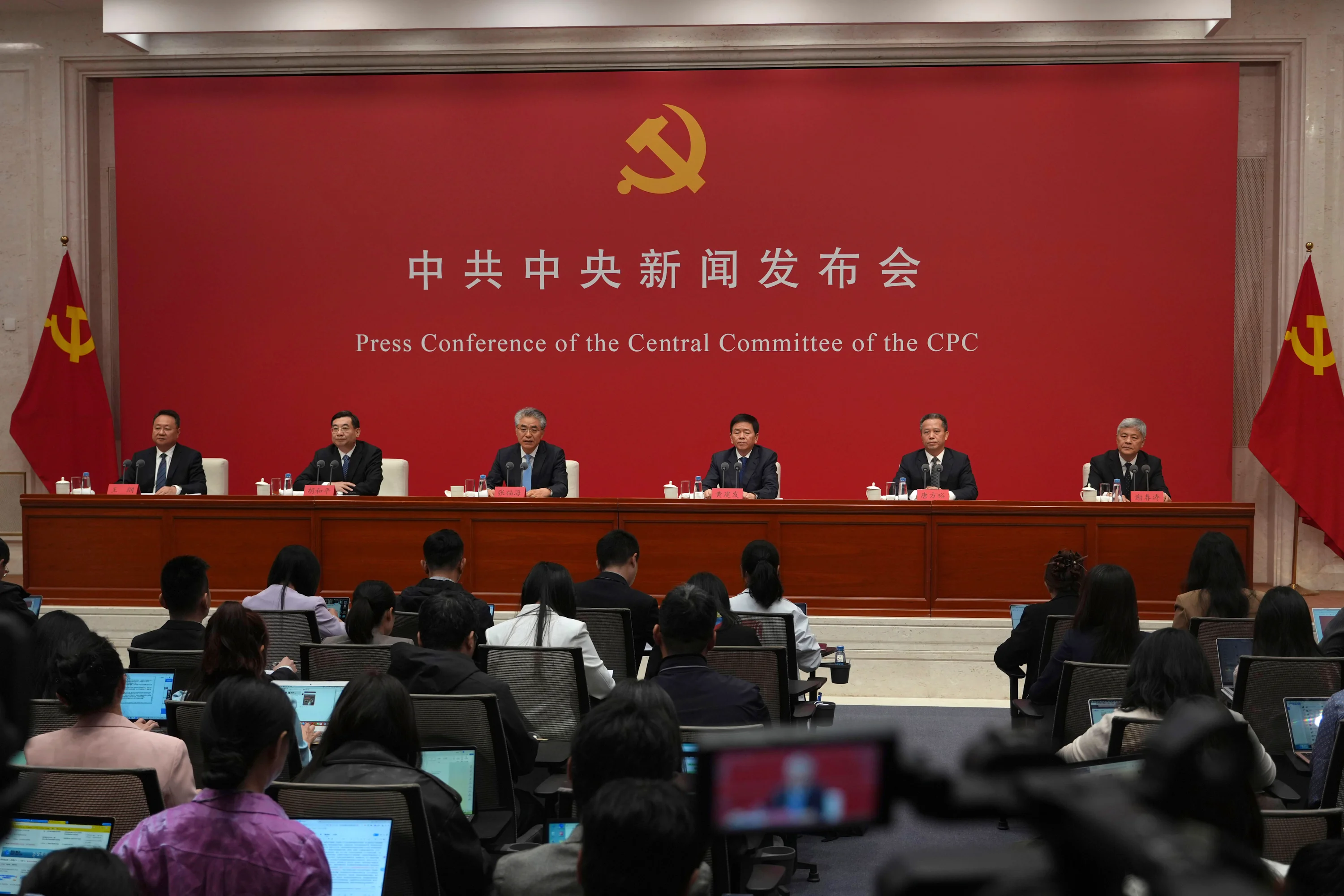
Every time Beijing concludes a major political gathering—whether it is the Two Sessions in March, a Central Committee Plenum, or a Politburo economic readout—the financial press produces the exact same post-mortem. Analysts comb through the communiqués looking for a headline GDP growth target, count the mentions of "stimulus," and declare the outcome either a disappointment or a pivot depending on whether a specific number of trillion yuan in sovereign bonds was announced.
That framework misses how Chinese economic governance actually functions.
According to institutional analyses from the Mercator Institute for China Studies (MERICS) and macro-financial researchers at the Rhodium Group, Western market commentary routinely misinterprets Beijing's policy meetings by treating them like Federal Reserve FOMC announcements or Western legislative budget votes. In Washington or Frankfurt, a policy meeting produces an immediate, discrete shock to interest rates or fiscal outlays. In Beijing, a high-level political meeting is not the launchpad of a stimulus package; it is the alignment of bureaucratic incentives across a multi-tiered administrative state.
If you are looking at the headline communiqué for a magic number, you are reading the wrong ledger.
The Myth of the "Bazooka" Stimulus
The most persistent misconception in global macro commentary is that Beijing's leadership is either "refusing" to rescue the economy or waiting for the right moment to unleash a massive, 2009-style consumer stimulus.
When a meeting ends without direct cash handouts to households or a sudden surge in infrastructure spending, headlines immediately frame the outcome as policy paralysis. In reality, as economist Michael Pettis of Peking University has repeatedly demonstrated in his research on Chinese macroeconomic imbalances, Beijing's reluctance to deploy massive debt-fueled stimulus is not a failure of nerve—it is a structural constraint.
China’s total debt-to-GDP ratio has already climbed past 280 percent, driven largely by decades of local government financing vehicle (LGFV) borrowing and property-sector expansion. Pushing another wave of indiscriminate credit into the system does not generate sustainable growth; it merely lowers the marginal productivity of capital while compounding systemic financial risk.
Furthermore, a direct fiscal transfer to households—the standard Keynesian prescription favored by Wall Street commentators—runs counter to the institutional structure of China's fiscal system. Central government revenues account for a relatively small share of total public expenditure, while local governments carry the bulk of social spending obligations alongside severe debt-service burdens. A political meeting in Beijing cannot simply decree a Western-style welfare transfer without first restructuring the entire central-local tax-sharing architecture established in 1994.
What the Meetings Actually Do: Cadre Evaluation and Industrial Allocation
To understand what actually happened in Beijing this week, you have to stop reading the English-language market summaries and look at the bureaucratic signal sent to provincial governors, municipal party secretaries, and state-owned bank executives.
Political economy scholars, including Yuen Yuen Ang (author of How China Escaped the Poverty Trap) and Victor Shih at UC San Diego, have documented how Chinese governance operates through "directed improvisation" and cadre evaluation metrics. High-level meetings establish the exact political weights assigned to competing objectives.
For nearly three decades, local officials were promoted primarily on one metric: raw regional GDP growth. If a mayor built an industrial park, paved a highway, and inflated local output, they moved up the ranks.
Recent Beijing readouts—characterized by dense ideological phrasing like "new quality productive forces" and "high-quality development"—are not empty slogans. They are a direct rewriting of the promotion rubric for millions of officials. When the Politburo or Central Committee elevates supply-chain self-reliance, advanced manufacturing, and debt containment above raw GDP velocity, it alters how local officials allocate land, approve bank loans, and deploy local guidance funds.
Here is the practical reality that market commentators miss:
- Capital is deliberately starved from legacy sectors. Real estate developers and traditional municipal infrastructure projects are no longer the primary recipients of state-directed credit. The political cost to a bank executive of a bad loan in property is now far higher than the reward for hitting a volume target.
- State capital is funneled into industrial bottlenecks. Rather than subsidizing domestic consumption, Beijing uses these meetings to synchronize industrial policy across provinces—directing credit toward semiconductors, grid infrastructure, electric vehicles, industrial robotics, and green energy storage.
- Deflation is treated as a tolerable byproduct, not an emergency. While foreign analysts view falling producer prices and weak consumer sentiment as signs of an impending crisis requiring immediate demand-side intervention, Beijing’s planners view low input costs and industrial overcapacity as a competitive advantage that reinforces manufacturing dominance.
The Structural Trade-Off Nobody Wants to Admit
The contrarian view is not that Beijing’s approach is guaranteed to succeed. In fact, the downside of this strategy is severe, and both sides of the debate often gloss over the core tension.
By prioritizing industrial supply-side upgrading over household income redistribution, Beijing is doubling down on an export-led and investment-heavy growth model at the exact moment global trading partners are erecting tariff barriers. As reports from the Peterson Institute for International Economics and the European Union Chamber of Commerce in China have noted, absorbing China's manufacturing surplus requires global demand that is increasingly restricted by geopolitical friction.
At the same time, assuming Beijing will eventually cave to market pressure and adopt a Western consumer-led stimulus model misunderstands the political priorities of the Chinese Communist Party. Leadership views dependence on foreign technology and vulnerable supply chains as an existential national security threat, whereas sluggish domestic retail sales are viewed as a manageable economic headwind.
How to Actually Read a Beijing Policy Readout
If you manage supply chains, allocate capital, or track geopolitical risk, stop waiting for a press conference to hand you a neat macroeconomic forecast. Use a completely different filter when analyzing official statements from Beijing:
- Ignore the adjective count; track the institutional ownership. When a communiqué mentions a priority—whether it is AI infrastructure, local debt swaps, or elderly care—look at which ministry or state body is assigned responsibility in the days immediately following the meeting. A policy backed by the National Development and Reform Commission (NDRC) and the People's Bank of China (PBOC) carries capital allocation power; a policy left solely to provincial ministries without central fiscal backing is an unfunded mandate.
- Watch the sequence of implementation, not the announcement. In Chinese policymaking, major structural shifts are almost always piloted at the municipal or provincial level before being ratified nationally. By the time a phrase appears in a major Beijing communiqué, the underlying regulatory adjustments have usually been operating in test zones like Shenzhen, Shanghai, or Hefei for six to eighteen months.
- Separate cyclical noise from structural reallocation. A weak quarterly retail figure does not mean Beijing is "failing" to stimulate; it means Beijing is actively choosing to transfer wealth from households and legacy property holders to industrial producers and state balance sheets.
The financial media will continue to grade every Beijing meeting on whether it delivers the short-term sugar high that equity traders want. Meanwhile, the state apparatus in China is executing a multi-year industrial reallocation that operates on an entirely different clock—and an entirely different balance sheet.


