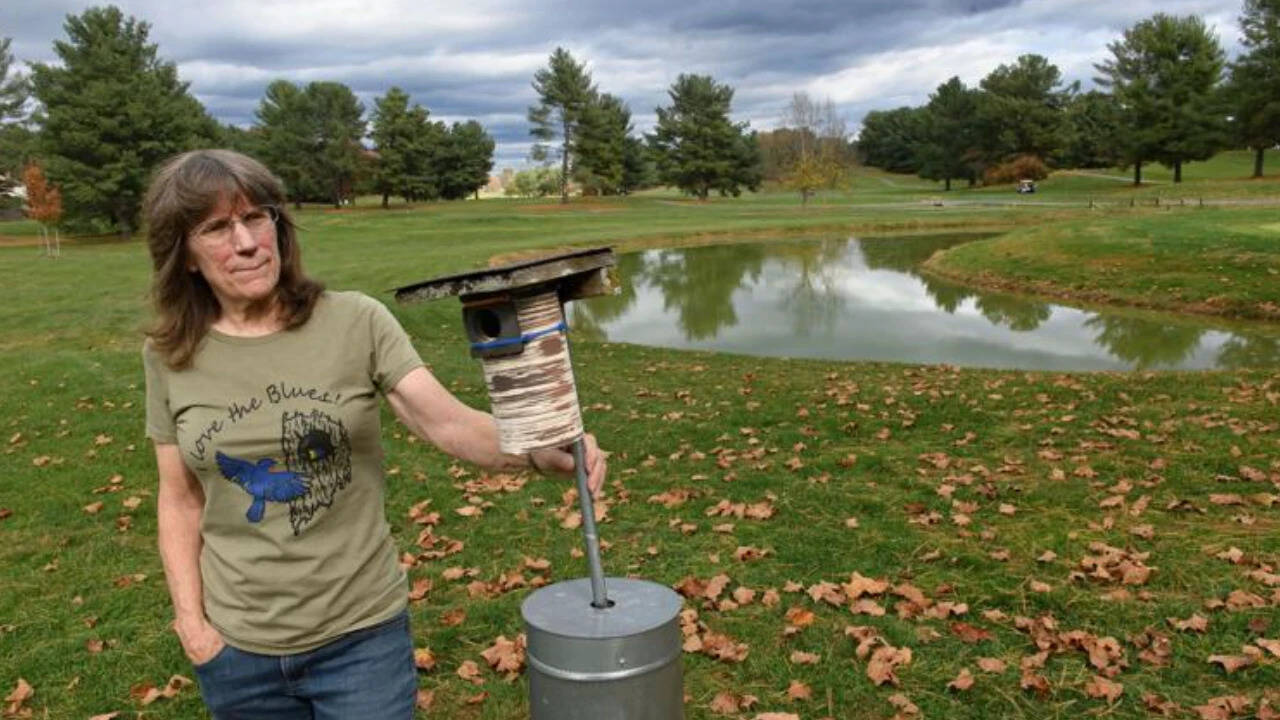
Feel-good viral stories love a tidy scoreboard. Twenty-seven wooden boxes. Twenty years of weekly checks. One thousand six hundred and seventy-four baby Eastern bluebirds launched into the Virginia sky.
It reads like an effortless conservation triumph. Put up a wooden box, peek inside once a week from April to July, count the pale blue eggs, and watch nature heal itself.
Except that story leaves out the brutal math of backyard birding. Most people who copy that blueprint without the obsessive discipline behind it are not saving songbirds. They are building subsidized fast-food drive-thrus for invasive species and local predators.
The Myth of Passive Conservation
The lazy consensus in suburban wildlife advocacy says that hanging a birdhouse is an automatic net positive. Habitat loss took away dead trees, the logic goes, so nailing a cedar box to a fence post restores the balance.
That logic collapses the moment you step off a managed bluebird trail and look at the average suburban yard.
Eastern bluebirds (Sialia sialis) are secondary cavity nesters. They cannot excavate their own holes like woodpeckers do. Historically, they relied on abandoned woodpecker cavities in rotting snags, wooden fence posts, and fire-scarred orchards. When modern forestry, suburban neat-freak landscaping, and metal fence posts wiped out those dead trees, bluebird populations crashed in the mid-twentieth century.
Nest box trails brought them back. Organizations like the North American Bluebird Society (NABS) and the Cornell Lab of Ornithology proved that targeted housing works.
What the viral headlines sanitize is the sheer amount of ruthless intervention required to make those numbers happen. When a dedicated trail monitor logs 1,674 fledglings over two decades, she is not merely acting as a passive landlord. She is running an active ecological management zone.
Without weekly monitoring, proper pole baffling, and aggressive competitor management, a nest box quickly turns into an ecological trap. An ecological trap occurs when an animal chooses a habitat based on cues that used to signal safety—like a snug wooden cavity—only to walk straight into a high-mortality zone.
Why Your Unmonitored Box Is a Death Trap
If you nail a bluebird house to a tree trunk and leave it alone until autumn, you have created a buffet.
Raccoons, black rat snakes, domestic cats, and flying squirrels memorize the locations of unguarded boxes. A tree trunk is a highway for a climbing predator. Even a box mounted on a bare wooden post without a metal stove-pipe baffle offers zero resistance to a determined snake or raccoon. They simply reach inside and eat the brooding female along with her eggs.
Worse than native predators are the invasive cavity competitors introduced from Europe in the nineteenth century.
- House Sparrows (Passer domesticus): These aggressive, non-native weavers do not just steal nest boxes. They wait until a female bluebird is trapped inside the box, enter through the 1.5-inch hole, and peck her to death on top of her own eggs. They will then build their messy grass nest directly over her body.
- European Starlings (Sturnus vulgaris): Slightly larger, starlings will evict native birds from any box with an entrance hole wider than 1.5 inches.
- House Wrens (Troglodytes aedon): Native, protected by federal law, and fiercely territorial. Wrens routinely pierce bluebird eggs with their bills and toss the broken shells out of the box just to eliminate future competition for insects.
I have walked trails maintained by well-meaning HOA boards where eighty percent of the boxes were stuffed with House Sparrow nests. Those boards proudly boasted about their "bird sanctuary" while actively subsidizing the exact invasive species driving native songbirds out of the neighborhood.
The Unspoken Reality of Nest Box Monitoring
The Virginia monitor highlighted in the news checked her 27 boxes every single week from April to July. That detail is the entire ballgame, yet casual readers skim right past it.
Weekly monitoring is not about taking cute photos for social media. It is an active triage system.
First, you are checking for blowflies (Protocalliphora). Blowfly larvae live in the nesting material and crawl onto featherless nestlings at night to feed on their blood. Heavy infestations weaken chicks so severely that they die in the box or fledge too weak to escape hawks. Experienced monitors swap out infested nests with clean, dry grass once the chicks are feathered enough to regulate their own body heat.
Second, you are managing House Sparrow invasions. Because House Sparrows are non-native, they are not protected under the Migratory Bird Treaty Act of 1918. Trail monitors legally remove sparrow nests every single week—sometimes multiple times a week—to prevent them from breeding and killing native cavity nesters.
Third, you are dealing with weather and abandonment. Late spring cold snaps wipe out flying insects, causing bluebird chicks to starve in the box. If a parent gets hit by a car, the surviving mate often cannot feed a brood of five alone.
If you are not willing to open that box every seven days, stare at dead chicks, scoop out maggot-ridden straw, and repeatedly evict invasive birds, do not put up the box.
Stop Asking Which Birdhouse to Buy
Search engines are flooded with people asking the wrong questions about backyard birding. They want to know the prettiest wood stain, the cutest decorative roof, or the best spot near their patio window so they can watch birds while drinking coffee.
They are shopping for lawn ornaments, not wildlife infrastructure.
If you actually want to help bluebirds, tear up your shopping list of decorative cedar houses and confront the real questions.
Does a painted or decorative birdhouse attract bluebirds?
Bluebirds do not care about curb appeal, and bright paints or fancy trim actively hurt them. Dark paints absorb solar radiation and turn the interior into an oven during July heatwaves in states like Virginia, cooking nestlings alive before they can fledge. Decorative perches nailed beneath the entrance hole do nothing for bluebirds, which cling directly to the wood; those perches simply give House Sparrows and predators a convenient foothold to attack the interior. Use unpainted, rough-sawn cedar or pine, drill ventilation holes near the roofline, and keep the exterior completely plain.
Can I mount a bluebird box on a tree or wooden fence?
Only if you want to feed the local snake and raccoon population. Mounting a box on a tree trunk violates the most basic rule of cavity management. Bluebirds prefer open meadows, pastures, or large lawns with scattered trees because they hunt insects on the ground by dropping down from low perches. Furthermore, trees provide cover for ambush predators and House Wrens. A legitimate bluebird box belongs on a smooth metal conduit pipe driven into open ground, fitted with a swinging metal baffle or a tall stove-pipe guard at least four feet off the soil.
Should I leave the old nest inside for next season?
No. Bluebirds rarely reuse a dirty nest, and leaving old material inside invites parasites, mites, and fungal spores to overwinter in the box. Once a brood fledges—usually around day 17 or 18 after hatching—you should immediately clear out the old pine needles or grass. Bluebirds frequently raise two or three broods in a single summer. Cleaning the box between broods gives the next clutch a sterile start and prevents the nest height from building up so close to the entrance hole that raccoons can reach inside.
The Hard Truth About Habitat vs. Hardware
Even a perfectly baffled, religiously monitored trail of 27 boxes has a hard ceiling.
Nest boxes only solve one bottleneck: the housing shortage. They do zero to solve the food crisis.
A single pair of Eastern bluebirds feeding a brood of four or five chicks needs hundreds of caterpillars, beetles, grasshoppers, and spiders every single day. Nestlings cannot digest seeds. They cannot survive on suet cakes. They require soft-bodied insects rich in protein and moisture.
Imagine a scenario where a suburban neighborhood installs fifty pristine, predator-proof bluebird boxes along a manicured golf course or an HOA greenbelt sprayed monthly with broad-spectrum insecticides. Adult bluebirds will happily move into those boxes. They will lay four or five eggs. Those eggs will hatch. And then the parents will fly miles across asphalt and chemically sterilized turfgrass, burning more calories than they can gather, until the chicks starve to death inside their state-of-the-art wooden homes.
According to research popularized by entomologist Doug Tallamy at the University of Delaware, native caterpillars are the primary engine of terrestrial bird reproduction. Non-native ornamental plants—like Bradford pears, Japanese barberries, and endless expanses of turfgrass—support almost zero native caterpillar species.
Putting up a nest box in a yard sprayed for mosquitoes and grubs is like building a luxury maternity ward in the middle of a famine.
The Downside of the Nest Box Obsession
There is a legitimate ecological trade-off to hyper-managed nest box trails that conservationists rarely discuss in public.
When humans intervene at scale—removing predators, treating parasites, and providing ideal artificial cavities—we alter natural selection. In the wild, heavy predation and parasite loads weed out weaker genetics and birds that choose poor nesting sites. A trail that artificially inflates fledgling survival rates to near ninety percent keeps weaker phenotypes in the gene pool.
Additionally, dense clusters of boxes spaced too closely together trigger unnatural territorial warfare. Bluebirds are fiercely territorial during breeding season. If you cram boxes fifty yards apart to boost your personal fledgling tally, male bluebirds will spend their daylight hours fighting each other at the boundary lines instead of foraging for their chicks. Boxes need at least 100 to 150 yards of separation to prevent constant territorial stress.
I admit that monitored trails remain an overwhelming net good because human development already rigged the game against cavity nesters. We destroyed the deadwood; we owe them the boxes. Still, pretending that human-engineered trails represent "wild" nature is pure self-delusion. They are semi-captive breeding programs operating without walls.
How to Actually Build a Functional Bluebird Territory
If you want to replicate real success rather than setting up a backyard slaughterhouse, follow the operational protocol used by serious field monitors.
- Audit your acreage before buying wood. If you live on a wooded lot with dense understory, forget bluebirds. You will only attract House Wrens and chickadees. You need at least an acre of open grassy habitat with sparse trees and zero regular pesticide use.
- Build to exact NABS specifications. The entrance hole must be precisely 1.5 inches in diameter for Eastern bluebirds (1 9/16 inches for Western or Mountain bluebirds). Even a sixteenth of an inch wider lets European Starlings inside. Ensure the floor measures at least 4 by 4 inches—preferably 5 by 5—so five growing chicks do not suffocate each other in July heat.
- Invest in the pole, not the box. Spend more money on a heavy-duty metal conduit pole and a Kingston-style stove-pipe baffle than you spend on the lumber. Place the box facing east or away from prevailing storms, at least 100 yards away from brushy thickets where wrens hide.
- Commit to the calendar. From late March through August, inspect every box once a week in the afternoon—never early morning when females are actively laying eggs, and never after day 13 of chick development, when opening the door triggers premature fledging.
- Rip out your turfgrass. Replace non-native shrubs and sterile lawn edges with native oaks, cherries, goldenrods, and native bunchgrasses to generate the insect biomass required to keep those chicks alive once they leave the box.
That Virginia monitor did not achieve 1,674 fledglings through good vibes and a love of nature. She did it through twenty years of sweat, heat, weekly data logging, and ruthless predator exclusion.
Leave the decorative birdhouses at the garden center unless you are ready to clock in for the shift.