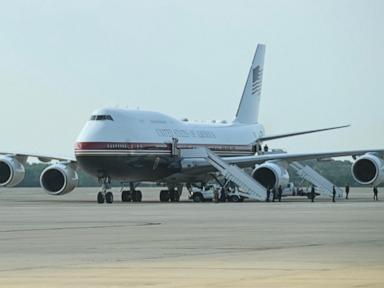
The lazy consensus floating around Washington is comforting, tidy, and entirely false.
When administration sources leaked to the press that the Boeing 747-8 gifted by Qatar is merely undergoing routine "cosmetic upgrades" inside its cabin, the media swallowed it whole. They reported it as a simple matter of swapping out gold-plated sink fixtures for presidential walnut trim, keeping the narrative light enough for an afternoon news cycle.
Believe that, and you will believe a commercial widebody can double as a command-and-control bunker by simply changing the upholstery.
I have watched defense contractors and government procurement offices burn through billions trying to retrofit commercial hulls into military assets. Stripping a VIP transport down to its ribs to install encrypted military tactical data networks, electromagnetic hardening, and countermeasure systems is not an interior design project. It is structural surgery. Calling the current phase of work "cosmetic" is a masterclass in bureaucratic misdirection designed to downplay the sheer engineering nightmare of turning a foreign royal transport into a secure presidential flagship.
Let us define what is actually happening beneath the skin of this aircraft.
A standard Boeing 747-8 built for luxury use—such as the one previously operated by the Qatar Amiri Flight—comes loaded with commercial-grade wiring, civilian satellite arrays, and open cabin layouts designed for comfort rather than survival. When the Secret Service and defense primes like L3Harris take possession of an airframe intended to serve as Air Force One, they cannot simply fly it with a fresh coat of blue-and-white paint. Every single inch of the aircraft must undergo a hostile intelligence audit.
Imagine a scenario where a foreign-built airframe flies into restricted airspace packed with legacy communication nodes, unidentified routing lines, and commercial-grade entertainment systems that could serve as open backdoors for foreign intelligence gathering.
The security vulnerabilities exposed earlier this year—which briefly sidelined the aircraft following threat assessments during international travel—proved that a luxury interior is a liability when you need military-grade survivability. The plane lacked the integrated defensive countermeasures and specialized communication architecture required for a sitting American president. Installing those systems requires cutting open pressure bulkheads, running heavily shielded fiber optics, and replacing entire avionics bays.
To label this overhaul "cosmetic" is to misunderstand the baseline definition of military airworthiness.
The administration wants to project speed and ease, claiming the refit is a minor touch-up. But seasoned aerospace engineers know the truth. You do not ground a flagship widebody for months just to change leather seats and lay down new carpets. The heavy lifting involves integrating the Senior Leader Communication System, hardening the airframe against electronic interference, and verifying every single screw and sensor against state-sponsored espionage.
The real story is not that the plane is getting a new coat of paint. The real story is the staggering friction of trying to make a foreign-gifted luxury toy conform to the ruthless security standards of the United States military. Stop looking at the curtains and start looking at the wiring harness.