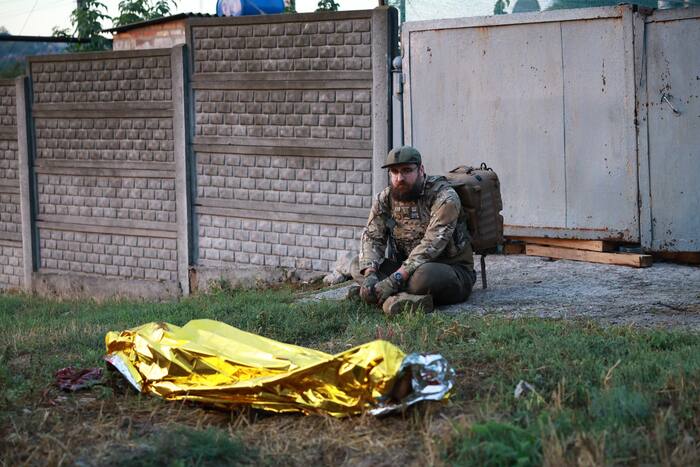
Every morning, news feeds regurgitate the same hollow metric. Another seven dead. Another wave of drones intercepted or impacting infrastructure. Another escalation measured in explosions and body bags. The headlines treat these exchanges as traditional attrition battles, as if modern warfare still operates on the simple logic of a slaughterhouse where the side with more bodies standing wins.
That perspective is lazy, dangerous, and fundamentally wrong.
Focusing on daily casualty tallies blinds observers to the actual engine driving this conflict. Modern warfare between heavily armed industrial states is no longer about territory or simple body counts. It is an evolutionary software loop. Every missile launched and every drone intercepted generates telemetry data that alters the engineering specifications of the next iteration within forty-eight hours. The seven dead reported by morning news anchors are tragic human casualties, but they are symptoms of a deeper structural friction that traditional military analysts completely fail to measure.
The Fallacy of the Attrition Spreadsheet
Traditional military history teaches us that wars of attrition are won by steel, oil, and manpower. Analysts look at GDP ratios, population numbers, and raw stockpiles of artillery shells, predicting outcomes like accountants auditing a dying corporation. This approach is completely broken.
I have spent years analyzing defense procurement and industrial supply chains, and the core mistake people make is assuming quantity equals power in a digital ecosystem. A million rusted artillery shells sitting in a Soviet-era warehouse mean nothing if electronic warfare systems can jam their fuses before impact. A thousand tanks mean nothing if loitering munitions costing a fraction of the fuel required to start a tank engine can disable them from above.
The daily exchange of strikes is not a struggle for territorial dominance. It is a massive, live-fire laboratory testing cost asymmetry.
Consider the economic reality of air defense. When a multi-million-dollar interceptor missile is fired at a cheap drone, the defender is losing economically even when they achieve a successful interception. The attacker has weaponized inflation and manufacturing capacity against defense budgets. Yet, mainstream journalism rarely addresses the math of replacement cycles. They report the explosion, count the dead, and move on, completely ignoring the balance sheet of industrial attrition.
Software Iteration Beats Steel Production
To understand why the aerial war is intensifying rather than burning out, you must look at the feedback loop between code and metal.
In previous decades, military hardware updates took years. A fighter jet or radar system went through rigorous testing phases, procurement committees, and bureaucratic bottlenecks. Today, that timeline has collapsed into days. When a software-defined guidance system encounters a new electronic jamming frequency over a target city, engineers rewrite the frequency-hopping algorithm before the sun sets. The next batch of drones deployed twenty-four hours later carries the patch.
This speed of adaptation turns the battlefield into a high-stakes software development sprint. Traditional defense contractors built their entire business models on decade-long procurement cycles designed to maximize profit margins through bureaucratic bloat. They are structurally incapable of competing with decentralized teams modifying consumer-grade electronics and open-source autopilot software in abandoned warehouses.
When news outlets report on an intensified aerial bombardment, they frame it as a brute-force contest of willpower. In reality, it is a race to see which industrial base can iterate software faster than the other can manufacture physical countermeasures. The casualties are the devastating byproduct of this technological compression chamber.
The Electronic Warfare Blind Spot
Most civilian commentators talk about missiles and drones as if they are self-contained mechanical objects flying on pre-programmed coordinates. This reveals a profound ignorance of modern electromagnetic combat.
The airspace over the conflict zone is a dense, invisible soup of radio frequency interference, GPS spoofing, and radar emissions. Most drones do not reach their targets, and many do not even get shot down by kinetic interceptors. They are blinded, redirected, or dropped out of the sky by localized electronic suppression.
When an aerial campaign intensifies, it usually means both sides are shifting their electronic signatures, changing modulation schemes, or deploying new sensor fusion packages. The physical explosions captured on smartphone cameras are only the visible tip of an invisible war fought across the electromagnetic spectrum.
If you evaluate the conflict solely by physical destruction, you miss the tactical shifts happening entirely in code and signal processing. An attacking wave that appears identical to last week's wave on television screens might utilize entirely different navigation resilience protocols. Ignoring this technical reality leads to catastrophic miscalculations in strategic forecasting.
The Political Utility of Escalation
Beyond the technology and the economics, analysts frequently misread the political drivers behind these synchronized aerial exchanges. The conventional narrative assumes that escalating strikes are designed to terrorize civilian populations into submission or achieve a decisive breakthrough on the front lines.
History demonstrates that aerial bombardment almost always hardens civilian resolve rather than breaking it. Both leaderships know this. Therefore, the intensification of strikes serves entirely different internal and external functions.
Internally, constant aerial activity maintains a state of mobilization. It justifies wartime governance, suppresses domestic dissent, and keeps the industrial apparatus running at maximum velocity. Externally, these strikes act as signaling mechanisms directed at foreign capitals. They communicate technological staying power, test adversary red lines, and demonstrate that neither side is willing to accept a mediated stalemate on unfavorable terms.
When pundits express shock that strikes continue despite heavy civilian tolls, they are projecting rationalist economic assumptions onto survival-driven political entities. For leadership structures locked in existential struggles, civilian casualties are an accepted cost of maintaining strategic positioning on the international stage. Expecting humanitarian considerations to alter military calculus in this environment demonstrates a fundamental misunderstanding of state survival instincts.
Dismantling the Stalemate Myth
A common refrain in mainstream commentary is that the conflict is locked in an unbreakable stalemate, implying that time favors the side with greater aggregate resources. This is another dangerous misconception.
In a software-driven war of attrition, stalemate is an illusion masking rapid, volatile shifts underneath the surface. One breakthrough in microchip manufacturing, battery chemistry, or autonomous targeting algorithms can completely upend the cost balance overnight. A defensive system that works with ninety percent efficiency today can be rendered obsolete tomorrow by a low-cost swarming protocol that overwhelms processing limits.
Treating the current operational environment as a permanent plateau is a recipe for strategic surprise. Both industrial bases are continuously stress-testing their supply chains for critical components like microcontrollers, optical sensors, and chemical precursors. The breaking point will not arrive as a dramatic military collapse on a televised map. It will happen quietly behind closed doors when a supply chain bottleneck chokes off the ability to produce the next firmware update.
What Military Planners Miss
Military establishments around the world are watching these aerial campaigns with profound anxiety because they expose the complete obsolescence of legacy doctrine. Doctrine written for twentieth-century conflicts assumes clear front lines, massive logistical tails, and clear distinctions between military and civilian infrastructure.
In a world of ubiquitous aerial surveillance and loitering munitions, rear areas do not exist. Every factory, power station, and logistics hub is a frontline asset. The traditional division between strategic bombing and tactical support has collapsed.
Defense planners attempting to apply lessons from this conflict to future geopolitical flashpoints often focus on the wrong variables. They buy more expensive hardware when they should be investing in modular software architecture, decentralized manufacturing, and rapid prototyping capabilities. They prepare for the last war with better paint, missing the structural transformation happening under their noses.
The Reality of Industrial Attrition
We are witnessing the painful birth of a new era of warfare where industrial capacity is measured not by tons of steel produced, but by agility in iteration cycles. The tragic loss of civilian lives and the grinding daily statistics are the brutal friction of two systems grinding against each other until one breaks beneath the weight of its own technological inertia.
Until observers learn to look past the superficial drama of daily casualty reports and examine the underlying mechanics of software iteration, supply chain resilience, and cost asymmetry, every analysis of this conflict will remain fundamentally detached from reality.
The strikes will continue to intensify, not because either side believes in a miraculous battlefield breakthrough, but because stopping means accepting defeat in an ongoing evolutionary race where standing still is fatal.
Stop counting the daily casualties as if they tell you who is winning. Look at the code, look at the supply chains, and look at the cost curves. That is where the war is actually being decided.