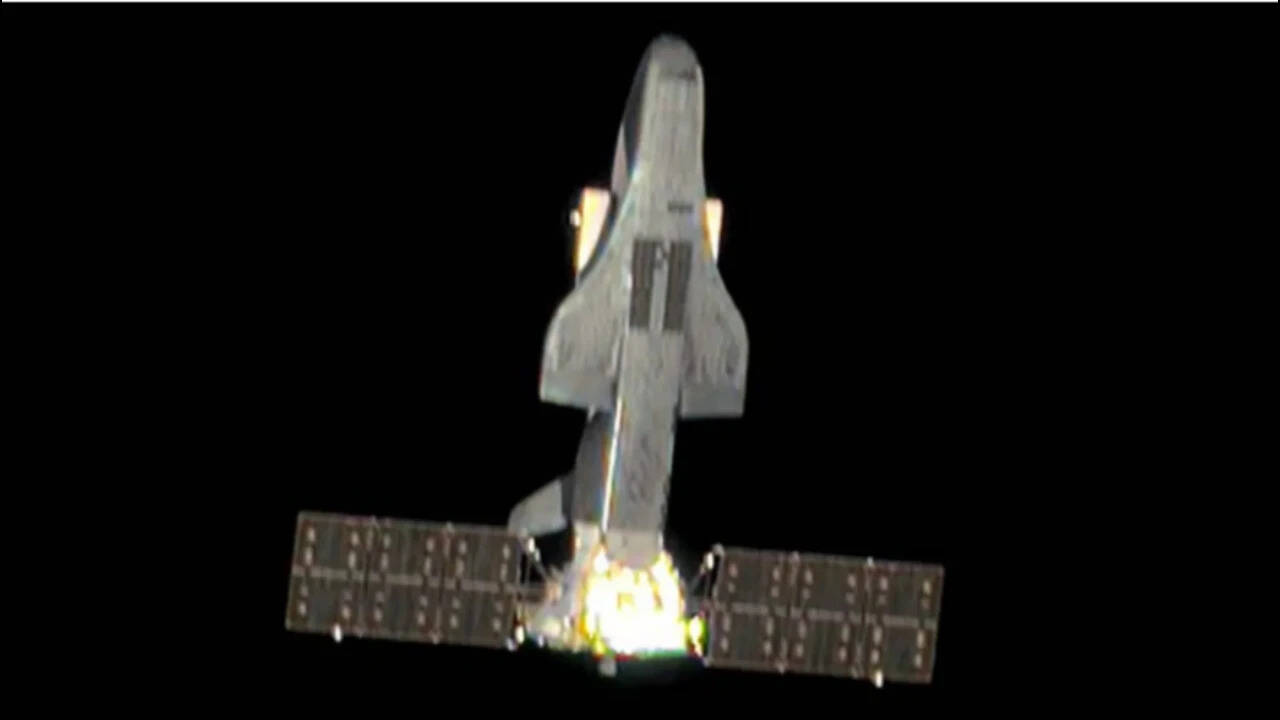
The defense establishment loves a blurry photograph. When the U.S. Space Force or a commercial tracking partner releases a grainy, low-resolution image of China's reusable experimental spacecraft—commonly known as Shenlong—docked to a mysterious sub-satellite, the mainstream press loses its collective mind. Headlines scream about orbital warfare, secret space weapons, and a sudden, terrifying technological leap by Beijing.
It is pure theater. And you are falling for it.
The lazy consensus in aerospace reporting treats every released image of Shenlong as an accidental intelligence leak or a terrifying glimpse into an imminent Pearl Harbor in orbit. That narrative relies on a fundamental misunderstanding of how orbital mechanics, space domain awareness, and strategic signaling actually work. When Washington releases an image of a classified Chinese asset, it is rarely a warning that the sky is falling. It is a calculated flex designed to tell Beijing, "We see you, we know your orbital plane, and your stealth capabilities are exaggerated."
If you want to understand what is actually happening 300 miles above your head, you have to stop looking at the pixel-starved photos of Shenlong and start looking at the geometry of the orbit itself.
The Myth of the Secret Space Plane
Let us dismantle the primary premise of every breathless defense article written on this topic. There is no such thing as a "secret" space plane once it leaves the atmosphere.
Launching a multi-ton vehicle into Low Earth Orbit (LEO) requires a massive chemical rocket—in Shenlong's case, a Long March 2F launching from the Jiuquan Satellite Launch Center. You cannot hide a rocket plume from infrared early-warning satellites. The moment the boosters ignite, the U.S. Space Surveillance Network has the launch azimuth, the booster separation velocity, and the initial insertion trajectory.
Within two orbits, amateur astronomers in backyards from Arizona to Australia are tracking the vehicle with commercial telescopes and posting its Two-Line Element (TLE) sets on public forums. Hobbyists like Marco Langbroek and Scott Tilley regularly publish the exact orbital inclinations and altitude changes of Shenlong within hours of a maneuver.
Calling Shenlong "secretive" is a linguistic crutch used by reporters who do not understand radar cross-sections. The vehicle's payload is classified. Its mission profile is opaque. Its physical presence in orbit is about as secret as a flare gun fired in a dark stadium.
When the U.S. releases an image of Shenlong docked to another object, they are not revealing a hidden asset. They are revealing the resolution capability of their own non-Earth imaging (NEI) sensors. Think about the physics required to capture a clear silhouette of a 30-foot spacecraft moving at 17,500 miles per hour from another orbital platform hundreds of miles away. The relative closing velocities, the lighting angles, and the optical stabilization required to resolve docking mechanisms or solar arrays are staggering.
By publishing the photo, the Pentagon is engaging in classic Cold War deterrence. They are burning a fraction of their own sensor capability to strip away the ambiguity Beijing relies on for psychological leverage.
Why Rendezvous and Proximity Operations Matter (And Why They Don't)
The core panic surrounding the recent imagery centers on the fact that Shenlong is docked to, or operating in tight formation with, a secondary object. Mainstream analysts immediately jump to the "killer satellite" trope—the idea that Shenlong is practicing grabbing American spy satellites and dragging them out of orbit.
Let us look at the actual orbital mechanics of that scenario. It falls apart under basic physics.
Space is incomprehensibly vast, and changing orbital planes is the most energy-expensive maneuver in astrodynamics. Shenlong operates in a specific inclination—usually around 50 degrees—dictated by the latitude of its launch site in the Gobi Desert. Most high-value U.S. intelligence, surveillance, and reconnaissance (ISR) satellites operate in sun-synchronous polar orbits (roughly 98 degrees inclination) or geostationary orbits (0 degrees inclination, 22,236 miles up).
To move Shenlong from a 50-degree inclination to a 98-degree polar orbit to "kidnap" a U.S. satellite would require a change in velocity ($\Delta v$) greater than the energy needed to launch the vehicle into orbit in the first place. It is physically impossible with current chemical propulsion. A space plane cannot simply bank left like an F-35 in atmosphere and fly over to another satellite. It is locked into a gravitational track dictated by its launch window.
So, if it isn't hunting random American satellites across different inclinations, what is it actually doing with that secondary object?
- On-Orbit Servicing and Refueling: The most lucrative and strategically vital capability in modern spaceflight is extending the life of existing assets. Northrop Grumman already proved this commercially with its Mission Extension Vehicles (MEV-1 and MEV-2), which docked with aging Intelsat satellites in geostationary orbit to take over their station-keeping thrusters. China is testing the exact same mechanical docking and fluid-transfer architectures in LEO.
- Co-Orbital Inspection and Electronic Intelligence: A space plane deploying a sub-satellite allows Beijing to test relative navigation sensors—LiDAR, optical cameras, and radar—without risking a billion-dollar operational satellite. By releasing a target, drifting apart, and re-docking, engineers validate autonomous guidance algorithms.
- Resilient Communications Relays: In a contested environment, direct line-of-sight to ground stations in mainland China is limited. A space plane acting as a mothership for smaller, disposable relay nodes creates a localized mesh network capable of transmitting telemetry back to Beijing even when the primary vehicle is over the Western Hemisphere.
I have sat in enough program reviews to know how aerospace contractors pitch these capabilities. When a program manager wants a budget increase, they do not ask for money to fund "autonomous relative navigation sensor calibration." They whisper about "asymmetric orbital denial capabilities" and watch the congressional appropriations committees open their checkbooks.
The X-37B Mirror Trap
Whenever Shenlong makes headlines, journalists inevitably describe it as "China's answer to the U.S. Air Force's X-37B." This comparison is lazy, historically backwards, and analytically blinding.
Yes, both vehicles are lifting-body, uncrewed, reusable orbital testbeds. Both fit inside standard payload fairings, launch vertically on expendable rockets, and land horizontally on runways. The physical convergence is dictated by aerodynamics and thermodynamics, not espionage. If you want a vehicle to survive Mach 25 reentry and glide to a precision landing without a pilot, physics forces you into a delta-wing lifting body with a blunt nose and silica-based thermal protection tiles.
However, treating Shenlong as a mere copy of the Boeing-built X-37B misses the vastly different strategic doctrines driving the two programs.
The X-37B is primarily an endurance and component-testing platform. It stays in orbit for 700 to 900 days at a time, exposing materials, solar cells, and propulsion units (like Hall-effect thrusters) to the harsh radiation environment of the Van Allen belts. It rarely performs dramatic, high-energy orbital maneuvers in LEO because its mission is long-duration persistence.
Shenlong flies much shorter missions—often lasting a few days to a few months—and exhibits vastly higher maneuvering frequency. During its second and third orbital flights, Shenlong repeatedly ejected sub-satellites, altered its apogee and perigee, and executed rapid rendezvous maneuvers.
Beijing is not trying to replicate the X-37B's endurance. They are using Shenlong as a rapid-turnaround tactical testbed. While the U.S. treats the X-37B like a deep-space laboratory, China is treating Shenlong like an experimental fighter prototype, pushing its flight envelope, testing quick-turnaround thermal protection systems, and iterating on flight software at a pace that traditional Western aerospace procurement simply cannot match.
The Real Threat Is Not the Plane; It's the Cadence
If you want to lose sleep over Chinese space capabilities, stop worrying about a space plane grabbing a GPS satellite. Start looking at launch cadence and industrial scaling.
In the last decade, the global space industry shifted from bespoke, artisanal spacecraft manufacturing to mass production. SpaceX proved that reusable boosters and assembly-line satellites (Starlink) completely break traditional defense economics. If an adversary can launch 100 satellites faster than you can build one anti-satellite missile, your kinetic weapons are obsolete.
Shenlong is a symptom of China's broader push toward reusable, rapid-response space access.
Think about the logistics of traditional orbital warfare. If a satellite is destroyed or degraded during a conflict, replacing it normally takes months or years of booster integration, payload encapsulation, and weather delays. A fleet of reusable space planes—paired with reusable first-stage boosters like the commercial LandSpace Zhuque-3 or the state-backed Long March 10—changes the replenishment equation.
A reusable space plane sits in a climate-controlled hangar. When a strategic gap opens in an orbital constellation—say, an optical reconnaissance satellite goes dark over the Taiwan Strait—a space plane can be loaded with a modular sensor pod, mated to a booster, and launched within days. It executes its imaging passes, drops off a micro-satellite to maintain persistent coverage, and glides back to a runway in Xinjiang to be refueled and re-tasked.
This is called Tactically Responsive Space (TacRS). The U.S. Space Force has been screaming about the need for TacRS for years, running experiments like Victus Nox to prove they can launch a satellite on 24 hours' notice. Meanwhile, China is quietly building the reusable infrastructure to make rapid orbital reconstitution a routine operational capability rather than a one-off demonstration.
What Everyone Gets Wrong About Orbital Warfare
Let us address the elephant in the room: the persistent public belief that space warfare looks like Star Wars or Gravity, filled with kinetic explosions, shrapnel clouds, and dramatic dogfights.
Anyone who actually works in orbital dynamics knows that kinetic warfare in LEO is a suicide pact.
When China destroyed one of its own defunct weather satellites (Fengyun-1C) with a ground-based kinetic kill vehicle in 2007, it created over 3,500 pieces of trackable debris and tens of thousands of smaller fragments. Nearly twenty years later, that debris cloud still forces the International Space Station and commercial constellations to execute collision-avoidance maneuvers.
A full-scale kinetic war in Low Earth Orbit would trigger the Kessler Syndrome—a cascading chain reaction of collisions that would render orbital altitudes between 300 and 1,000 miles unusable for decades. It would destroy China's own BeiDou navigation network, blind its military communications, and wipe out its commercial space economy just as thoroughly as it would cripple the United States.
Therefore, modern counter-space operations are overwhelmingly non-kinetic and reversible.
- Dazzling and Blinding: Ground-based high-energy lasers used to temporarily saturate or permanently damage the optical sensors of overhead imaging satellites without creating a single piece of debris.
- Uplink/Downlink Jamming: Flooding a satellite's transponders with radio-frequency noise to sever its connection to ground controllers.
- Cyber Intrusion: Compromising the ground-station networks or exploiting software vulnerabilities in the satellite's telemetry, tracking, and command (TT&C) protocols to hijack attitude control systems.
- Co-Orbital Parasitism: Using a vehicle like Shenlong to park a small electronic warfare payload a few hundred meters away from a target satellite, silently intercepting its unencrypted cross-links or spoofing its GPS receivers.
Notice that none of these methods require a dramatic explosion, and almost all of them rely on plausible deniability. If a satellite suddenly loses attitude control or suffers a corrupted command upload, is it a solar flare, a software bug, or a sub-satellite deployed by Shenlong three weeks ago?
That ambiguity is the real weapon.
The Downside of the Contrarian View
To be entirely transparent, dismissing the immediate kinetic threat of Shenlong carries its own analytical blind spot. History is littered with defense analysts who proved, using impeccable math and physics, why an adversary's new platform was impractical—right up until the adversary used it in a way nobody anticipated.
While inclination changes in LEO are prohibitively expensive for a single space plane, a constellation of reusable vehicles launched into staggered orbital planes solves the geometry problem. Furthermore, if China succeeds in pairing a reusable space plane with high-efficiency nuclear-thermal or advanced solar-electric propulsion for its deployed sub-satellites, the $\Delta v$ constraints shrink dramatically. A sub-satellite released by Shenlong could spend six months slowly spiraling into a higher, strategically vital orbit, lying dormant until activated.
Dismissing Shenlong as harmless because it cannot execute cinematic dogfights is just as dangerous as panicking over blurry photos. The correct posture is cold, mathematical realism.
How to Actually Read Space Intelligence
The next time a defense blog publishes a breathless exposé featuring a grainy, high-contrast photo of a Chinese spacecraft, apply a simple filter to separate signal from noise:
- Check the Source of the Imagery: Was it released by a commercial satellite operator (like Maxar, Planet, or Vantor) or the U.S. government? Commercial releases are marketing exercises designed to sell Non-Earth Imaging contracts to the Pentagon. Government releases are diplomatic messages aimed at Beijing. Neither is an accidental leak.
- Look at the Inclination and Altitude: Ignore the shape of the spacecraft and look at the orbital parameters. If the vehicle is staying at 350 kilometers and 50 degrees inclination, it is conducting localized engineering tests. If it begins raising its apogee toward Medium Earth Orbit (MEO) or executing large plane-change maneuvers, the strategic calculus has just shifted.
- Track the Sub-Satellites, Not the Mothership: The space plane is just the delivery truck. The real story is what gets left behind in orbit after the space plane lands in the desert. Watch the cataloged debris and newly registered objects associated with the launch international designator.
- Watch the Turnaround Time: Measure the days between Shenlong's runway landing and its next vertical launch. When that gap drops from nine months to three weeks, the era of routine orbital logistics has officially arrived.
The defense media wants you terrified by a shadowy silhouette in the dark because fear drives clicks and justifies bloated hardware budgets. Stop staring at the shadow. Look at the trajectory.


